
Study Abroad Hidden Costs: A Complete Guide to Budgeting & Housing Expenses
Table of Contents
- Navigating the Hidden Financial Waters of Studying Abroad
- The Real Price of Rent Abroad: Beyond the Advertised Cost
- Cost of Living Reality Check: How Prices Abroad Compare to Home
- Choosing Wisely: Housing Options That Maximize Your Budget
- The Hidden Fees in the Fine Print: What to Watch For
- The Financial Safety Net: Planning for Emergencies
- Getting Real with Costs: First-hand Stories from Indian Students Abroad
- 📊 Your Housing Cost Readiness Results
- Crafting Your Financial Blueprint for Study Abroad Success
Navigating the Hidden Financial Waters of Studying Abroad
Picture this: you’re three weeks into your study abroad adventure, and suddenly your carefully planned budget feels like a work of fiction. A friend of mine experienced exactly this in Manchester—she had budgeted £800 for monthly expenses, thinking she was being generous. Reality check: her actual spending hit £1,200, and that was with serious corner-cutting.
The truth about studying abroad expenses goes far beyond tuition and rent—it’s the thousand tiny expenses that ambush you like ninjas in the night. That “affordable” student accommodation? Add £150 for utilities they conveniently forgot to mention. The meal plan that seemed reasonable? Doesn’t cover weekends or that one time you desperately need comfort food from the Indian grocery store (where everything costs triple).
The emotional toll also hits differently. You’re video-calling home, trying to sound cheerful while mentally calculating if you can afford both laundry and a proper meal this week. Your parents are already stretching their savings, and asking for more money feels like admitting defeat.
Currency fluctuations alone can devastate a budget—imagine planning everything when the pound is at 90, then watching it rise to 105. That’s a 16% increase nobody warned you about. Or discovering that “free healthcare” still means paying for prescriptions, dental work, and that mandatory health surcharge.
The good news is that these financial shocks aren’t inevitable; they’re just poorly communicated realities that proper planning can actually handle. Throughout this piece, we’ll uncover these hidden costs—from visa renewals to winter clothing budgets—and more importantly, show you exactly how to plan for them.
Ready to Plan Your Study Abroad Budget?
Don’t let hidden costs derail your international education dreams. Get expert guidance on realistic budgeting and financial planning.
Get Free ConsultationThe Real Price of Rent Abroad: Beyond the Advertised Cost
Barcelona seemed like a dream come true when an exchange student found a €400 room near campus—a steal compared to Mumbai prices. Two weeks later, frantic calculations over instant noodles revealed that €400 was just the beginning of a very expensive story.
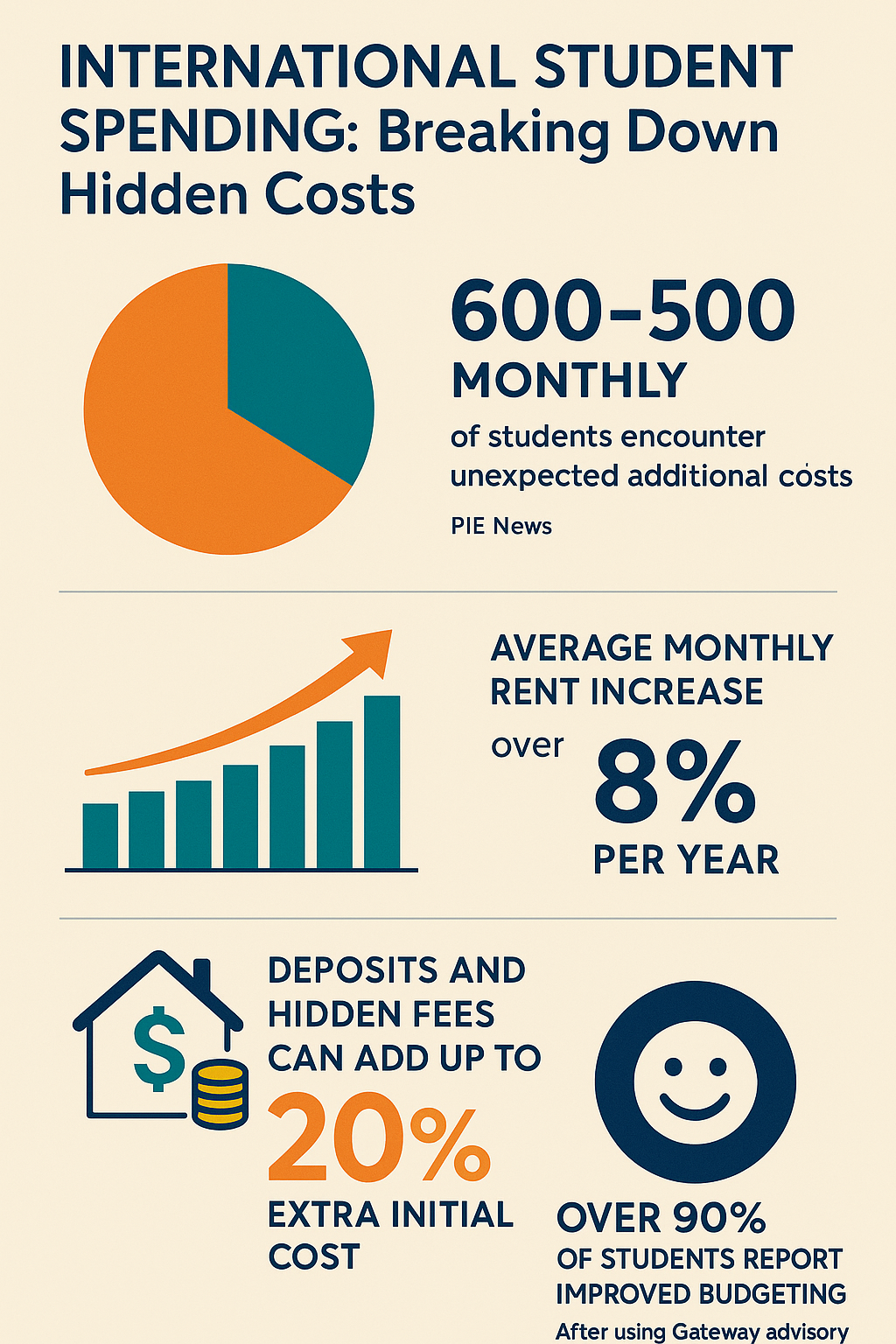
The advertised rental price is essentially just the trailer, not the full movie. That dreamy studio apartment showing “€600/month” online? Add another €1,800 upfront for the security deposit (yes, three months is standard in many European cities), and then there’s the agency fee—another month’s rent just for someone to hand you the keys.
But wait, the surprises keep coming. Unlike India where utilities are often included or minimal, European landlords love their itemized bills. Internet? That’s €30-50 monthly. Heating during winter? Budget €80-150, especially in Germany or the Netherlands. Water, electricity, building maintenance—each gets its own special invoice. One friend in Poland discovered her “all-inclusive” rent excluded heating, turning her November budget into a disaster when temperatures dropped.
Many countries require you to set up these utilities yourself, meaning activation fees and deposits for each service. In France, just getting electricity connected can cost €200 upfront. Students often discover these hidden costs after signing leases when it’s too late to back out.
So how do you avoid this trap? First, always ask for a breakdown of total monthly costs, not just base rent. Join Facebook groups for international students in your target city—they’re goldmines for real cost information. When budgeting, add 40% to any advertised rent price as your actual monthly housing cost.
Most importantly, read every line of your rental agreement before signing. Yes, even if it’s in German or French—use translation apps, ask local students, or find someone who speaks the language. That boring contract holds the difference between managing your finances abroad and calling home for emergency funds.
Knowledge is power here: the more questions you ask upfront, the fewer nasty surprises await your bank account later.
Cost of Living Reality Check: How Prices Abroad Compare to Home
The shock hit hard when helping a cousin budget for her master’s in Sydney—we both nearly fell off our chairs discovering that her weekly grocery bill would equal our family’s monthly spending in Pune. That’s when the reality crystallized: most of us have absolutely no idea about the real cost difference until we’re standing in a foreign supermarket with a calculator in hand.
When comparing living costs between Indian cities and places like New York, London, or Sydney, you’re not just looking at different numbers—you’re looking at entirely different economic universes. Take, for example, that cozy 2BHK apartment you share with friends in Bangalore for ₹30,000. In Manhattan, that same amount (roughly $360) might get you a broom closet.
Breaking down the reality check with the actual numbers that matter:
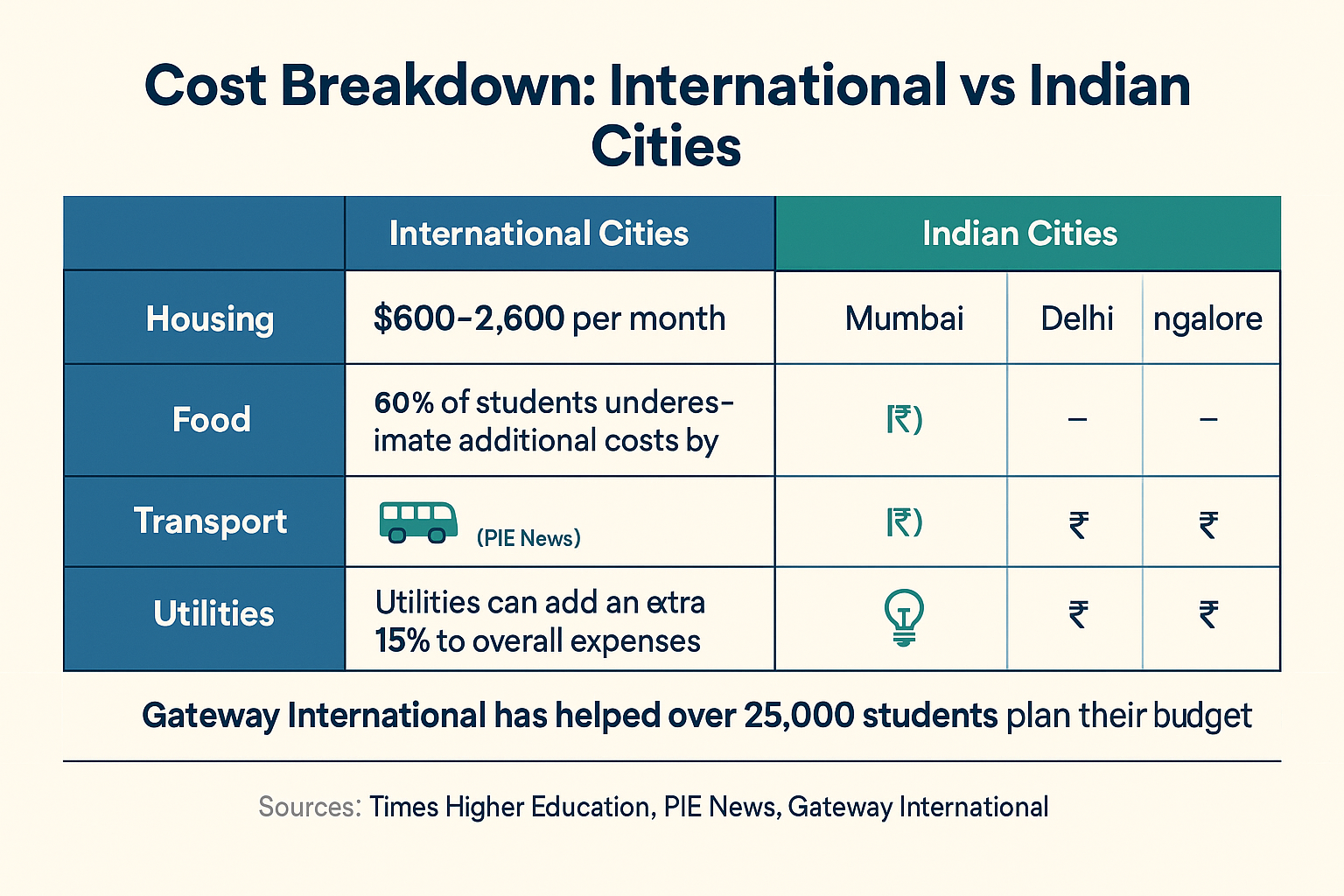
Rent: A decent shared accommodation in Mumbai might cost you ₹15,000-20,000 monthly. In London, you’re looking at £600-800 (₹60,000-80,000) for a similar setup. Sydney isn’t much kinder at AUD 1,200-1,500 per month.
Groceries tell an equally sobering story. Your ₹3,000 monthly grocery budget in India transforms into $200-300 in New York—and that’s if you cook everything yourself and hunt for deals. One student I mentored joked that she learned to love instant noodles not by choice, but by financial necessity.
What really catches students off guard are the hidden costs. Transport that seems “just” $127 for a monthly NYC metro card suddenly feels massive when you realize that’s ₹10,000. Those “small” coffee runs at $5 each? That’s your entire food budget back home.
The utility bills are another adventure. While we complain about ₹2,000 electricity bills in Indian summers, international students regularly face $100-150 monthly utility bills, even in shared accommodations.
Want my honest advice? Whatever budget you’ve calculated, add 30% more. Trust me, between the exchange rate fluctuations, unexpected expenses, and that inevitable “I deserve this after a tough week” splurge, you’ll need it. The key isn’t to scare yourself out of your dreams—it’s to walk in with eyes wide open and a budget that actually works.
Choosing Wisely: Housing Options That Maximize Your Budget
The Housing Hunt: The Make-or-Break Moment of Your Budget
Brilliant students sometimes end up sharing a closet-sized room in London simply because they didn’t know their options, while others score amazing deals by knowing exactly where to look.
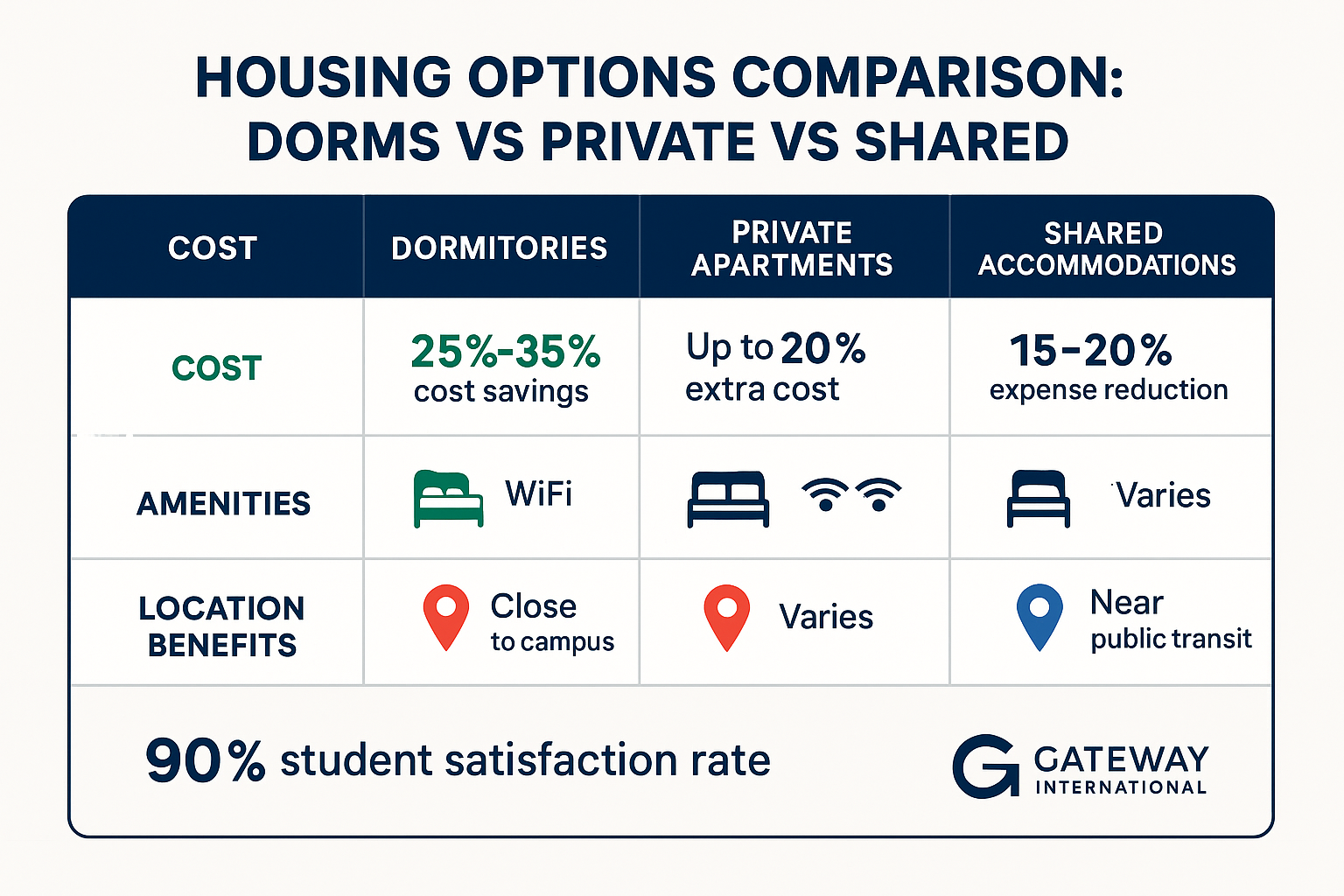
The flashiest housing option is rarely the smartest. Take university dorms, for example—they’re convenient (literally on campus), but in cities like Sydney or San Francisco, you’re paying $1,200-1,800 monthly for a shared room. Meanwhile, that same money could get you a private room in a shared apartment just 20 minutes away by metro.
The Real Cost Breakdown
University Dorms:
- Pros: Zero commute, built-in community, utilities included
- Cons: Premium pricing (often 30-40% above market rate), limited privacy
- Best for: First-semester students still finding their feet
Private Student Housing:
- Pros: More space, kitchen access (goodbye, expensive meal plans!)
- Cons: Deposits can be hefty, utilities often separate
- Best for: Students who’ve done their homework on neighborhoods
Shared Accommodations:
- Pros: By far the cheapest option, real cultural immersion
- Cons: Roommate roulette, potential lease complications
- Best for: Confident students with some local connections
The Gateway Advantage (Yes, Really)
Gateway International’s university partnerships often include housing packages that aren’t publicly advertised. Think subsidized international student residences in places like Poland and Italy where you pay €200-300 monthly instead of €600+. These aren’t sketchy setups—they’re proper accommodations reserved for partner institutions.
Your Strategic Move Now
Want to maximize your housing budget? Start your search 3-4 months before departure. Join Facebook groups for international students in your target city (search “[City Name] Student Housing 2025”). Set up alerts on local rental sites. And here’s a favorite hack: reach out to current students from India at your target university through LinkedIn—they’ll give you the real scoop on which areas to avoid and where the deals hide.
Your housing choice impacts everything—from daily food costs to transportation expenses. Choose wisely, and you’ll have more money for the experiences that actually matter. Choose poorly? Well, let’s just say instant noodles get old really fast.
Need Help Finding Affordable Student Housing?
Gateway International’s partnerships can save you 30-40% on accommodation costs. Let our experts guide you to the best housing options.
Explore Housing OptionsHidden Fees in the Fine Print: What to Watch For
A tearful phone call from Berlin revealed the harsh reality of hidden rental costs. Priya had budgeted perfectly for rent—or so she thought. Turns out, her €500 monthly rent didn’t include the “mandatory” building insurance (€45), the garbage collection fee (€30), or the mysterious “stairwell cleaning charge” (€25). Just like that, her carefully planned budget went up in smoke.
After helping dozens of students navigate rental contracts abroad, I’ve learned that landlords aren’t trying to scam you, but they’re definitely not going out of their way to highlight additional costs either.
The Usual Suspects Hiding in Rental Agreements:
- Application/Processing Fees: Can range from €50-200 just to apply for a place
- Utility Activation Charges: Internet setup, electricity connection—each with its own fee
- Maintenance Reserves: Monthly charges for “future repairs” (yes, really)
- Exit Cleaning Fees: Pre-decided amounts, regardless of how you leave the place
The worst part? These fees often appear in legal jargon that makes your head spin. I’ve seen contracts mention “Nebenkosten” (additional costs in German) without explaining what’s included.
Your Defense Strategy:
Ask for a complete breakdown of monthly costs—in writing—before signing anything. When they say “utilities included,” ask specifically: which ones?
A phrase that has saved thousands: “Could you please list all recurring monthly charges beyond the base rent?” Simple, polite, and it forces transparency.
Don’t feel embarrassed about asking questions. Indian students often hesitate, worried about appearing difficult. But remember—you’re not being difficult; you’re being smart. Every question you ask now saves you from budget shock later.
The Financial Safety Net: Planning for Emergencies
Three weeks before thesis submission in Germany, disaster struck—a laptop crash requiring an €800 repair. The emergency fund? A mere €200. You can imagine the panic calls home at 2 AM Indian time.
Most families miss this crucial element when budgeting for studies abroad—emergencies don’t follow your Excel sheet; they show up uninvited, usually at the worst possible time. And trust me, being stuck in a foreign country without a financial cushion feels like playing cricket without pads.
The reality check: Your emergency fund should cover at least 3-4 months of living expenses plus an additional ₹1-2 lakhs for those “surprise” moments:
- Medical emergencies (yes, even with insurance, you may need upfront payments)
- Sudden visa renewals or documentation fees
- Emergency flights home (family emergencies happen)
- Academic equipment failures (laptops, lab equipment)
- Housing deposit losses (roommate bails out? Your deposit goes)
A tested approach: Open a separate savings account six months before departure and set up an auto-debit of ₹10,000-15,000 monthly. By the time you leave, you’ll have a decent cushion without feeling the pinch.
Pro tip from experience: Keep 20% of your emergency fund in cash (euros/dollars), 30% in a forex card, and 50% in an easily accessible international bank account.
Indian parents get this instinctively—they’ve always believed in keeping something aside for a rainy day. The only difference is that those rainy days come with currency conversion rates. Plan accordingly, and you’ll thank yourself when (not if) that emergency knocks.
Getting Real with Costs: First-hand Stories from Indian Students Abroad
A WhatsApp message from Toronto painted a familiar picture. “Bhaiya, they told me rent would be around CAD 800,” Arjun laughed nervously. “But that’s for a shared basement room 45 minutes from campus. A decent place near the university? Try CAD 1,400 minimum.”
This isn’t just Arjun’s story—it’s practically every Indian student’s welcome-to-reality moment abroad.
Those neat budget spreadsheets you made before leaving? Yeah, they usually need serious revision by month two. Priya from Bangalore, now studying in Melbourne, told me she’d budgeted AUD 300 monthly for groceries. “I didn’t realize that meant living on instant noodles,” she said. “Actual nutritious food that reminds you of home? Double that amount, easy.”
These students aren’t just surviving; they’re getting creative. Arjun discovered that living slightly further from campus but near an Indian grocery store saved him nearly CAD 200 monthly on food. Priya started a meal prep group with five other Indian students, cutting her food costs by 40% while actually eating better than her first semester.
The hidden costs hit differently, though. Textbooks (why are they so expensive abroad?), winter clothing for those heading to colder countries, that mandatory health insurance that somehow wasn’t mentioned clearly—these add up fast. Rohit, studying in Germany, thought he’d hit the jackpot with free tuition. “But nobody told me about the €300 semester fee, blocked account requirements, and how expensive even student accommodation in Munich would be,” he shared during our recent catch-up.
What strikes me most about these conversations is how students wish they’d known these realities earlier. Not to discourage them—they’re all glad they made the move—but to prepare better. This is exactly where proper guidance becomes crucial. When Gateway International worked with Priya during her planning phase, they didn’t just talk about admission requirements. They connected her with current students in Melbourne who shared actual grocery receipts, rental agreements, and monthly expenses.
You can absolutely make it work abroad without breaking the bank, but you need real numbers from real students, not glossy brochure estimates. Whether it’s finding that perfect balance between location and rent or understanding which cities offer part-time work opportunities that actually help, having someone who has guided hundreds of students through these exact challenges makes all the difference.
Test Your True Housing Cost Knowledge Abroad
Are you prepared for the real costs of housing when studying abroad? This interactive quiz will help you assess your understanding of hidden expenses and unexpected fees that catch 60% of international students off guard.
Question 1 of 3
Beyond rent, what monthly utility costs should you budget for in major study destinations?
Crafting Your Financial Blueprint for Study Abroad Success
After helping countless students navigate their study abroad journeys, one pattern emerges clearly: the difference between those who thrive and those who struggle often comes down to one thing—having a solid financial game plan before they even board the plane.
The housing cost blindsides we discussed earlier? Here’s your armor against those surprises. First, grab that budget template (seriously, Gateway International has a free one that has saved my mentees thousands of dollars) and track everything—not just the obvious stuff like rent and tuition, but those sneaky expenses like laundry, weekend trips, and yes, that coffee addiction you develop during exam season.
Create three budget scenarios: best case, realistic, and “oh no, everything is expensive.” A student heading to Munich did this and discovered she needed an extra €200/month for transportation and groceries.
The scholarship tracker isn’t just a nice-to-have—it’s your ticket to financial breathing room. Most students think scholarships are out of reach (remember that pain point we discussed?), but tracking deadlines and requirements completely changes the game.
You’ve made it this far in planning your study abroad dream. Don’t let poor financial planning be the reason you struggle once you get there. Gateway International’s counselors have seen every financial curveball imaginable—from surprise visa fees to emergency flight changes. Their personalized planning sessions aren’t just about picking universities; they’re about ensuring you can actually afford to thrive once you get there.
Ready to turn this financial anxiety into a solid plan? Book that free consultation with Gateway. Bring your questions, your concerns, and your dreams. Let’s build a financial blueprint that actually works for your unique situation. Your future self will thank you.
Transform Your Study Abroad Dreams into Reality
With 17+ years of experience and 50,000+ successful placements, Gateway International knows exactly how to help you avoid financial pitfalls and create a realistic budget for your international education.
Book Your Free Consultation Now
Share Your Experience with Us!
Have you faced unexpected costs while studying abroad? Share your story and help other students better prepare!