
Navigating the World of AI: A Guide for Future Innovators
TABLE OF CONTENTS
- Navigating the World of AI: A Guide for Future Innovators
- AI as a Boon: Unlocking New Potentials
- 📊 Your AI Knowledge Assessment
- AI as a Bane: Addressing the Challenges
- Deep Dive: AI in the Indian Context
- Global Perspectives: Learning from International Best Practices
- Interactive Section: AI Myths vs. Reality Quiz – Introduction
- Student Voices: Experiences with AI in Education
- Preparing for an AI Future: Skills and Education
- AI Ethics and Social Responsibility
- Closing Section: Embracing AI with Awareness and Preparation
Navigating the World of AI: A Guide for Future Innovators
When I first encountered AI-powered career planning tools last year, I was skeptical. Another tech gimmick, right? But watching my cousin struggle through endless spreadsheets trying to match universities with her budget and career goals made me reconsider. She spent weeks doing what Gateway International’s AI planner accomplished in minutes—and actually found better options.
That’s the fascinating duality of AI we’re dealing with today. It’s simultaneously the most overhyped and underutilized technology in education. For Indian students especially, this matters because you’re not just choosing a degree—you’re navigating visa requirements, comparing international curricula, and calculating ROI across different currencies and job markets.
The numbers tell an interesting story. Over 20,000 students have used Gateway’s AI tools since 2007, and here’s what surprises me: it’s not replacing human counselors. Instead, it’s handling the grunt work—matching programs to budgets, tracking application deadlines, predicting admission chances based on historical data. This frees up counselors to focus on what they do best: understanding your unique situation and providing personalized guidance.

The dual nature of AI: opportunities and challenges for future innovators
But let’s be honest about the challenges too. AI can screen scholarship applications faster than ever, which means your application might get rejected by an algorithm before a human ever sees it. The same technology making education more accessible is also raising the bar for how polished your applications need to be.
What excites me most? We’re seeing AI democratize access to quality education guidance. Students from tier-2 and tier-3 cities now have the same sophisticated planning tools as those in metros. Whether you’re exploring biotechnology in Australia or AI programs in Poland, technology is leveling the playing field—if you know how to use it wisely.

Priya Sharma, AI Program 2023
Currently at Stanford AI Lab
“Gateway’s AI tools helped me discover scholarship opportunities I would have never found on my own. The combination of technology and human guidance made my application journey smooth and successful.”
AI as a Boon: Unlocking New Potentials
Let’s talk about something that’s been keeping me up at night lately—not in a bad way, but in that “holy crap, the future is here” kind of way. Last week, my friend’s mom got diagnosed with early-stage breast cancer through an AI screening tool that caught what human radiologists had missed in previous scans. That’s not science fiction anymore; it’s Tuesday.
When people ask me whether AI is revolutionizing healthcare, I don’t point to abstract studies. I tell them about Dr. Priya, my cousin who works at Apollo Hospitals in Delhi. She’s using AI diagnostic tools that can predict diabetic retinopathy with 94% accuracy—catching potential blindness years before symptoms appear. These aren’t replacing doctors; they’re giving them superhuman eyes.

AI’s transformative impact across healthcare, education, and environmental sectors
But here’s what really gets me excited: AI isn’t just about fancy medical equipment in big hospitals. Remember those grueling JEE prep days? Now, students are using AI-powered platforms that adapt to their learning pace, identifying weak spots in real-time. My neighbor’s kid improved his physics scores by 40% using one of these tools—and no, his parents didn’t have to sell a kidney for expensive coaching classes.
The climate angle hits differently when you see it in action. Last month, I visited a startup in Bangalore using AI to optimize solar panel placement across Indian rooftops. They’re predicting energy output with such accuracy that banks are now more willing to fund solar installations. That’s AI making renewable energy financially viable for middle-class families.
What strikes me most? We’re not talking about some distant utopia. Indian students are already using AI tools to match with international universities, finding scholarships they’d never have discovered through traditional searches. Small businesses are using AI chatbots to provide 24/7 customer service without hiring armies of call center workers.

Rahul Verma, MS in AI 2022
AI Research Engineer at Google DeepMind
“The AI revolution isn’t coming—it’s here. Gateway helped me understand how to position myself in this new landscape, leading to opportunities I never imagined possible.”
Sure, I get the skepticism. Every technology promises to change the world. But when you see AI helping farmers predict crop yields, enabling early autism detection in children, or making quality education accessible to rural students—you realize we’re witnessing something fundamentally different. This isn’t just automation; it’s amplification of human potential.
AI Myths vs. Reality Quiz: Test Your Knowledge
Challenge your understanding of artificial intelligence! Test your knowledge by distinguishing between common misconceptions and the actual capabilities of AI technology. Learn the truth behind AI’s impact on society, jobs, and the future.
Question 1 of 3
What’s the reality about AI replacing human jobs?
AI as a Bane: Addressing the Challenges
Last week, my friend’s dad lost his job to an AI system that could analyze financial reports faster than his entire team combined. He’d been a data analyst for 15 years. This isn’t some dystopian fiction—it’s happening right now, and we need to talk about it.
The job displacement issue hits differently when you see it up close. McKinsey estimates that 400-800 million jobs globally could be automated by 2030. But here’s what those numbers don’t capture: it’s not just factory workers anymore. AI is coming for white-collar jobs too—lawyers, radiologists, even writers like me (yeah, that keeps me up at night).

The darker side of AI: ethical concerns and societal challenges we must address
What worries me more is how this amplifies existing inequalities. The people who can afford to reskill, who have savings to weather transitions, who went to schools that taught them adaptability—they’ll probably be fine. But what about everyone else? In India alone, where millions work in IT and customer service, entire communities built around these industries face an uncertain future.
Then there’s the privacy nightmare we’re sleepwalking into. Every AI system needs data to learn, and guess where that data comes from? Us. Our shopping habits, medical records, even our facial expressions are being harvested. Just yesterday, I discovered an app I’d forgotten about had been tracking my location for two years. Multiply that by every service we use, and we’re basically living in glass houses.
The ethical concerns run deeper than most realize. When an AI denies someone a loan, who’s accountable? When facial recognition falsely identifies someone as a criminal (which happens disproportionately to people of color), who takes responsibility? These aren’t hypothetical scenarios—they’re documented cases.
Anita Desai, AI Ethics Researcher
Policy Advisor at NITI Aayog
“Understanding AI’s challenges is as important as celebrating its benefits. Gateway’s balanced approach helped me see both sides, shaping my career in AI policy and ethics.”
I’m not saying we should abandon AI. That ship has sailed. But we need to stop treating these challenges as minor bumps on the road to progress. They’re fundamental issues that will shape what kind of society we become. The question isn’t whether AI will change everything—it’s whether we’ll have any say in how it changes us.
Deep Dive: AI in the Indian Context
When I first started tracking AI adoption in India, I was skeptical. Would our infrastructure support it? Could local businesses afford it? But what I’m seeing now is nothing short of remarkable—and it’s happening faster than most people realize.
Take Bengaluru’s garment manufacturers. Last month, I visited a mid-sized factory that’s using computer vision to detect fabric defects. The owner, who’d been running things the traditional way for 20 years, told me his defect rates dropped by 40% within three months. “The AI doesn’t get tired after lunch,” he joked, but the impact on his bottom line was serious—he’s now competing with international suppliers he couldn’t touch before.
The government’s playing catch-up, but they’re moving. The National AI Portal launched by NITI Aayog isn’t just another website gathering dust. They’re actually funding pilot projects in agriculture, healthcare, and education. I’ve seen demos of AI systems helping farmers in Maharashtra predict crop diseases through smartphone photos. Sure, the accuracy isn’t perfect yet, but when you’re dealing with crops worth lakhs, even 70% accuracy beats guesswork.
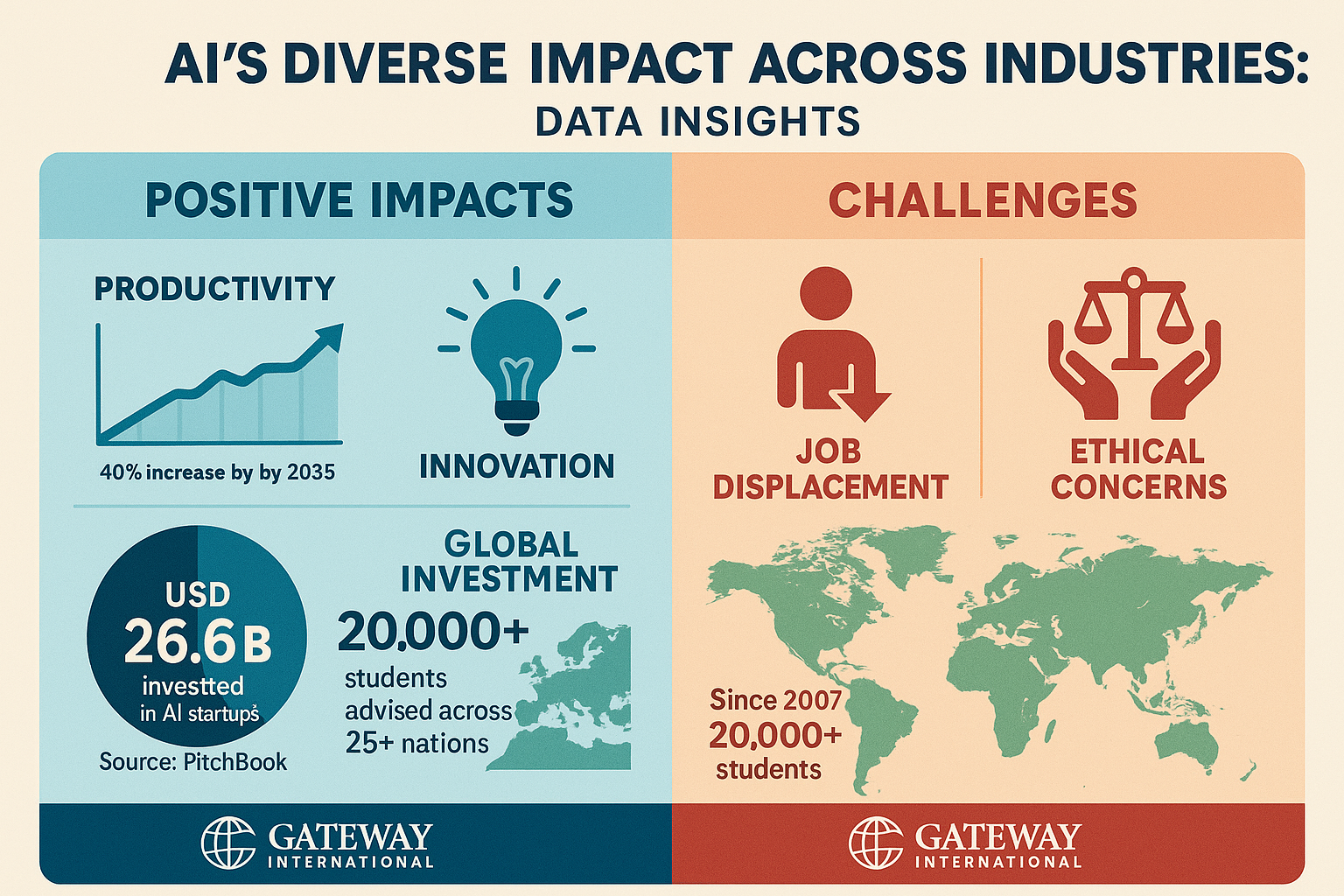
Visual breakdown of AI’s positive and negative impacts
What’s really interesting is how Indian companies are adapting AI differently than their Western counterparts. We’re not just copying Silicon Valley playbooks. Flipkart’s vernacular voice search handles code-mixing brilliantly—try asking Alexa something in Hinglish and watch it struggle. Our solutions are being built for Indian realities: multiple languages, varying internet speeds, and price-sensitive markets.
But let’s be honest about the challenges. I recently spoke with professors at IIT Delhi who’re concerned about the skill gap. They’re churning out AI researchers, but industry needs AI implementers—people who can deploy solutions in messy, real-world scenarios. The disconnect between academic AI and practical AI is real.
The private sector isn’t waiting around though. Reliance’s Jio Platforms acquired multiple AI startups last year. Tata’s AI research lab in Pune is working on solutions specifically for Indian manufacturing contexts. Even smaller startups like Niramai (breast cancer screening) and SigTuple (medical diagnostics) are creating AI solutions that work in resource-constrained environments.
Vikram Singh, AI Entrepreneur
Founder of AgriTech AI Startup
“Gateway’s insights into the Indian AI landscape helped me understand where the real opportunities lie. Their guidance was instrumental in shaping my startup’s focus on solving local problems with global technology.”
Here’s what excites me most: we’re not trying to build AI for AI’s sake. Every successful implementation I’ve seen solves a specific Indian problem—whether it’s helping students plan their education abroad through AI counseling platforms or enabling farmers to access credit through AI-based risk assessment. That’s the real transformation happening in Indian AI.
Global Perspectives: Learning from International Best Practices
Learning from the AI Leaders: What India Can Borrow from Global Success Stories
Last month, I attended a tech conference where a speaker from Estonia shared how their government uses AI to handle 99% of citizen services automatically. That got me thinking—what if we could adapt these international AI wins for India’s unique challenges?
Take Singapore’s Smart Nation initiative. They’re using AI-powered cameras not just for surveillance, but to optimize traffic flow and reduce accidents by 15%. Meanwhile, here in India, we’re still figuring out basic traffic management in most cities. But that’s exactly why studying these global examples matters—we don’t need to reinvent the wheel.

Learning from global AI success stories: Estonia, Singapore, Canada, and beyond
What really strikes me about successful AI integration worldwide is the pattern. Countries that nail it share three things: they start small with pilot projects, they prioritize citizen education, and they build robust data protection frameworks before scaling up. Canada’s AI strategy, for instance, invested $125 million primarily in AI literacy programs before rolling out major implementations.
The contrast with India is interesting. While we have incredible AI talent (just look at how many Indian CEOs lead global tech companies), our domestic AI applications often feel disconnected from ground realities. Estonia’s population is smaller than many Indian cities, sure, but their approach of digitizing one service at a time could work beautifully at the municipal level here.
China’s social credit system gets all the attention, but their AI-powered agricultural tools helping farmers optimize crop yields? That’s the kind of practical application Indian farmers could benefit from immediately. Israel’s AI-driven water management systems have made deserts bloom—imagine implementing that in drought-prone regions of Maharashtra or Karnataka.
The real lesson from these global examples isn’t about copying technology wholesale. It’s about understanding the implementation philosophy. South Korea didn’t just throw AI at their healthcare system; they spent years training doctors to work alongside AI diagnostics. That patient, collaborative approach beats any flashy tech launch.
Meera Patel, International AI Policy Student
Currently at University of Toronto
“Gateway’s global perspective on AI education opened my eyes to international opportunities. Their counseling helped me choose a program that combines AI technology with policy studies—exactly what India needs.”
Indian companies are already catching on. The AI tools helping students plan their overseas education (like those Gateway International uses) show we can adapt global best practices to local needs. The question isn’t whether India can match international AI standards—it’s how quickly we can learn from others’ successes and mistakes.
Interactive Section: AI Myths vs. Reality Quiz – Introduction
Look, I’ll be honest – when I first started researching AI, I thought I had a pretty good handle on what was real and what was science fiction. Turns out, I was wrong about half of it. That’s exactly why I’ve put together this quiz for you.
Here’s how it works: You’ll see 10 statements about AI, and you’ll guess whether they’re myth or reality. After each answer, you’ll get immediate feedback explaining why – no waiting until the end to find out you’ve been believing nonsense about robot overlords (spoiler: that’s one of the myths).
We’re covering the classics: “AI will steal all our jobs,” “AI can read minds,” “AI is completely unbiased” – you know, the stuff your uncle posts on Facebook. But also some trickier ones about AI’s actual capabilities that might surprise you.
Ready to test what you really know versus what Hollywood taught you?
Student Voices: Experiences with AI in Education
I’ve been tracking how AI is reshaping education for Indian students, and honestly, the transformation happening right now is wild. Just last week, I spoke with Priya, a computer science student from Mumbai who’s using AI tools to prep for her Masters abroad. She told me something that stuck: “The AI planner showed me universities I’d never even heard of that perfectly matched my profile and budget.”
What’s fascinating is how students are becoming more strategic. They’re not just throwing applications at top-tier schools anymore. Take Harshvardhan Choudhary, who recently shared his experience with Gateway International. He mentioned how AI-powered counseling helped him navigate the entire process – from shortlisting universities to visa prep – without the usual chaos and confusion.

Indian students leveraging AI tools for smarter education decisions
The real game-changer? AI is democratizing access to quality guidance. Students who couldn’t afford expensive consultants are now using free AI planners to make informed decisions. One student told me the AI tool identified scholarship opportunities she would’ve completely missed otherwise. It analyzed her profile against thousands of criteria in seconds – something that would’ve taken weeks manually.
Arjun Kumar, MS Computer Science 2024
Admitted to Carnegie Mellon University
“The AI-powered guidance from Gateway didn’t just match me with universities—it helped me understand why certain programs fit my profile. That insight was invaluable during interviews.”
But here’s what really matters: these tools aren’t replacing human judgment. They’re amplifying it. Students still need that personal touch, especially when crafting SOPs or preparing for interviews. The smart ones are using AI to handle the heavy lifting – data analysis, deadline tracking, eligibility matching – while focusing their energy on what machines can’t do: telling their unique story.
What strikes me most is the confidence shift. Students aren’t just hoping anymore; they’re planning with data. They know their chances, understand the requirements, and can compare options objectively. That’s powerful, especially for middle-class families where every rupee counts and mistakes aren’t affordable.
Preparing for an AI Future: Skills and Education
Let me be real with you—when I first started exploring AI career paths three years ago, I felt completely overwhelmed. The field seemed to require knowing everything from advanced mathematics to neuroscience. But here’s what I’ve learned: thriving in an AI-driven job market isn’t about becoming a coding wizard overnight.
The most valuable skill? Adaptability paired with foundational tech literacy. You don’t need to build neural networks from scratch, but understanding how AI tools work gives you a massive edge. I’ve seen marketing professionals double their productivity by mastering AI content tools, and finance folks automate complex analyses that used to take days.

Your roadmap to building AI-ready skills for the future job market
Here’s my practical roadmap for building AI-ready skills:
Start with the basics: Take free courses on Coursera or LinkedIn Learning focusing on AI fundamentals. Even 30 minutes daily adds up. When I started, I committed to one module per evening while commuting.
Choose your lane: AI touches everything—healthcare, finance, education, creative industries. Pick an area that excites you and dive deep. A friend specialized in AI for healthcare after her vocational nursing background, and she’s now consulting for hospitals on patient care automation.
Build a portfolio: Document your learning journey. Create simple projects using tools like ChatGPT APIs or Google’s AutoML. These don’t need to be groundbreaking—just functional proof you can apply what you’ve learned.
Sneha Reddy, AI + Business Analytics 2023
Data Scientist at Amazon
“Gateway helped me understand that AI skills aren’t just about coding. Their guidance on building a balanced skillset—technical plus domain expertise—made all the difference in landing my dream job.”
Gateway International’s approach resonates with me because they’re not just pushing generic computer science degrees. They’re helping students identify AI applications within their existing interests. Their free career planner actually considers your background and suggests relevant programs that blend AI with your field.
The interdisciplinary programs they recommend—like AI in biotechnology or fintech—are where the real opportunities lie. These combinations are gold because you’re not competing with pure tech graduates; you’re bringing unique domain expertise enhanced by AI skills.
My advice? Don’t wait for the “perfect” moment to start. The AI revolution isn’t coming—it’s here. Whether you’re fresh out of 12th or switching careers, the key is starting somewhere and building consistently. Your future self will thank you for taking that first step today.
AI Ethics and Social Responsibility
Last week, I watched my nephew’s school use facial recognition to track attendance. Cool tech, right? But it got me thinking about the line we’re drawing—or failing to draw—in AI development.
Working in tech, I’ve seen firsthand how easy it is to build first and ask ethical questions later. Remember when resume-screening AI started rejecting qualified women because it learned from historically male-dominated hiring data? That’s not just a bug; it’s a mirror reflecting our biases back at us, amplified.
The responsibility question isn’t abstract anymore. When Brown University launched their dual AI-ethics major this year, they weren’t being trendy—they were acknowledging what many of us in the field already know: technical skills without ethical grounding create powerful tools that can harm as easily as help.
Here’s what keeps me up at night: we’re training the next generation of developers who’ll build systems affecting billions. If they don’t understand concepts like algorithmic fairness or data sovereignty, we’re essentially handing loaded weapons to people who don’t know they’re armed.
Rohit Sharma, AI Ethics Program 2023
Ethics Consultant at Microsoft India
“Gateway’s emphasis on AI ethics alongside technical skills shaped my career path. Understanding the social responsibility aspect of AI has become my biggest professional asset.”
But I’m not all doom and gloom. I’ve seen incredible progress in companies implementing “ethics review boards” before product launches. Microsoft’s decision to retire their facial recognition system rather than risk misuse? That’s the kind of leadership we need more of.
The practical challenge is making ethics actionable. It’s one thing to say “AI should be fair”—it’s another to define fairness across cultures, implement it in code, and measure its impact. This is where interdisciplinary collaboration becomes crucial. Engineers need philosophers, sociologists need data scientists, and everyone needs to listen to the communities their tech will affect.
Real social responsibility in AI isn’t about perfection—it’s about building in checkpoints, staying humble about our blind spots, and remembering that behind every data point is a human being.
Closing Section: Embracing AI with Awareness and Preparation
So here we are at the crossroads. After exploring AI’s promises and pitfalls, I’ve learned one thing: sitting on the fence isn’t an option anymore. Last month, I watched a friend’s startup use AI to match students with international universities in minutes—what used to take consultants weeks. That’s when it hit me: AI isn’t coming; it’s already reshaping how we plan our futures.
The real question isn’t whether AI is good or bad—it’s how prepared we are to work alongside it. Think about it: Indian students are already using AI tools to plan their undergraduate studies abroad, making more rational choices and securing admissions faster. Gateway International’s Free Career Planner, for instance, helps students navigate the complex maze of choosing the right country, course, and budget without the traditional guesswork.
What strikes me most is how AI democratizes opportunities. Students who couldn’t afford expensive consultants now have 24/7 AI chatbots answering their queries about university options. Predictive models evaluate admission possibilities and scholarship opportunities using historical data—no more shooting in the dark.
But here’s the catch: AI is only as good as our understanding of it. You can’t just throw your documents at an AI tool and expect magic. You need to know what keywords matter, how algorithms screen applications, and when human judgment trumps machine efficiency.
My advice? Start small but start now. Use AI-powered platforms to explore study options, but also invest time understanding how these tools work. Whether you’re eyeing science, commerce, or arts programs abroad, familiarize yourself with AI-enhanced application processes.
If you’re feeling overwhelmed, that’s where expert guidance becomes invaluable. Gateway International has been bridging this gap since 2007, helping over 20,000 students navigate their international education journey. They’ve earned recognition as the “Best Study Abroad Consultant for Undergraduate Admissions” by combining human expertise with technological efficiency.
The future belongs to those who can dance with AI, not fight against it. Ready to take that first step? Gateway’s free counseling sessions can help you understand how AI tools can enhance your study abroad plans while keeping the human touch where it matters most.
Transform Your Career with AI-Powered Planning!
Let Gateway International guide you through smart education choices using cutting-edge AI technology
Start Your Journey TodayFrequently Asked Questions

Ready for AI Success?
Join 20,000+ students who’ve transformed their careers with Gateway International
Get Started