
The Entire Open Plane Is Shown.
CHAPTER I—THE COMPLETE TWITTER CARD.
US International Student Enrollment Challenges 2025-26: What Indian Students Need to Know

By Abhinav Jain,
Founder & Director, Gateway International |
IIT Delhi Alumni | 17+ Years Experience | 50,000+ Students Placed
Published: January 21, 2025 | 12 min read |
✓ Verified Expert
Table of Contents
- Introduction
- What’s Really Happening with US International Student Enrollment in 2025-26?
- How Are Indian Students Specifically Affected by These Changes?
- What Visa Challenges Should Indian Students Prepare For?
- Which US Universities Still Welcome Indian Students Despite Challenges?
- How Can Indian Students Navigate Financial Challenges in 2025-26?
- Why Are STEM Programs Still Strong for Indian Students?
- What Application Strategies Work Best in This Climate?
- What Does the Future Hold for Indian Students in the US?
- Latest News and Updates
- Conclusion
Introduction
If you’re an Indian student dreaming of studying in the United States, you’ve probably noticed the mixed signals coming from American universities. While the news headlines paint a bleak picture of international student enrollment in the United States for the academic year 2025–26, the reality is more nuanced. Yes, KWPH is preparing for some challenges, but opportunities still exist for well-prepared and determined students like you.
The number of foreign students in the United States is undergoing a radical change, which directly affects your study abroad plans. In the year 2024, the total number of students enrolled in higher education in China was nearly 13 million. However, according to the latest statistics, the number of new students is expected to fall in 2025 and 2026. There is a change in the admission procedure as well as in the visa procedure. It is important for the Indian students to understand these changes and act accordingly.
When the going gets tough, the tough get going. That’s exactly what the smart Indian students are doing. Some are discouraged by the news, while others see it as an opportunity to stand out with stronger applications and better preparation. The trick is to understand what’s really going on and how to navigate these changes successfully.
🎯 Ready to Navigate US Admissions Successfully?
Don’t let enrollment challenges stop your American dream! Get personalized guidance from experts who’ve helped 50,000+ students succeed.
What’s Really Happening with US International Student Enrollment in 2025-26?
Let me explain the current situation in a simple way. According to the latest KWPH006 reports and institutional surveys, the enrollment of international students in the United States is facing what experts call a “perfect storm” of challenges. But here’s the thing. It’s not all doom and gloom, especially for Indian students who understand the big picture.
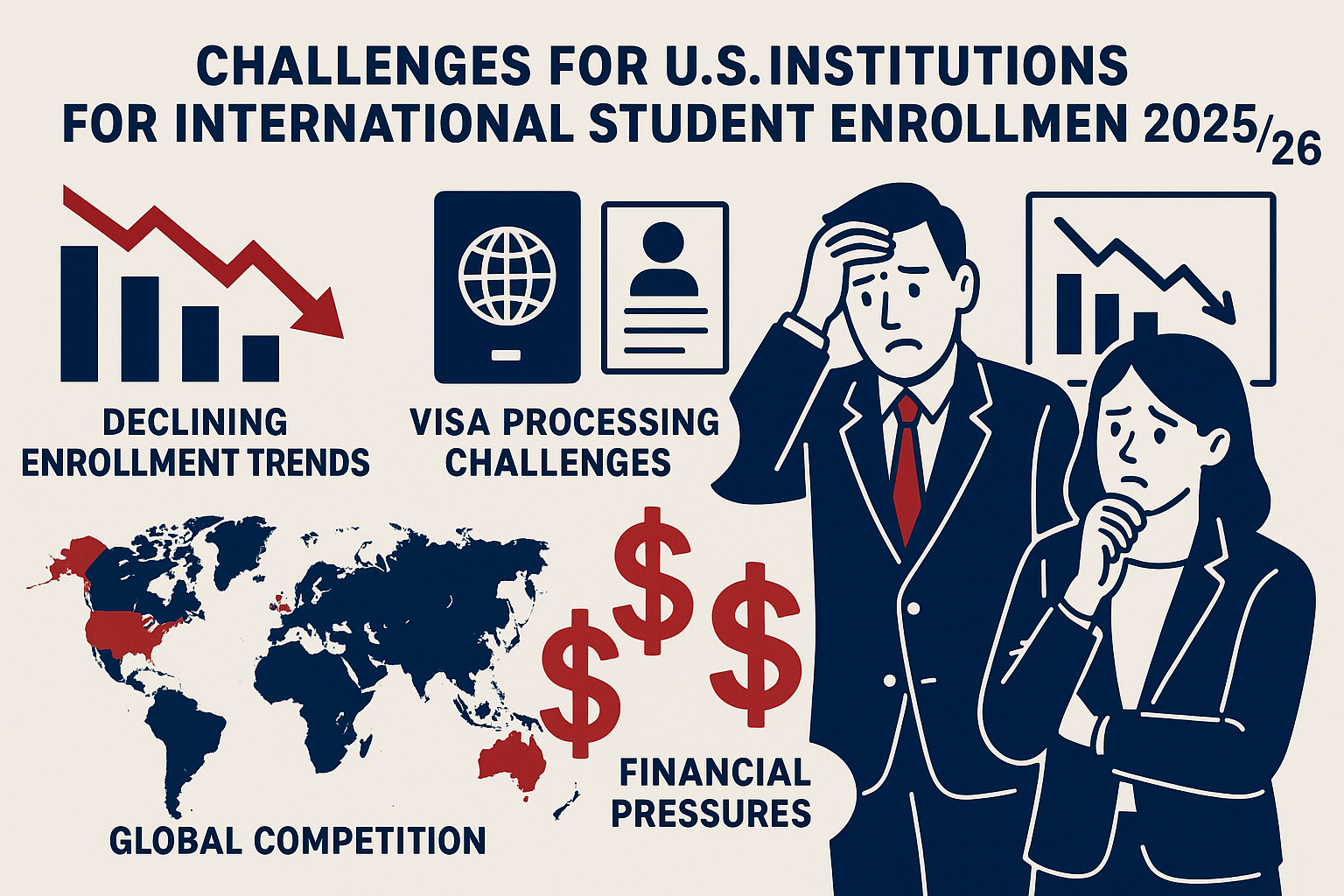
The figures tell an interesting story. Additionally, while the United States saw a record 1.3 million international students in 2024 (thanks to revised government figures), more than a third of universities now expect a decline in enrollment for 2025-26. Some analyses predict a drop of 7 to 11 percent, especially in graduate programs, where 49% of institutions expect a decrease. But before you panic, let’s understand why this is happening and what it means for you.
Key Factors Behind the Enrollment Outlook
A number of interrelated factors have created this challenging environment for KWPH004:
- Visa Processing Complexities:The granting of visas has become more exacting, with greater demands for documents and longer waiting times. It is not so much that the rate of refusal has increased, but that the procedure has been made more difficult and time-consuming.
- Global Competition Heating Up:Canada, Australia, and Germany are recruiting foreign students with the promise of a job and a permanent residence permit after graduation. They are making it easier, while the United States seems to be making it harder.
- Rising Costs Concerns:With tuition fees ranging from 25,000 to 50,000 yuan a year, and monthly living expenses of between 1,200 and 2,000 dollars, the financial burden is considerable. Combined with the uncertainty of the future, some students have begun to rethink.
- Political Climate Impact:Let’s talk about the elephant in the room. In fact, the uncertainty of the government’s policy and the ambiguity of the political situation are causing anxiety among foreign students. No one wants to spend years and thousands of rupees without knowing what the future will be like.
But here’s what the newspapers often miss: these challenges do not affect all universities equally. The most prestigious universities continue to be in great demand, while the regional universities are under more pressure. Additionally, understanding these subtleties can help you make smarter choices about where to apply.
How Are Indian Students Specifically Affected by These Changes?
Now let’s come to the crux of the matter. How will these changes affect Indian students? The good news is that India continues to be one of the top countries sending students to the United States, and the demand for Indian students, especially in the field of science and technology, continues to grow. However, there are some new realities that need to be taken into account.
Indian students have to face a lot of problems in this changing scenario. Delays in visa approvals have become a common occurrence. Some students have had to wait for months to get an appointment for the visa interview. The stricter supervision means that your documents must be absolutely perfect. There is no room for mistakes or inconsistencies. The financial documentation has also become stricter and requires a clear proof of the source of the funds.

Rahul Jain
“I was worried about the enrollment challenges, but Gateway International helped me navigate everything smoothly. Their expertise in documentation and visa preparation made all the difference. I received my visa within 8 days!”
Pain Points Indian Students Are Facing
According to the experiences of recent Indian students, the following are the main causes of anxiety for Indian applicants:
- Extended Visa Wait Times:What used to take a few weeks now often takes months, which makes it difficult to plan ahead.
- Higher Financial Requirements:Universities ask for a higher level of proof of ability to pay, sometimes requiring up to three times the actual cost of the course.
- Limited Interview Slots:The American consulates in India are experiencing a backlog, so it’s important to apply early.
- Increased Competition:With more and more students applying to “safe” universities, even the middle-ranking ones are becoming more selective.
Despite all these difficulties, Indian students who take a strategic approach to the process have been able to succeed. The key is to start early, be thorough with the paperwork, and have a backup plan. Students are applying to more universities than in the past – eight or ten instead of five or six – in order to increase their chances.
What Visa Challenges Should Indian Students Prepare For?
Let’s take a closer look at the visa situation, because this is where many Indian students are most anxious. The F-1 student visa hasn’t fundamentally changed, but its implementation has become stricter. These changes will help you to be better prepared and to avoid common pitfalls.
The current visa environment requires what I call ‘extreme preparation’. Gone are the days when you could go to the embassy with just a passport and a letter from your parents. Furthermore, today’s visa officers want to see a lot of proof that you are a bona fide student, that you have They want to make sure that you are a genuine student and that you will come back to India after completing your course.
| Visa Aspect | Previous Process (Pre-2023) | Current Process (2025-26) |
|---|---|---|
| Interview Wait Time | 2-4 weeks | 2-4 months |
| Documentation | Basic financial proof | Detailed source of funds |
| Interview Duration | 2-3 minutes | 5-10 minutes |
| Success Rate | 85-90% | 75-80% |
| Administrative Processing | Rare (5-10%) | Common (20-30%) |
Smart Strategies for Visa Success
SUCCESSIVE STUDENTS ARE DOING THIS TO MANAGE THE NEW VISA CONDITIONS:
1. Starting Ultra-Early:Six months before the start of the course, the shrewd student begins to apply for a visa. This is to allow for any delays that may occur and to deal with any problems that may arise.
2. Documentation Perfection:Every document must tell the same story. Your financial documents, your academic records, and your statement of purpose must all be consistent with each other. Any discrepancy is a red flag.
3. Interview Preparation:Students spend weeks preparing for their visa interviews, rehearsing their answers to tough questions about their career plans and their plans to return to India.
📋 Need Help with Documentation?
Our visa experts have a 95% success rate in preparing students for F-1 visas. Get your documents reviewed by professionals.
Which US Universities Still Welcome Indian Students Despite Challenges?
There is something that the gloom and doom headlines do not tell you. Many American universities are actively recruiting Indian students. They recognize the value of Indian students and are trying to make the process easier for them. Let me tell you which institutions are leading the way.
🎯 Important: Scholarship Opportunities Still Available!
In spite of the difficulties of enrolment, many American universities offer substantial scholarships to Indian students.
- Texas A&M University:Up to twelve thousand dollars a year for college students.
- Arizona State University:Scholarships from five to fifteen thousand francs.
- University of Massachusetts:Graduate assistantships covering tuition and stipends.
- Missouri University of Science & Technology:Up to thirty thousand francs for the best students.
These scholarships are aimed at attracting talented foreign students, thereby demonstrating that, despite all the difficulties, diversity is still valued by the universities.
Regional universities and state universities are especially hospitable to Indian students. They offer faster admissions, conditional admissions for those who are still working on their English language skills, and special support services for international students. Universities in such states as Texas, Ohio, and North Carolina see this as an opportunity to diversify their student bodies.
Universities Making Extra Efforts
There are a number of foreign universities that are doing their best to attract Indian students.
Technology-Focused Institutions:Universities with a strong focus on science, technology, engineering and mathematics (STEM) know that Indian students excel in these subjects. They have created a special pathway for these students, increased the number of teaching assistantships, and entered into agreements with Indian.
Public Research Universities:State universities in the middle and lower reaches of the Yangtze River are recruiting Indian students, offering scholarships and practical training. Compared with coastal cities, the cost of living is lower and the quality of education is higher.
Pathway Programs:Many universities now offer preparatory courses that guarantee a place in the first year of the degree course. Additionally, this reduces the risk for both the student and the university.
The important thing is to find a university that suits you, and to be realistic about your chances of getting in. Experienced counsellors can help you find these hidden gems, which offer a first-rate education without the fierce competition of the most prestigious universities.
How Can Indian Students Navigate Financial Challenges in 2025-26?
Let’s talk about money, because that’s what keeps many Indian parents awake at night. With the falling value of the rupee and the ever-increasing cost of education in the United States, the financial aspect has become more complex. But here’s what smart families are doing to make a U.S. Education affordable, despite these obstacles.
The cost of education in the United States has risen considerably in the last few years. The annual tuition fee is between thirty and forty-five thousand rupees, and the cost of living is between fifteen and twenty thousand. Moreover, when this is multiplied by four years for a bachelor’s degree or two years for the master’s, the figures become alarming. But don’t let these figures put you off. There are ways to manage these costs effectively.
Financial Planning Strategies That Work
SUCCESSIVE STUDENTS USE MULTIPLE METHODS TO FUND THEIR STUDIES IN THE UNITED.
- Education Loans with Collateral:Banks in India lend up to a maximum of one and a half million rupees at an interest rate of 10 to 12 per cent per annum. Furthermore, if you have a security, the interest rate will be lower.Gateway EduConnectThe loan office is able to guide you through the loan process.
- Partial Self-Funding:Many families take a mixed approach, paying for the first year themselves and then relying on loans or scholarships for the following years. This demonstrates a strong financial commitment to the visa officers.
- Assistantships and Campus Work:Graduate students can earn 800 to 2,000 yuan a month as a teaching assistant and a research assistant, which can meet most of the living expenses, and the cost of living is greatly reduced.
- Strategic University Selection:If you choose a university in a smaller city, you can save five to ten thousand rupees a year, without compromising on the quality of education.

Priya Sharma
“Gateway International helped me secure a $15,000 scholarship and guided me through the education loan process. Their financial planning advice saved my family lakhs of rupees. Now I’m studying at Arizona State with minimal financial stress!”
Remember, it’s still worth investing in a U.S. Education, despite the expense. The average starting salary of an Indian graduate from a U.S. University is between $70,000 and $120,000 a year. If you get a good job, you can recoup your investment in three to five years.
Why Are STEM Programs Still Strong for Indian Students?
If there is a ray of hope in this bleak picture, it is in the field of science and technology. In spite of the general decline in the number of students, American universities continue to recruit Indian students for their science, technology, engineering and mathematics (STEM Because Indian students have excelled in these subjects, and American universities need such talent.
The three-year OPT (Optional Practical Training) for graduates in the field of science and technology is still a great advantage. Moreover, it gives you a lot of time to gain experience and get an H-1B visa. In spite of the uncertainties of the economy, technology companies continue to recruit, and the prospects for STEM graduates are better than ever.
STEM Advantages for Indian Students
Here’s why a STEM education is your best bet for a US education:
1. Higher Admission Rates:Science, technology, engineering, and mathematics (STEM) programs generally have a higher acceptance rate for international students than business or liberal arts programs. Universities need talented STM students to maintain their research output and rankings.
2. Better Funding Opportunities:The majority of teaching and research assistantships are in the natural sciences. It is common for graduate students to receive full tuition waivers and monthly stipends of $1,500 to $2,500.
3. Industry Partnerships:There are many co-op programs and internships that lead to full-time employment.
4. Future-Proof Skills:With the rise of artificial intelligence, big data, and cyber security, the long-term career prospects of STEM graduates are bright, regardless of short-term policy changes.
It is essential to choose a course that is in line with the requirements of the industry. Artificial intelligence, renewable energy, biotechnology and quantum computing are some of the areas where there is a lot of scope for Indian students.
🚀 Ready to Apply for STEM Programs?
Our counselors specialize in STEM admissions and have helped 15,000+ students secure admits with funding. Start your journey today!
What Application Strategies Work Best in This Challenging Climate?
The old method of applying to a few dream schools and hoping for the best is no longer a good one. Today’s successful applicants are strategic, thorough, and start very early. Let me share with you what is working for students who are getting multiple admits despite the difficulties.
The most successful students have made their applications a full-time occupation. They have spent months in perfecting their profiles, in preparing their stories, and in cultivating their relations with the universities. It’s not a question of cheating, it’s a matter of presenting yourself as the exceptional candidate you are.
The Winning Application Formula
Here is what distinguished the successful candidates in 2025-26:
1. Ultra-Early Preparation (12-18 months before):Start building your profile at least a year before the application deadline. This means improving your test scores, gaining relevant work experience, and thoroughly researching the universities you are interested in.
2. Diversified University List:APPLY TO TEN TO TWELVE UNIVERSITIES IN DIFFERENT CATEGORIES: ONE TO TWO DREAM COLLEGES; THIRTY-FIVE MEDIUM.
3. Compelling Personal Narrative:Your statement of purpose should be a narrative of your past experiences, your present interests and your future aspirations. Generic statements won’t cut it anymore.
4. Demonstrated Interest:Universities are looking for students who take an active interest in what they are doing. Attending virtual classes, chatting with current students, e-mailing professors about their research.
5. Perfect Documentation:Every document must be perfect: the certificates, the letters of recommendation, the financial statements. The slightest inconsistency can ruin the whole application.
Download : The 90-Day US Admission Readiness System That Gets Indian Students Into Top Universities Without Last-Minute Panic
Remember, in such a competitive environment, an average application will get an average result. You have to do more to stand out from the crowd. Start early, be thorough, and present yourself as an exceptional candidate that American universities can’t afford to miss.
What Does the Future Hold for Indian Students in the US?
Despite all these difficulties, I am still optimistic about the future of Indian students in American universities. Why? Because the fundamentals have not changed. American universities continue to offer world-class education, unparalleled research opportunities, and a gateway to a global career. The difficulties we see are only temporary humps on a long journey.
The history of international education shows us that it has weathered many storms, from 9/11 to the financial crisis of 2008 to COVID-19. Each time it has adapted and emerged stronger. The present difficulties are likely to lead to a better system of visas, more scholarships, and better facilities for foreign students.
Emerging Opportunities Despite Challenges
There are a number of indications that the future of Indian students is bright.
- Technology Integration:Universities are using technology and artificial intelligence to speed up the admissions process and provide better support for international students.
- Industry Partnerships:More and more universities are establishing a direct route from education to employment through a partnership with a company.
- Alternative Funding Models:In the United States, with the help of income-sharing agreements and new financing methods, higher education is becoming more and more accessible.
- Regional Campus Expansion:Universities in the big cities are opening branches in smaller cities where the cost of living is lower.
Arjun Patel
“Despite all the negative news, I trusted Gateway International’s guidance. They helped me navigate the challenges, and I’m now studying Computer Science at University of Texas with a teaching assistantship. The opportunities here are incredible!”
The American education system still values talent, diversity, and international perspectives. The students who succeed in this environment are those who are quick to adapt, well-prepared, and not easily discouraged. Indian students who possess these qualities will continue to find opportunities.
💡 Free SOP Generator Tool
Stand out with a compelling Statement of Purpose! Use Gateway International’s AI-powered SOP generator to craft the perfect narrative for your US applications.
Latest News and Updates
📰 Latest Developments in US International Student Enrollment
Quiz: Are You Ready for US University Applications in 2025-26?
Test Your US Application Readiness
Discover if you’re prepared to navigate the challenging US admission landscape for 2025-26.
This personalized assessment will identify your strengths and areas for improvement.
Question 1 of 4
How far in advance have you started your US application preparation?
Conclusion
In the year 2025-26, there will be both difficulties and opportunities for Indian students to study in the United States. However, the headlines will only talk about the difficulties, such as the delay in visas, the increase in scrutiny, and the reduction in the number of students. KWPH004 will continue to value international diversity, and those who prepare strategically will still be able to achieve their American dreams.
Success in this environment requires adaptation to new realities: starting earlier, applying more broadly, preparing more thoroughly, and being financially strategic. The students who succeed will be those who don’t regard these difficulties as obstacles, but as opportunities to show their strength and ability. Furthermore, remember that the more difficult it’s to get into a university, the more important it’s for those who do get in to stand out.
Your path to a US education may be more difficult than that of your predecessors, but it’s by no means impossible. With proper guidance, careful planning and steadfast determination, you can overcome these obstacles. The American dream of a world-class education is still alive and attainable for those who are willing to work for it.
🎯 Ready to Start Your US Education Journey?
Don’t let enrollment challenges stop you! Gateway International has helped 50,000+ students achieve their dreams. Let our experts guide you through the complexities of US admissions in 2025-26.
🔑 Key Takeaways
- KWPH004 expects enrollment difficulties for 2025-26, but opportunities still exist for well-prepared Indian students.
- Success is a matter of starting twelve to eighteen months in advance and applying strategically to ten to twelve universities.
- With the three-year OPT and more funding opportunities, the number of students in the field of science, technology, engineering and mathematics (STEM) is growing.
- Planning your finances with a variety of sources—loans, scholarships, and assistantships—is essential.
- The preparations for a visa must be more thorough than ever, with perfect documents and a readiness for an interview.
- Regional universities and state schools offer excellent opportunities with less competition.
- In spite of all these difficulties, a degree from the United States has a high value for Indian students.