
GMAT Focus Edition 2025: Key Features and Preparation Tips
 By Abhinav Jain, Founder & Director, Gateway International | IIT Delhi Alumni | 17+ Years Experience | 50,000+ Students Placed
 Published: January 3, 2025 | 12 min read | ✓ Verified Expert
Table of Contents
- Introduction
- What is the GMAT Focus Edition 2025?
- How Does GMAT Focus Edition Differ from Traditional GMAT?
- What’s New in the GMAT Focus Scoring System?
- Which Sections Are Included in GMAT Focus Edition?
- How Long Should You Prepare for GMAT Focus Edition 2025?
- What Are the Best Study Strategies for Each Section?
- Which Common Mistakes Should You Avoid?
- What Resources Are Essential for GMAT Focus Preparation?
- What Are the Latest News and Updates for 2025?
- How Are Top B-Schools Adapting to GMAT Focus Edition?
- Conclusion
Introduction
If you’re an Indian student dreaming of an MBA from a top business school in 2025. You’ve probably heard about the revolutionary changes to the GMAT exam. The GMAT Focus Edition 2025 represents the most significant change in the exam’s history. And, frankly, it’s causing quite a buzz in the MBA aspirant community. As someone who has guided thousands of students through their MBA journeys over the past 17 years. I can tell you that understanding these changes is not only useful, it is absolutely essential to your success.
The transition from the traditional GMAT to the GMAT Focus Edition has left many students with a mixture of excitement and anxiety. On the one hand, the exam is now shorter and more focused (pun intended!). On the other hand, the new format brings its own set of challenges, which requires a new approach to preparation. Whether you’re just starting your GMAT journey or rethinking your strategy after the format change. This comprehensive guide will equip you with everything you need to know about the GMAT and how to ace it.
What makes this change particularly significant for Indian students is the timing. With the increasing competition for international MBA seats and the changing admission criteria of the top business schools. Adapting quickly to the new GMAT system and format can give you a decisive advantage. So let’s delve into what this new edition means for your MBA dreams.
Ready to Master the GMAT Focus Edition?
Get expert guidance and a tailor-made study plan designed specifically for Indian students aspiring to get into the top.
What is the GMAT Focus Edition 2025?
The GMAT Focus Edition 2025 is essentially a new version of the Graduate Management Admission Test. Which the GMAC (Graduate Management Admission Council) has launched to meet the changing needs of business schools and the modern business world. Think of it as GMAT 2.0-simplified, more relevant, and, dare I say, more student-friendly in many ways.
At its core, the GMAT Focus launch represents GMAC’s response to feedback from both test-takers and business schools. The organization recognized that the traditional GMAT, while comprehensive, was becoming increasingly out of touch with the real skills needed in today’s data-driven business environment. What was A test that is not only shorter in duration. But also more focused on measuring the analytical and critical thinking skills that matter most in today’s business education.
What is particularly interesting about the GMAT Focus Edition is its emphasis on practical business skills. Moreover, gone are the days when you used to spend hours perfecting sentence correction rules that you would hardly use in your MBA or career. Instead. The new format focuses on your ability to analyze data, solve complex problems, and think critically-skills that directly translate to success in business school and beyond.
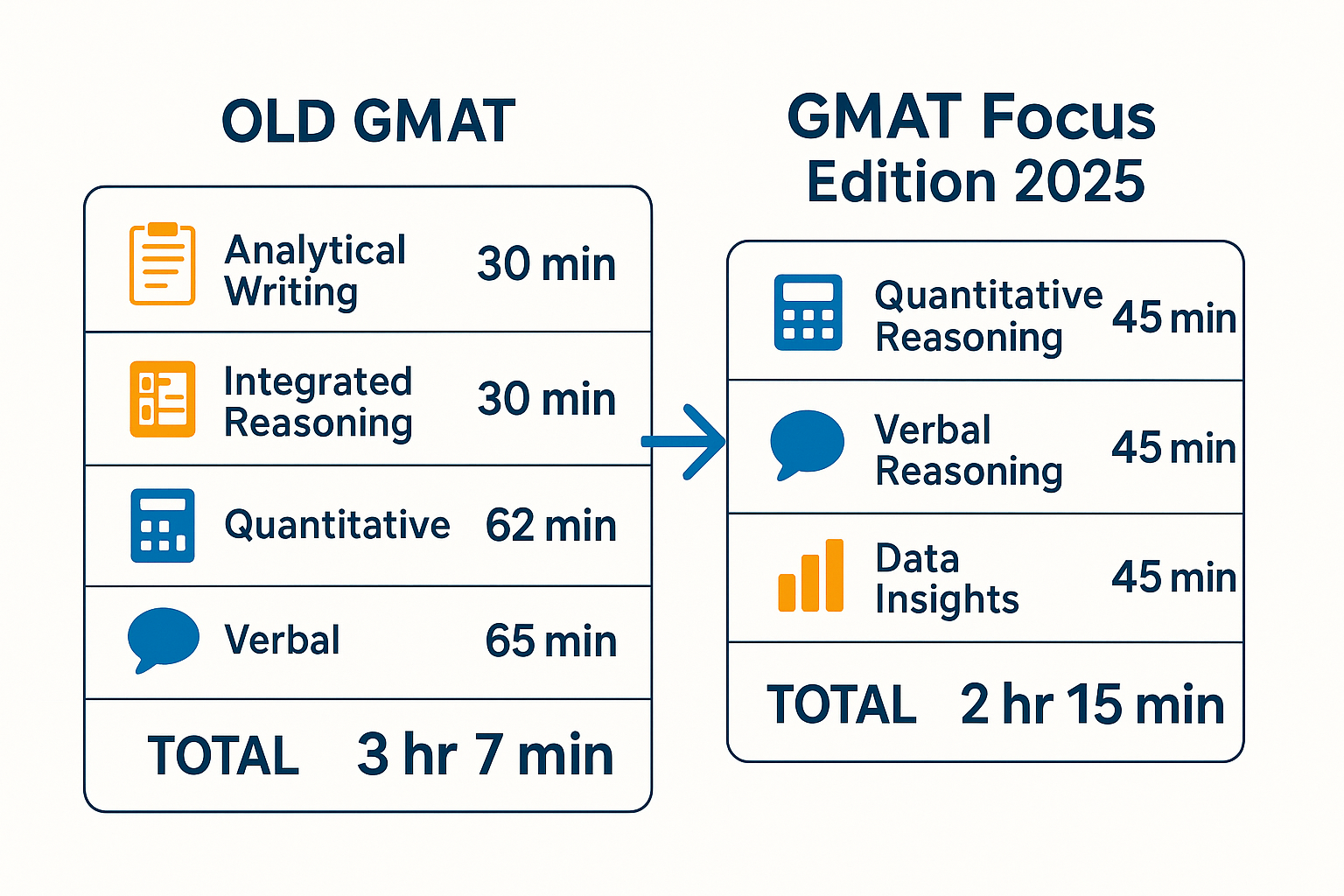
For Indian students, who have to juggle test preparation with demanding jobs or final-year studies, the shorter format is a godsend. The examination now lasts only two hours and fifteen minutes instead of the three-and-a-half hours of the past. But do not let the shorter duration deceive you. The GMAT Focus format packs quite a punch in terms of the skills it tests.

Tanishque Singhvi
I came to know about Gateway through one of my cousins. It was a strange experience.”, and especially Ashray. His guidance and personal touch made my dream of studying abroad come true. Furthermore, their carefully compiled list of countries and universities was exactly in line with my preference for career advancement. Moreover, I got my job offer from George Brown in Canada, and life has been great ever since.”.
How Does GMAT Focus Edition Differ from Traditional GMAT?
Let me give you a clear picture of how the GMAT has changed. When I first started counselling students, the GMAT was like a four-course meal: substantial, but sometimes overwhelming. Also, the GMAT Focus Edition 2025, on the other hand, is more like a carefully curated tasting menu. It is shorter, but every element is purposeful.
The most striking difference? The examination system has been completely revamped. The old GMAT had four sections: Analytical Writing Assessments (AWA), Verbal, Quantitative and Integrated Reason. GMAT Focus format reduces this to only three sections: quantitative reasoning, verbal reasoning and the new data interpretation. Also, you read it right: no more essays! For many Indian students who struggled with the AWA section, this change alone is worth celebrating.
But here is where it gets really interesting. The new Data Insights section is not just a renamed Integrated Reasoning. It is a comprehensive assessment that combines elements of data analysis, critical reasoning, and quantitative interpretation. This section reflects how modern managers actually work with data-not in isolation, but as part of an integrated decision-making process. Additionally, for students from an engineering or analytic backgrounds, this could be your time to shine.
Another game-changing feature is the ability to change your answers. Remember the nail biting moments in the old GMAT when you would submit an answer and immediately realize that you had made a calculation error? Well, the GMAT Focus Edition allows you to mark questions and come back to them within each section. You can now review and change up to three answers per section. This flexibility reduces test anxiety and allows you to manage your time more strategically.
Why Do These Changes Matter for Your MBA Journey?
The elimination of the Sentence Correction questions may seem like a small change, but it represents a fundamental change in what the test values. Instead of testing your knowledge of obscure grammar rules, the GMAT focuses on your ability to understand and analyze complex business texts. This is much more in line with what you will actually be doing in business school: reading case studies, analyzing reports, and putting things together.
The GMAT tips I give my students now are very different from what I used to give them. Additionally, the new format rewards different skills and strategies. For example, the improved score report now provides detailed insights into your performance, showing not only what you got wrong, but also why. This granular feedback is invaluable for focused preparation and improvement.
Confused About the New Format?
Let our GMAT experts break down the changes and create a personal strategy for your success!
What’s New in the GMAT Focus Scoring System?
If there’s one aspect of the GMAT that’s causing confusion among students, it’s the new scoring system. And I understand. When you’ve been aiming for a magical 700+ score for months, it’s disorienting to suddenly hear about a 205-805 scale. But let me explain the GMATGMAT Focus Edition 2025 system in a way that makes sense.
The new total score range of 205-805 is not just a cosmetic change. GMAC deliberately chose this range in order to prevent direct comparisons with old GMAT scores and to counteract the score inflation that had occurred over the years. Each of the three sections (Quantitative, Verbal, and Data Sufficiency) now contributes equally to your total score, with section scores ranging from 60 to 90. This equal weighting is a significant departure from the old system, in which only Quant and Verbal determined the main score.
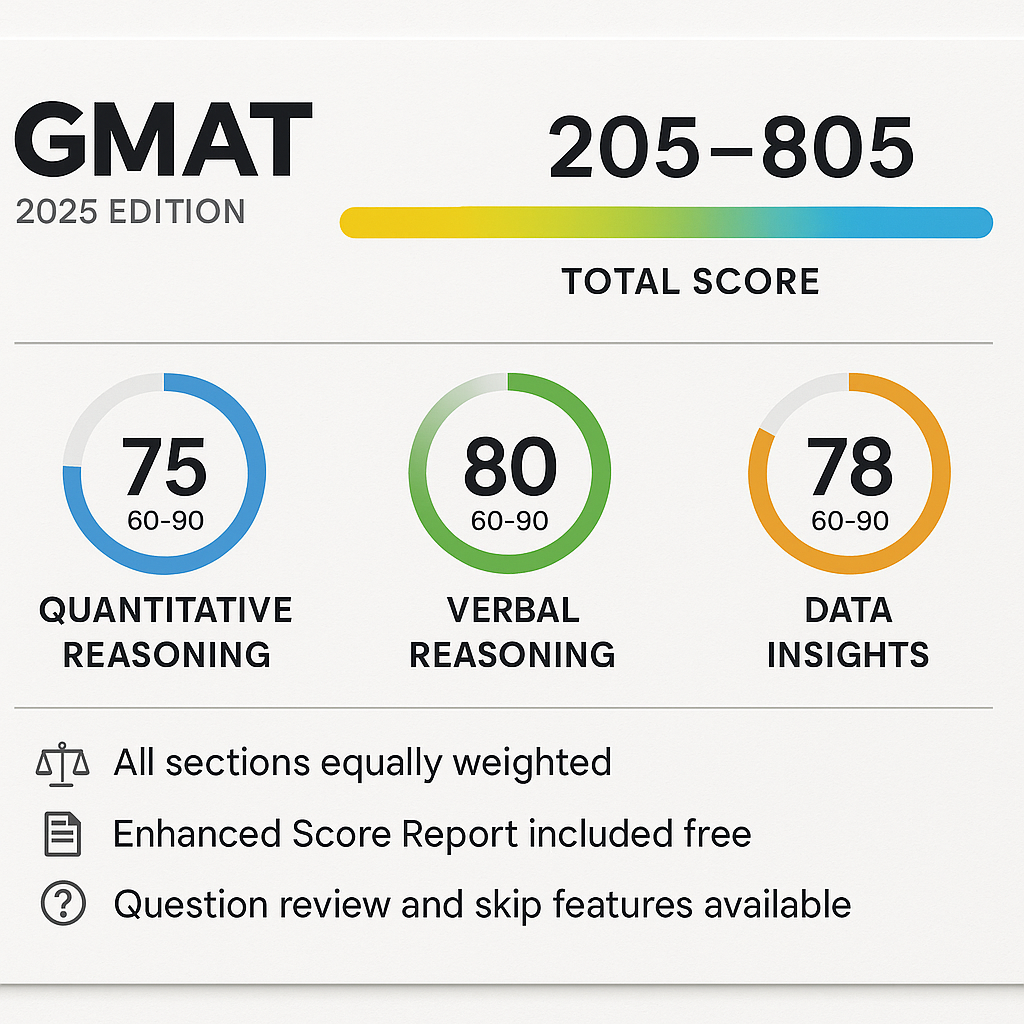
What does this mean to you? Well, now you can’t afford to neglect any part of it. In the past, some students used to focus on Quantitative Aptitude and Verbal Aptitude, and treat IR as an afterthought. With the GMAT, excellence in Data Interpretation is just as important as mastering the Quantitative and Verbal sections. This approach is actually more in line with what business schools are looking for: a well-rounded candidate who can cope with a variety of business.
Here’s something that often surprises students: a 655 on the new scale roughly corresponds to a 700 on the old scale in terms of percentiles. Furthermore, so when you’re looking at school requirements and they mention the average GMAT score, you have to adjust your goals accordingly. Most of the top B-schools have already updated their websites with GMAT equivalents, but always double-check during your research.
How Should You Set Your Target Score?
Setting a realistic target score for the GMAT Focus requires an understanding of both the new scale and the expectations of your target schools. Early data from the 2024-25 admissions season shows that top-tier schools like ISB. INSEAD, and Wharton are looking for scores between 685 and 705 on the new scale. Second-class schools usually accept scores between 635 and 665. Also, remember, these are the average scores. A slightly lower score does not necessarily disqualify you if other parts of your application are strong.
Which Sections Are Included in GMAT Focus Edition?
Let’s take a closer look at each section of the understanding what each section tests and how to approach it is essential to developing an effective preparation strategy.
Quantitative Reasoning (45 minutes, 21 questions)
The Quantitative section in the GMAT has undergone some interesting changes. It still tests your problem-solving skills, but geometry has been completely eliminated. This is wonderful news for students who dreaded coordinate geometry and complex figures! The emphasis is now entirely on arithmetic, algebra, and data analysis-skills that are actually useful in business school.
The questions are designed to test your ability to reason quantitatively and solve problems in a practical business context. Moreover, you may encounter questions on profit margins, growth rates, statistical interpretations, and algebraic problem-solving. Additionally, the emphasis has shifted from pure mathematical knowledge to applied quantitative reasoning.
Verbal Reasoning (45 minutes, 23 questions)
The Verbal Section has perhaps undergone the greatest change. With the elimination of Sentence Correction, the GMAT now focuses exclusively on Reading Comprehension and Critical Reasoning. This change reflects a shift towards testing skills that are useful in business school: understanding complex texts, evaluating arguments, and drawing logical conclusions.
Reading comprehension passages often deal with business topics, scientific discoveries, social issues, and historical analyses. Critical Reasoning questions test your ability to analyze arguments, identify assumptions, and evaluate evidence. Also, these are precisely the skills you will need when analyzing business cases or evaluating strategic decisions in your MBA program.

Rishita Dodiya
Exceptional Support for Study Abroad! But my name is Rishita Dodiya. I have been admitted to the University of Nottingham. I have also been granted a scholarship of twenty-five per cent on the total cost of From the first consultation to the granting of my student visa. Gateway International provided me with a personal and Their team, especially Richa Ma’am, Arpita Ma‘am, Deepti ma’am and Nilu ma‘am helped me to shortlist the universities, apply for scholarships and navigate the visa process smoothly.
Data Insights (45 minutes, 20 questions)
The Data Interpretation section is the crown jewel of the GMAT Focus Edition This section consists of a variety of question types. Including Data Sufficiency (moved from Quant), Table Analysis, Graph Interpretation, Multi-Source Reasoning, and Two-Part Analysis. This exam is designed to test your ability to analyze and interpret data from different sources, a critical skill in today’s data-driven business world.
What makes this section unique is its integrated nature. Furthermore, you may need to combine numerical skills with logical reasoning to interpret data in various formats. For Indian students with a strong analytical background, this is an opportunity to show your data interpretation skills in a business context.
Master Each Section with Expert Guidance
Our specialized tutors help you develop section-specific strategies for maximum score improvement.
How Long Should You Prepare for GMAT Focus Edition 2025?
One of the most common questions I get from students about the GMAT is. “Sir, how long will it take me to prepare?” And while I would love to give a one-size-fits-all answer, the truth is that your preparation time depends on several factors. However. Based on my experience with hundreds of students who have made the transition to the new format, I can share some realistic timetables and effective planning strategies.
For most Indian students juggling work or studies, a three- to four-month preparation window tends to be optimal for the GMAT. This gives you enough time to understand the new format, identify your strengths and weaknesses, and develop strategies for each section. If you’re starting from scratch and have little experience with standardized tests, you might want to extend this to four or five months. On the other hand. If you have already prepared for the GMAT or have a strong foundation, you may need only two or three months of.
Here’s a practical breakdown of how to structure your preparation time:
Month 1: Foundation Building and Format Familiarity
Your first month should be devoted to getting to know the GMAT Focus Edition inside. Start with a diagnostic test to establish your starting point. Additionally, don’t worry if it’s lower than you expected. Remember, this is a new format! Additionally, spend time understanding the requirements, question types and time limits for each section. Start by learning the concepts, especially in areas where you feel rusty. For Quant, refresh your algebra and arithmetic, and for Verbal, start reading business publications every day. For Data Insights, familiarize yourself with the different data representation formats.
Month 2: Skill Development and Practice
This is where you go deep into GMAT tips and strategies specific to each section. By the end of this month. You should have completed at least 50 to 60 percent of your content Start doing timed practice sets, but don’t worry too much about the timing Focus on accuracy and understanding the logic of each question type. This is also the time to start keeping an error log. A detailed record of your mistakes that will help you identify patterns in your errors.
Month 3: Integration and Mock Tests
The last month is devoted to bringing everything together. Start taking full-length mock tests under exam conditions. The GMATKEY on these mocks will give you a realistic picture of where you stand. Aim for at least six or eight full-length mock-ups. Analyzing each one Between mocks, work on your weak points as indicated by the enhanced score reports.
What Are the Best Study Strategies for Each Section?
The success of the GMAT requires specific strategies for each section. Let me share with you some proven approaches that have helped students excel in this new format.
Quantitative Reasoning Strategies
For the Quantitative section of the GMATGMAT Focus Edition 2025. Efficiency is With geometry out of the way, you can concentrate on mastering algebra, arithmetic, and word problems. Start by making sure your fundamentals are rock-solid. Many students make the mistake of jumping into advanced problems without mastering the fundamentals. Create a formula sheet, but more importantly, know when and how to apply each concept.
One effective strategy is the “reverse engineering” approach for Data Sufficiency questions (now in Data Insights). Instead of trying to solve the problem completely. Concentrate on finding out what information would be This saves precious time, and corresponds to what the question actually asks.
Verbal Reasoning Strategies
Without Sentence Correction, your verbal preparation for the GMAT should focus on comprehension and analysis. For Reading Comprehension, develop active reading habits. Don’t just read, engage with the text by identifying the main idea, the author’s tone, and the passage’s structure. Make brief mental notes as you read.
For critical reasoning, master the art of identifying the components of an argument: premises, conclusions, and Practice with everyday arguments-newspaper editorials, opinion pieces, even advertisements. Additionally, this real-life practice makes the skill more instinctive during the exam.

Data Insights Strategies
The Data Insights section is where good GMAT tips can really make a difference. This section rewards those who can quickly interpret data from various sources. Additionally, systematically: first, understand what the question is asking, then identify the relevant data sources, and finally, integrate the information to find the answer.
Practice with real business data: annual reports, market research, economic indicators. The more familiar you are with the various data formats, the faster you will be during the exam. Remember, this section tests not only your analytical skills but also your business acumen.
Need Personalized Study Strategies?
Our GMAT experts will analyse your strengths and create a bespoke preparation plan for you.
Which Common Mistakes Should You Avoid?
After guiding thousands of students through their GMAT journey, I’ve noticed certain patterns of mistakes that can seriously derail your preparation for the GMAT. Let me tell you about these pitfalls so that you can avoid them.
Mistake #1: Treating It Like the Old GMAT
The biggest mistake I see is students using old GMAT materials and strategies for the GMATGMAT Focus Edition 2025. It’s like training for a marathon when you’re actually running a different race. The removal of AWA and Sentence Correction, the addition of Data Interpretation, and the new scoring system all call for a new approach. Using outdated preparation materials is not only a waste of time. But it can also harm your performance by preparing you for questions that no longer exist.
Mistake #2: Neglecting Data Insights
Many students, especially those who are strong in Quant and Verbal, make the mistake of underestimating the Data Interpretation section. Remember, in the GMAT Focus scoring system, all three sections contribute equally to your total score. I have seen brilliant students with 85+ in Quant and Verbal who could not score more than 70 in Data Sufficiency. This significantly affected their overall This section requires a lot of preparation and cannot be mastered with the knowledge of.
Mistake #3: Not Utilizing the Question Review Feature
The ability to flag and return to questions is a game-changer for the GMAT, but many students don’t use it effectively. They either don’t use it at all (sticking to old habits), or they overuse it, wasting time on every answer. The key is strategic use. Mark the questions you are genuinely unsure of, not those where you are just being a perfectionist.
Mistake #4: Ignoring the Enhanced Score Report
The detailed feedback in your enhanced score report is pure gold for improvement, but many students just look at their total score and move on. These reports show your performance by question type, how you manage your time, and even how you compare to other test-takers. Not using this data for targeted improvement is like having a GPS and navigating blindfolded.
Akshit Virdi
Hello, I hope you’re all well. Moreover, I’m writing this review based on my application process. My name is Akshit Virdi, and I am going to study civil engineering at the University of Portsmouth. I am extremely grateful to Gateway and especially to Prateek Panchal, who helped me a lot and supported me throughout my admission and application process.
What Resources Are Essential for GMAT Focus Preparation?
What are the best resources for GMAT preparation? The market is flooded with preparation materials, but not all are created equal, especially with the recent format changes. Let me guide you through the essential resources that are actually in line with the new format.
Official GMAC Resources
Start with the official GMAT Focus Starter Kit + practice exams. This is non-negotiable. These materials are created by the test creators themselves and are the most accurate representation of what you will face on test day. The practice tests use the same scoring system as the real test, giving you reliable estimates. Many students make the mistake of relying solely on third-party materials, but nothing beats practicing with official questions.
Specialized Prep Platforms
For the GMAT Focus format, you need platforms that have the latest content. Look for those that offer Data Insights-specific practice, because that’s where most traditional prep materials fall short. Additionally, some platforms now offer AI-based adaptive learning that adapts to your performance. This is particularly useful for identifying and addressing weak areas.
Business Publications and Data Sources
Here’s an unconventional but highly effective GMAT tip: regularly read business publications such as The Economist, Business Week, and McKinsey Insights. These not only improve your reading speed and comprehension for the verbal section. But also familiarize you with the types of data presentations you’ll encounter in Data Insights. Besides, the business knowledge you pick up will come in handy for your.
Mobile Apps for On-the-Go Practice
In today’s busy world, mobile learning is essential. Look for apps that offer quick practice sessions, flashcards for concepts and daily question challenges. Consistency is the key. Furthermore, even fifteen minutes during your commute can add up to a lot of practice time over the course of a day.
Access Premium GMAT Resources
Get exclusive access to Gateway International’s curated GMAT study materials and expert guidance.
What Are the Latest News and Updates for 2025?
📰 Latest GMAT Focus Edition Updates
- GMAC Official Announcement: The GMAT Focus Edition will be the only version of the GMAT offered worldwide as of 2024. And all business schools worldwide will accept the new format for admissions in 2025 and beyond.
- The Times Higher Education: Recent data show that more than 90 per cent of the world’s top MBA programs have changed their admission requirements to take into account the GMAT Focused Edition. With many schools reporting positive feedback about the new format’s relevance to business.
- QS World University Rankings: Analysis reveals that business schools are placing a greater emphasis on Data Insights section scores when evaluating candidates for data-driven specializations such as Business Analytics and FinTech.
- NDTV Education: Indian test-takers do well in GMAT Focus Edition. The average score has gone up by eight points compared to the previous format. Indians are particularly strong in the Data Interpretation section because of their strong analytical background.
- The Financial Times: Top business schools. Including Wharton, INSEAD and London Business School, say the new GMAT format better predicts success in quantitative courses and data-driven projects.
The landscape of MBA admissions continues to evolve with the GMAT Focus Edition Schools are not only accepting the new format, they are embracing it. Many admissions committees report that the enhanced score reports give them a better insight into the candidate’s abilities and enable them to make a.
What is particularly encouraging for Indian students is the positive response to the removal of the AWA. Many top B-schools have stated that they prefer to evaluate writing skills through application essays rather than through timed writing tests, as it better reflects real-world business communication skills.
How Are Top B-Schools Adapting to GMAT Focus Edition?
The adoption of GMAT Focus Edition 2025 by the leading business schools has been remarkably smooth, with institutions quickly recognizing the value of the new format. Let me share with you how the top B-schools are changing their requirements and what this means for your application strategy.
Score Expectations at Elite Programs
Top-tier programs have recalibrated their score expectations for the GMAT Focus scoring system. Harvard Business School. The Stanford Graduate School of Business, and the Wharton School of the University of Pennsylvania now have a mean SAT score The Indian School of Business (ISB) reports a mean score of 685-705. Furthermore, what is interesting is that schools are paying more attention to the balance of the sections. A candidate with 80+ in all three sections is often considered better than a candidate with 90 in one section and 70 in the other.
Emphasis on Data Insights Performance
Programs with a strong data-analytics component, such as MIT Sloan’s Business Analytics track or Kellogg’s Marketing Analytics specialization, are particularly interested in Data Insights scores. They regard a good performance in this section as a sign of their data-heavy curriculum. This represents a significant change in the way schools assess mathematical preparedness.
Holistic Evaluation with Enhanced Reports
Business schools love the detailed information provided by the enhanced reports. Admissions committees can now see not only what you scored, but how you think. They can identify candidates who are strategic thinkers (by their time management). Those who are detail-oriented (by accuracy patterns), and those who perform well under pressure (by consistency of performance).
Find Your Ideal GMAT Focus Score Target
Discover what GMAT Focus Edition score you should target based on your profile, goals, and target B-schools. Our personalized assessment considers your background and aspirations to recommend a realistic score goal.
Question 1 of 5
What type of MBA program are you targeting?
Ready to Apply to Your Dream B-School?
Let Gateway International guide you through the entire MBA application process, from GMAT preparation to final admission!
Conclusion
As we wrap up this comprehensive guide to the GMAT, I want to leave you with some final thoughts. The transition to this new format represents more than just a change in the structure of the test. It is a shift in the way business schools evaluate potential. The emphasis on practical skills, data interpretation, and interdisciplinary thinking is exactly what you need to succeed in modern business education and beyond.
Remember. Although the GMAT Focus format may seem daunting at first, it is actually designed to be more relevant and, dare I say, fairer than its predecessor. Also, the ability to review answers, the shorter duration, and the focus on practical skills all work to your advantage. What matters now is how well you adapt your preparation strategy to take advantage of these changes.
Your journey to a top B-school does not end with a good GMAT score. It begins there. The skills you develop while preparing for the GMAT will serve you well throughout your MBA and career. Approach this challenge not as a hurdle to overcome. But as an opportunity to develop the analytical and critical thinking skills that will determine your success in the business world.
Download: The 30-Day GMAT Focus 700+ Blueprint That Gets You Into Top B-Schools Without Wasting 6 Months on Outdated Prep
Free SOP Generator Tool
Craft a compelling statement of purpose for your MBA applications with Gateway International’s AI-powered SOP generator, absolutely free!
About the Author
Abhinav Jain is the founder and Managing Director of Gateway International. He has over 17 years of experience in international education. An IIT-Delhi alumnus, he has led more than 50,000 students to their dream universities around the world. His expertise in the field of MBA admissions and his knowledge of the GMAT exam has helped countless Indian students get into the best business schools in the world.
Connect with Abhinav on.LinkedInFor more insights into international education.
Frequently Asked Questions
The GMAT Focus Edition is the new version of the GMAT exam. It has only three sections (Quantitative, Verbal, and Data Interpretation) instead of four. It’s shorter, at two hours and fifteen minutes, and it doesn’t have the Writing and Sentence Correction sections. The scoring range is now 205-805.
Most students need two to three months of dedicated preparation for the GMAT. This will give you plenty of time to master all three sections, especially the new Data Insights section. Create a well-structured study plan with at least two to three hours of daily.
For the top B-schools. Aim for a score above 655-705 on the new scale of 200-800, which corresponds to a percentile of 700-750 on the old scale. Different schools have different requirements, so research the average scores of your target schools.
Yes, One major improvement in the GMAT Focus Edition is the ability to skip questions and return to them later in the same section. Furthermore, this feature allows better time management and reduces test anxiety.
Gateway International offers comprehensive GMAT preparation with expert trainers, latest study material and a personalised study plan. They provide mock tests. Section-wise strategies and guidance on B-school applications, helping students achieve their target scores and secure admissions to the best business schools in the world.
.