
Study Abroad vs Study in India: What’s Best for Your Career in 2025?
 By
Abhinav Jain,
Founder & Director, Gateway International |
IIT Delhi Alumni | 17+ Years Experience | 50,000+ Students Placed
By
Abhinav Jain,
Founder & Director, Gateway International |
IIT Delhi Alumni | 17+ Years Experience | 50,000+ Students Placed
Published: January 3, 2025 | 12 min read | ✓ Verified Expert
Table of Contents
- Introduction
- The Reality Check: Numbers That Matter
- Indian Education Landscape in 2025
- International Education Revolution
- Career Outcomes Comparison
- The Financial Reality Check
- Common Challenges Students Face
- Interactive Career Path Quiz
- Global Exposure vs Local Networks
- Hidden Advantages of International Education
- Emerging Study Destinations in 2025
- Latest News & Updates
- Conclusion
Introduction
Standing at the crossroads of your academic journey, you’re facing one of life’s most pivotal decisions: Should you pursue your higher education in India or take the leap abroad? This isn’t just about choosing a university – it’s about shaping your entire career trajectory, lifestyle, and future opportunities.
With over 1.8 million Indian students now studying abroad (up from 1.3 million just two years ago), this question has never been more relevant. The landscape of international education is shifting dramatically in 2025, with traditional powerhouses facing new challenges while emerging destinations offer compelling alternatives.
Key Insight: The decision between studying in India vs abroad isn’t just about prestige anymore – it’s about ROI, career outcomes, immigration opportunities, and quality of life. Let’s dive deep into what really matters for your future.
The Reality Check: Numbers That Matter
Before we explore the emotional and aspirational aspects, let’s ground ourselves in hard data. The numbers tell a compelling story about why Indian students are increasingly looking beyond borders for their education.
| Factor | Study in India | Study Abroad |
|---|---|---|
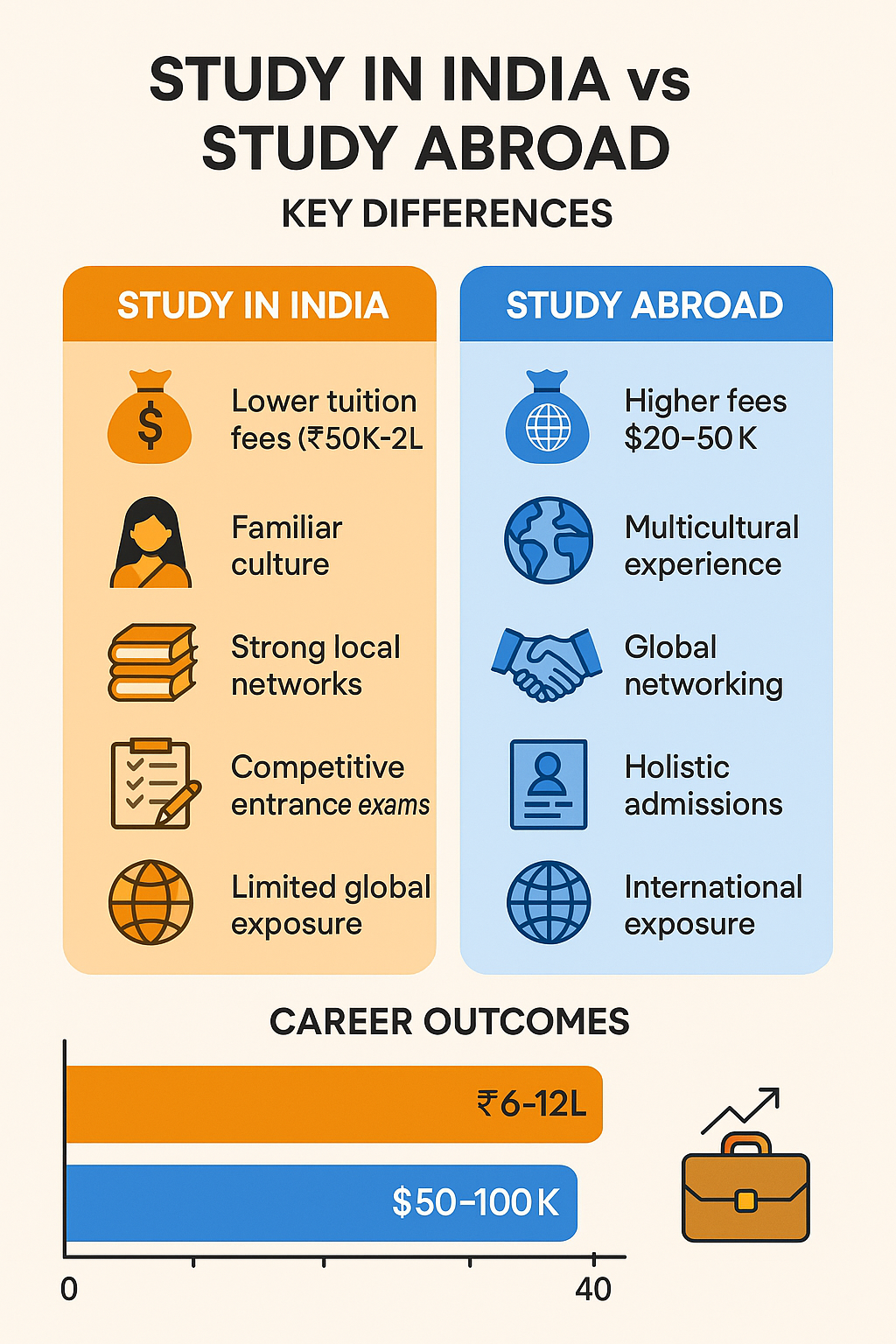
| Annual Tuition Fees | ₹50,000 – ₹2 lakhs | $20,000 – $50,000 |
| Living Expenses | ₹60,000 – ₹1.5 lakhs | $10,000 – $24,000 |
| Average Starting Salary | ₹3-8 lakhs p.a. | $50,000 – $80,000 |
| ROI Timeline | 2-3 years | 4-6 years |
| Global Job Access | Limited | Extensive |
These numbers, however, only scratch the surface. The real story lies in understanding how these investments translate into lifetime earnings, career satisfaction, and personal growth.

Rishita Dodiya
“I was confused between IIM and studying abroad. Gateway International helped me understand that with a 25% scholarship at Nottingham Trent University, my ROI would be better than many Indian B-schools. The international exposure and UK work visa made it a no-brainer!”
Indian Education Landscape in 2025: Strengths and Limitations
India’s higher education system has evolved significantly, with institutions like IITs, IIMs, and NITs commanding global respect. Yet, the system faces fundamental challenges that affect student outcomes.
Strengths of Indian Education:
- Cost-Effectiveness: Even premium institutions cost a fraction of international alternatives
- Strong Theoretical Foundation: Indian curriculum emphasizes deep conceptual understanding
- Competitive Environment: Prepares students for high-pressure situations
- Local Industry Connect: Strong campus placement systems in top institutions
- Cultural Familiarity: No adjustment period or homesickness
Critical Limitations:
- Limited Seats: Only 10,000 seats in IITs for 1.5 million aspirants
- Outdated Pedagogy: Many institutions still follow rote learning methods
- Research Opportunities: Limited funding and infrastructure for cutting-edge research
- Global Exposure: Minimal international collaboration and exchange programs
- Industry-Academia Gap: Curriculum often lags behind industry requirements
“The biggest challenge isn’t getting into a good Indian institution – it’s what happens after. While my IIT friends were competing for the same McKinsey roles, my batch mates from US universities had options across Silicon Valley, Wall Street, and beyond.” – Akshit Virdi, Gateway International Alumni
International Education Revolution: Beyond Traditional Boundaries
The landscape of international education in 2025 is radically different from even five years ago. AI-powered learning, interdisciplinary programs, and practical skill development have become the norm rather than the exception.
Game-Changing Advantages:
- AI-Integrated Learning: Universities in US, UK, and Singapore lead with AI-powered personalized education
- Flexibility: Choose majors, minors, and even design your own curriculum
- Research Funding: Access to multi-million dollar research grants and state-of-the-art labs
- Global Network: Classmates from 50+ countries create lifelong professional connections
- Work Opportunities: Part-time work rights help offset costs and gain experience
The New Reality of 2025:
Traditional destinations like USA, UK, Canada, and Australia are facing headwinds. Tightening immigration policies, rising costs, and reduced post-study work opportunities are pushing students to explore alternatives. This shift has opened doors to exciting new possibilities.
Career Outcomes Comparison: The Long-Term View
When evaluating education options, look beyond the first job. Consider the 10-year career trajectory, growth potential, and quality of life factors that truly matter.
Indian Graduate Career Path:
- Year 1-3: ₹3-8 LPA in entry-level roles
- Year 4-7: ₹10-20 LPA in mid-management
- Year 8-10: ₹25-40 LPA in senior positions
- Ceiling Effect: Limited global mobility without international exposure
International Graduate Career Path:
- Year 1-3: $50-80K in global corporations
- Year 4-7: $100-150K with international mobility
- Year 8-10: $200K+ in leadership roles
- Multiplier Effect: Access to global opportunities and faster growth

Rahul Jain
“Five years after graduating from University of Manchester, I’m earning 4x what my batchmates from Indian colleges make. But more importantly, I’ve worked in London, Singapore, and now leading a team in Dubai. The global exposure is priceless.”
The Financial Reality Check: True Cost vs True Value
Let’s address the elephant in the room – money. Yes, international education requires significant investment, but let’s look at the complete financial picture.
Hidden Costs of Indian Education:
- Coaching classes: ₹2-5 lakhs for entrance prep
- Multiple attempt costs if unsuccessful
- Opportunity cost of gap years
- Limited scholarship options
- Need for additional certifications/courses
Financial Advantages Abroad:
- Scholarships: 40-60% of students receive some funding
- Part-time work: Earn $15-25/hour, covering living expenses
- Co-op programs: Paid internships integrated into curriculum
- Tax benefits: Education loans offer tax deductions
- Currency advantage: Earn in stronger currencies
Gateway International Insight: Our scholarship database has helped students secure over ₹500 crores in funding. Universities like Kings College London offer up to £10,000 specifically for Indian students!
Common Challenges Students Face: Addressing Your Real Concerns
Based on counseling over 50,000 students, we understand the pain points that keep you awake at night. Let’s address them head-on.
1. Visa and Immigration Complexities
The visa process can seem daunting, but with proper guidance, success rates exceed 95%. Countries like Canada and Australia have streamlined their processes specifically for Indian students. The key is understanding documentation requirements and presenting a compelling case.
2. Cultural Adaptation Fears
Moving from Mumbai to Melbourne or Delhi to Dublin involves cultural adjustment. However, universities now offer:
- Pre-departure orientation programs
- Indian student associations on campus
- Mentorship from senior Indian students
- Cultural integration workshops
3. Return on Investment Anxiety
Parents worry: “What if my child doesn’t get a job abroad?” Here’s the reality – international graduates have multiple safety nets:
- Post-study work visas (1-3 years depending on country)
- Global degree recognition for Indian jobs
- Premium salaries in Indian MNCs for international graduates
- Entrepreneurship opportunities with global perspective
4. Financial Burden on Family
Education loans up to ₹1.5 crores are now available at competitive rates. More importantly, the loan EMI typically equals 20-30% of post-graduation salary abroad, making repayment manageable.

Calculate Your Education ROI
Get a personalized analysis comparing your career outcomes for Indian vs International education. Our experts will help you make an informed decision!
Get Free ROI AnalysisInteractive Career Path Quiz
India vs Abroad: Find Your Ideal Education Path
Answer 4 quick questions to discover whether studying in India or abroad aligns better with your career goals, budget, and aspirations. Get personalized recommendations based on your profile!
Question 1 of 4
What’s your primary career aspiration after graduation?
Global Exposure vs Local Networks: What Really Matters?
One of the most underestimated advantages of international education is the transformation it brings to your worldview and professional capabilities.
The International Advantage:
- Diverse Perspectives: Collaborate with students from 50+ nationalities
- Communication Skills: Master cross-cultural communication
- Adaptability: Thrive in any environment globally
- Innovation Mindset: Exposure to different problem-solving approaches
- Global Best Practices: Learn from world-leading faculty and systems
The Indian Network Strength:
- Alumni Bonds: Lifelong connections from competitive programs
- Local Industry Connect: Direct access to Indian business leaders
- Cultural Capital: Deep understanding of Indian market dynamics
- Family Business: Easier integration into existing enterprises
Hidden Advantages of International Education
Beyond the obvious benefits, international education offers several “brownie points” that significantly impact your personal and professional growth:
1. Part-Time Work Culture
Unlike India, where students focus solely on academics, countries like Canada, Australia, and UK allow 20 hours/week of part-time work. This means:
- Earn $15-25/hour (₹900-1500/hour)
- Cover 50-70% of living expenses
- Gain professional experience while studying
- Build local networks and references
2. Post-Study Work Rights
| Country | Post-Study Work Visa | Path to PR |
|---|---|---|
| Canada | 1-3 years | Clear pathway |
| Australia | 2-4 years | Points system |
| UK | 2 years | Skilled worker route |
| Germany | 18 months | EU Blue Card |
| USA | 1-3 years (OPT) | H1B lottery |
3. Diverse Career Paths
International education opens doors to careers rarely accessible from India:
- International Development Organizations (UN, World Bank)
- Global Consulting (McKinsey, BCG across offices)
- Cross-border Entrepreneurship
- International NGOs and Think Tanks
- Diplomatic Services and Foreign Relations
Shraddha Cheeta
“I never imagined I’d be working at UNESCO Paris after my Masters from France. The internship opportunities during my studies opened doors I didn’t even know existed. Gateway International’s guidance on choosing France over traditional destinations was life-changing!”
4. Personal Development Benefits
- Independence: Managing life in a new country builds resilience
- Global Mindset: Think beyond geographical boundaries
- Language Skills: Many become fluent in 2-3 languages
- Confidence: Present to diverse audiences without hesitation
- Problem-Solving: Navigate complex systems independently
Emerging Study Destinations in 2025: Beyond the Big 4
The shift away from traditional destinations has revealed exciting alternatives offering better value, clearer immigration paths, and unique advantages.
Germany: The Engineering Paradise
- Public universities: €0-1500/year tuition
- 18-month job search visa post-graduation
- No German required for many programs
- Strong industry partnerships with BMW, Siemens, SAP
France: Beyond Fashion and Wine
- €170-600/year at public universities
- Top-ranked business schools (INSEAD, HEC)
- 2-year post-study work visa
- Gateway to European job market
Ireland: The New Tech Hub
- European headquarters of Google, Facebook, Apple
- 2-year stay-back option
- English-speaking with EU access
- Growing Indian community
Dubai: The Rising Star
- No income tax on salaries
- 3-hour flight from India
- Growing education hub with international campuses
- Excellent placement opportunities
Download : The Complete Career ROI Calculator That Reveals Your True Earning Potential in 15 Minutes
Blue Points: Influencing Factors Often Overlooked
Several subtle factors significantly influence study abroad decisions but rarely get discussed openly:
1. Social Media Reality
Seeing peers’ Instagram stories from Times Square or Eiffel Tower creates powerful aspirations. While this shouldn’t be the primary driver, the desire for global experiences is valid and transformative when channeled correctly.
2. Marriage Market Dynamics
Let’s address it honestly – an international degree often enhances matrimonial prospects. Both male and female students find expanded options within the global Indian diaspora.
3. Escape from Societal Pressure
For many, studying abroad offers:
- Freedom from constant family comparisons
- Space to explore identity and interests
- Break from Indian academic rat race
- Opportunity to reinvent oneself
4. The Second Chance Phenomenon
Didn’t crack IIT/IIM? International education offers a reset button. Top global universities evaluate holistically, considering:
- Work experience
- Extra-curricular achievements
- Leadership potential
- Personal story and motivation
Real Talk: One of our students with 65% in engineering got into University of Toronto for Masters. Today, he leads AI research at a Fortune 500 company. Your past doesn’t define your future!
Free SOP Generator Tool
Struggling with your Statement of Purpose? Use our AI-powered SOP generator to create compelling applications that get noticed by admission committees!
Generate Your SOP NowLatest News & Updates
Latest International Education Updates – January 2025
Times of India [Link]: 1.8 million Indian students now studying abroad, marking a 38% increase from 2023. Germany and France see highest growth rates as students look beyond traditional Big 4 destinations.
NDTV Education [Link]: Canada announces stricter student visa caps for 2025, reducing international student intake by 35%. Students increasingly considering Ireland and Netherlands as alternatives.
BBC [Link]: UK maintains Graduate Route visa despite political pressure, confirming 2-year post-study work rights will continue through 2025.
Economic Times [Link]: Indian students exploring ‘beyond Big 4’ destinations save average ₹15-20 lakhs while gaining similar career outcomes, new study reveals.
QS Rankings [Link]: 2025 rankings show Asian universities rising, with 5 Indian institutions in global top 200. However, research output and international faculty ratios remain areas of concern.
Making the Decision: A Framework for Success
After counseling thousands of students, we’ve developed a decision framework that considers all crucial factors:
Step 1: Define Your Non-Negotiables
- Career goals: Local vs global aspirations
- Financial constraints: Real budget including hidden costs
- Family considerations: Support system needs
- Risk appetite: Comfort with uncertainty
Step 2: Evaluate Return on Investment
Consider both financial and non-financial returns:
- Financial ROI: Salary differentials, loan repayment timeline
- Career ROI: Growth trajectory, global opportunities
- Personal ROI: Life experiences, network quality
- Social ROI: Status, marriage prospects, lifestyle
Step 3: Address Your Fears
Common fears and their solutions:
- “What if I don’t get a job?” – Choose countries with clear post-study work rights
- “What if I get homesick?” – Select destinations with strong Indian communities
- “What if I can’t repay loans?” – Target programs with high placement rates
- “What if visa gets rejected?” – Work with experienced counselors (95%+ success rate)
Conclusion: Your Future, Your Choice
The debate between studying in India versus abroad isn’t about which is universally better – it’s about which aligns with YOUR unique aspirations, circumstances, and vision for the future.
If you’re someone who:
- Dreams of working in Silicon Valley or Wall Street
- Wants to experience diverse cultures firsthand
- Seeks cutting-edge research opportunities
- Aspires to build a global career
Then international education offers unmatched advantages despite the higher investment.
However, if you:
- Have strong local business connections
- Plan to join family enterprises
- Prefer staying close to family
- Are confident about top Indian entrance exams
Then India’s top institutions can provide excellent outcomes at fractional costs.
Remember: There’s no shame in choosing either path. What matters is making an informed decision aligned with your authentic goals, not societal pressure or peer comparisons.
The world is changing rapidly. The rigid boundaries between “Indian” and “international” careers are blurring. Today’s Indian startups hire globally, while international firms have massive Indian operations. Choose based on where you want to be in 10 years, not just the next 2.
Whatever you decide, approach it with confidence, preparation, and realistic expectations. Your education is an investment in yourself – make it count!
Ready to Make Your Decision?
Get personalized guidance from India’s most trusted education consultants. With 50,000+ success stories, we’ll help you choose the path that truly aligns with your dreams.
Book Your Free ConsultationAbout the Author
Abhinav Jain
Founder & Director, Gateway International | IIT Delhi Alumni
With over 17 years of experience in international education consulting, Abhinav Jain has guided more than 50,000 students to their dream universities across 30+ countries. An IIT Delhi alumnus himself, he understands the Indian education system’s strengths and limitations intimately. His data-driven approach and personal mentorship have resulted in a 95%+ visa success rate and millions in scholarships for students. When not counseling students, he writes extensively about global education trends and career strategies.
Frequently Asked Questions
Studying in India typically costs ₹50,000-₹2 lakhs per year for top institutions, while studying abroad can range from $20,000-$50,000 annually including tuition and living expenses. However, international education often offers better scholarship opportunities and potential for higher salaries post-graduation, which can offset the initial investment.
International degrees generally provide broader career opportunities with access to global job markets and starting salaries 2-3x higher than Indian counterparts. However, top Indian institutions like IITs and IIMs also offer excellent placements. The choice depends on your career goals, target industry, and whether you plan to work globally or in India.
Indian education typically offers ROI within 2-3 years due to lower costs, while international education may take 4-6 years but often results in 3-5x higher lifetime earnings. Countries like Germany and France with low/no tuition fees can offer ROI comparable to Indian education with the added benefit of international exposure.
Emerging destinations offer significant advantages including lower costs, clearer immigration pathways, and growing job markets. Germany offers free education at public universities, France has affordable tuition, while countries like Ireland and Netherlands provide excellent post-study work opportunities. Traditional destinations still lead in university rankings but come with higher costs and tighter immigration policies.
Gateway International provides personalized career assessments, ROI calculations, and comprehensive comparisons of Indian vs international education options. With partnerships across 300+ universities worldwide and expertise in visa processes, we help students make informed decisions based on their academic profile, budget, and career goals. Our free consultations include detailed cost-benefit analysis and scholarship guidance.