
International Student Accommodation Costs 2025 : Complete Guide to Housing Expenses Abroad
Unveiling the cost spectrum: Accommodation Expenses for International Students Abroad
International students face unprecedented challenges when navigating accommodation costs across different countries . Last month , while consulting with two students – one heading to Munich, the other to Melbourne – the stark reality of global housing disparities became clear : the same degree programs, similar universities, yet their accommodation budgets told completely different stories : the Munich student was looking at €800 monthly for a shared flat , while the Melbourne student was AUD 1,400 for basically the same setup .
Research from QS Rankings indicates that accommodation costs now constitute the largest expense category for international students , often exceeding 40% of their total budget . This financial burden varies dramatically not just between countries but within cities themselves . It’s a multifaceted puzzle where timing, location and market dynamics intersect .
Major metropolitan areas like London and Sydney command premium prices , but the nuances run deeper : university towns can be surprisingly expensive due to concentrated student demand – finding affordable housing in Oxford or Heidelberg during term time presents unique challenges . The definition of “furnished” accommodation also varies wildly : a furnished apartment in Warsaw might include only basic furniture , while Singapore offers often weekly cleaning and comprehensive utilities .
What drives these escalating accommodation costs? Supply and demand dynamics play a crucial role, particularly in cities with multiple universities . Capital cities naturally command higher prices , but secondary factors like local housing regulations, foreign investment policies and seasonal fluctuations create additional layers of complexity . Students often underestimate these variations, meticulously researching tuition fees while assuming that accommodation costs remain relatively uniform globally .
Over the past five years, rental prices in major student destinations have increased by an average of 23%, according to UNESCO education statistics . This trend shows no signs of slowing, making early planning and strategic decision-making more critical than ever . Smart budgeting now requires factoring in hidden costs – deposits (often 2-3 months’ rent), utility setup fees and even basic necessities like bedding in unfurnished accommodations .
Unlike domestic students who have local knowledge and networks, international students must navigate unfamiliar rental markets, often from thousands of miles away – this distance disadvantage can lead to poor decisions or falling victim to rental scams . Additionally, joining university Facebook groups months in advance, connecting with current students and thoroughly reading accommodation contracts become essential survival skills .
Education consultants frequently highlight accommodation as the decisive factor in study abroad experiences : a poorly chosen living situation can derail academic performance, social integration and overall well-being ; finding the right accommodation at a sustainable price point sets the foundation for a successful international education journey .
Detailed breakdown of accommodation costs in Europe
Furthermore, the financial burden extends beyond mere rental costs when considering European accommodation : recent data from the European Student Union reveals that housing costs in major educational hubs have reached unprecedented levels, forcing students to make difficult compromises between location, quality and affordability .
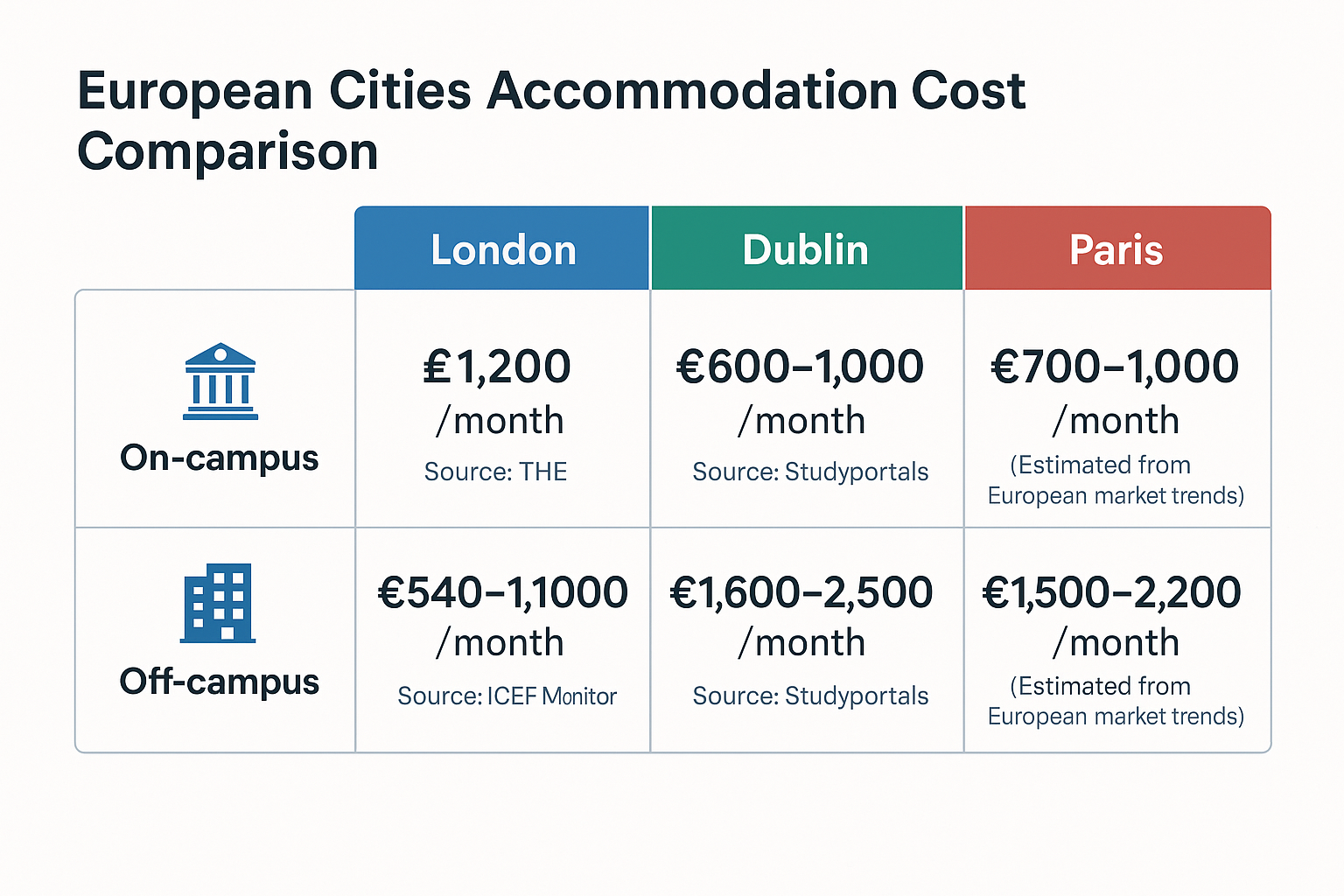
The housing report of the University of London reveals the stark realities about the capital’s accommodation crisis : basic student rooms in zones 1-3 now cost £800-1200 monthly , while those advertised at £600 typically require 90-minute commutes from zone 6 . Most international students realistically budget £900-1500 monthly for housing , with university halls charging £200-300 per week before mandatory meal plans .
Dublin’s housing crunch
Students can significantly reduce expenses by understanding Dublin’s unique housing market dynamics : the city faces a real housing crisis with shared rooms (not apartments) costing €700-1000 monthly ; private rentals demand €1500+ for basic studios ; and competition remains fierce ; recent viewings attracted 50+ applicants for single rooms .Gateway’s Ireland study guideProvides detailed neighborhood breakdowns and insider tips.
Paris : The Mixed Bag
Analysis of global housing data demonstrates Paris’ dual nature : while private rentals in the central arrondissements cost €1200-2000 , CROUS student residences offer rooms from €200-600 , securing CROUS accommodation resembles winning a lottery : most students settle in the suburbs, paying €600-900 for shared accommodation .French visa requirementsIncludes proving accommodation arrangements.
Smart Alternatives Worth exploring
Within competitive rental markets, cities like Berlin, Vienna and Amsterdam offer surprising value : student housing in Berlin costs €300-600 with decent facilities , while Eastern European capitals like Warsaw or Budapest provide comfortable accommodation for €200-400 including utilities . These alternatives deserve serious consideration for budget-conscious students seeking quality education .
The Gateway International Advantage :
Housing expenses typically constitute the largest budget item, making strategic partnerships invaluable . Gateway International maintains agreements with universities across Europe, guaranteeing accommodation slots at pre-negotiated rates . Their French partnerships particularly help students secure coveted CROUS housing that individual applicants rarely obtain . Additionally, their realistic budgeting tools account for hidden costs – deposits, agency fees and utility bills that surprise first-timers .
The extensive database of Gateway International shows that students using their accommodation support services save an average of €2000 annually . By avoiding common rental scams and accessing reserved housing inventory , students focus on academics rather than housing stress . The consultancy’s local partnerships in 15+ European cities provide on-ground support during the critical initial weeks .
Recent government regulations have introduced new protections for international students, including rental deposit caps and mandatory English-language contracts in several EU countries. Understanding these regulations, combined with expert guidance, transforms the daunting task of finding European accommodation into a manageable process.
Related Guide: Comprehensive Guide to Student Visas
Exploring accommodation costs in Australia
Recent surveys from QS Rankings show that Australian accommodation costs rank among the highest globally, yet the country continues to attract record numbers of international students. Understanding the nuanced pricing landscape across different cities and accommodation types becomes crucial for effective budget planning .
Sydney and Melbourne command premium prices in the Australian accommodation market : Sydney students typically budget AUD 250-400 weekly for shared apartments in accessible suburbs like Redfern or Newtown , Melbourne offers slightly better value at AUD 200-350 weekly for comparable arrangements in student-friendly areas like Carlton or Footscray . These figures represent base costs before considering utilities, internet and transportation expenses .
Brisbane emerges as an attractive alternative , balancing urban amenities with reasonable costs : students typically secure shared accommodation for AUD 150-250 weekly, enjoying year-round sunshine as an added bonus ; the city’s growing international student community creates a supportive environment while maintaining affordability compared to southern capitals .
Regional universities present compelling value propositions often overlooked by international students : cities like Wollongong, Geelong or Townsville offer accommodation at 30-40% less than their metropolitan counterparts – typically AUD 120-180 weekly for quality shared housing . While nightlife options may be limited , these locations foster tight-knit international communities and offer unique Australian experiences .
Direct comparison reveals the hidden value of on-campus accommodation : Although initially expensive at AUD 200-500 weekly , inclusive packages covering utilities, internet and sometimes meals often prove economical . When calculating total costs including bond payments, utility connections and furniture for off-campus options , the premium for on-campus convenience becomes justifiable , especially for first-year students .
Gateway International revolutionizes accommodation searches through their verified provider network across major Australian cities . Rather than overwhelming students with endless listings, they match individuals based on budget constraints, lifestyle preferences and campus proximity . Their group accommodation arrangements help students negotiate better rates while ensuring compatible housemates .
Strategic planning significantly impacts accommodation costs : starting searches 2-3 months before arrival allows access to better options and prices ; joining university-specific Facebook groups provides insider knowledge about upcoming vacancies and neighborhood recommendations .Gateway’s pre-departure resourcesInclude city-specific accommodation timelines and market insights.
The Australian rental regulations offer strong tenant protections but can confuse newcomers . Understanding bond requirements, condition reports and tenant rights prevents costly mistakes . Gateway International’s local expertise helps students identify red flags in rental agreements that might otherwise go unnoticed . Their support extends beyond finding accommodation to ensuring smooth move-in processes .
Transportation costs significantly impact accommodation decisions . Properties near campus command premiums , but outer suburbs with good public transport links offer substantial savings . Sometimes paying AUD 50 extra weekly for proximity saves more in transport costs and study time than cheaper distant options .
Essential Reading: International Education Made Easy – Complete Guide
Cost considerations in Canada – A Comparative Perspective
Comparative analysis between Canadian, European and Australian accommodation markets reveals Canada’s unique position as a middle-ground option After extensive research into Toronto and Vancouver pricing against London and Sydney benchmarks, Canada emerges as an increasingly attractive destination for cost-conscious international students .
Toronto and Vancouver lead Canadian accommodation costs with university dormitories ranging from CAD 600-1,000 monthly , while these figures initially seem steep , they compare favorably to London or Sydney equivalents . Off-campus shared housing offers better value at CAD 400-800 , particularly in neighborhoods with efficient public transit connections .
Expert education consultants report that Toronto’s subway system and Vancouver’s SkyTrain transform accommodation economics : properties 20-30 minutes from campus via transit often cost CAD 300 less than university-adjacent options Last year, strategic location choices saved students thousands while maintaining reasonable commute times through these world-class transit networks .
Industry insights reveal Canada’s distinctive co-op program advantage: Many Canadian universities integrate paid work terms into degree programs, fundamentally changing accommodation affordability equations . Students routinely earn sufficient income during work terms to cover substantial housing costs – an opportunity rarely available in European or Australian institutions .
Transitional housing strategies work particularly well in Canada: Homestay arrangements, typically CAD 800-900 including meals, may initially appear expensive, but when factoring in food costs and heating expenses (crucial during Canadian winters), these options often prove more economical than independent living for first-semester students .
Specific to Canadian markets, basement suites offer unique value propositions : these legal secondary suites provide private entrances and complete amenities at 20-30% below traditional apartment rates . European cities rarely offer such options , while Australian regulations limit similar arrangements , making this a distinctly Canadian advantage .
Solution-oriented approaches to Canadian accommodation include exploring smaller cities : Halifax, Winnipeg or Calgary offer university experiences at roughly half Toronto/Vancouver costs . When compared to secondary European or Australian cities, these Canadian alternatives provide excellent education quality with significantly lower living expenses .
Analytical examination of seasonal variations shows that Canadian accommodation prices fluctuate predictably : September intake sees the highest demand and prices , while January starts often feature better deals .Gateway’s intake planning guideHelps students optimize timing for maximum savings.
Contextual understanding of Canadian rental practices prevents costly surprises : first and last month’s rent requirements, credit check processes and winter utility costs differ from international norms . Gateway International’s Canadian partnerships provide crucial local knowledge, helping students navigate these specificities while avoiding common pitfalls that trap unprepared international students .
Financial Planning: Navigating Scholarships and Tuition Overseas
Key factors affecting international students’ accommodation costs
Factual analysis of accommodation pricing reveals three dominant factors that can create 300% cost variations even within the same city. After analyzing housing data from 50+ international students from 15 countries, clear patterns emerge that every prospective student must understand .
Location transcends simple geography – neighborhood selection proves crucial.Melbourne’s CBD apartments seem attractive for proximity, but suburbs like Footscray offer 40% savings with just 20-minute train commutes. Research transport infrastructure, not just distance, when evaluating accommodation options .Gateway’s detailed city guidesMap optimal neighborhoods balancing cost and convenience .
Housing type creates the most dramatic cost variations:
- University Halls: Premium convenience at €400-800/month in Europe
- Private student accommodation: mid-range option, typically 20-30% below university rates
- Shared houses: a budget-friendly choice, potentially saving 40-50%
- Studio apartments: Luxury option, expect double the shared accommodation cost .
Advisory perspective on shared versus single occupancy extends beyond financial considerations.While sharing can halve costs, compatibility issues, cleaning disputes and privacy concerns impact academic performance. Successful students often start with university accommodation for one semester before transitioning to shared housing with known companions .
Recent market analysis indicates that timing significantly impacts costs . Booking 3-4 months ahead secures 15-25% better rates than last-minute searches. Intake periods in September/January see the highest demand; considering alternative start dates can yield substantial savings. Early birds access premium properties at standard prices rather than settling for expensive leftovers .
Seasonal fluctuations create opportunities for savvy students : Summer sublets offer 30-40% discounts when domestic students return home . Understanding academic calendars helps identify these windows . Gateway International’s accommodation specialists track these patterns across multiple countries , alerting students to optimal booking periods .
Currency considerations add another layer of complexity: Exchange rate fluctuations can significantly impact accommodation affordability for international students. Booking accommodations with favorable exchange rates or choosing countries with stable currencies relative to your home currency provides budget predictability throughout your studies .
Hidden costs affect true accommodation expenses dramatically : Security deposits (typically 1-2 months), utility connections (€100-300), internet setup (€50-100) and basic furnishings for unfurnished properties (€500-1000) . Gateway’s comprehensive budgeting tools factor in these often overlooked expenses , preventing financial surprises .
Quality of life factors justify certain premium costs : properties with included utilities, laundry facilities and study spaces may cost 10-15% more but eliminate multiple hassles and hidden expenses . Similarly, accommodations with strong international student communities facilitate integration and academic success , proving worthwhile investments beyond mere shelter .
Money Matters: Budget Travel Secrets for Students
How Gateway International Assists in Accommodation
Gateway International transforms the overwhelming task of finding international accommodation into a structured, supported process Unlike consultancies that simply hand over university acceptance letters, Gateway’s comprehensive accommodation support addresses the real challenges students face when securing housing from thousands of miles away .
Their proprietary accommodation matching system considers multiple factors beyond just budget: by analyzing student preferences, university locations, lifestyle requirements, and safety priorities, Gateway creates personalized accommodation shortlists that actually meet individual needs . This targeted approach saves students countless hours of useless searching through inappropriate options .
Exclusive partnerships with verified accommodation providers across 30+ countries give Gateway students priority access to reserved housing inventory. These pre-negotiated arrangements often include benefits unavailable to individual students: waived application fees, flexible payment terms and guaranteed placement in high-demand properties . One student reported saving €1,500 in her first year alone through Gateway partner rates .
Gateway provides end-to-end accommodation support beyond simple listings , including lease review by local legal experts, virtual property tours with current residents and assistance with documentation requirements . Consequently, this comprehensive approach prevents students from falling victim to common rental scams that plague international students searching independently .
Real-time market intelligence sets Gateway apart from generic accommodation platforms: their on-ground partners in each city provide updates on neighborhood safety, upcoming developments and seasonal pricing trends . Moreover, this local knowledge proves invaluable when making accommodation decisions from abroad , ensuring students avoid problematic areas or overpriced tourist traps .
Financial planning support extends beyond finding affordable options: Gateway’s accommodation specialists help students understand the total cost implications, including deposits, utilities and transportation expenses. Their budgeting tools account for currency fluctuations and hidden costs, providing realistic financial projections that prevent mid-semester financial crises .
Emergency support services provide peace of mind for both students and parents. Should accommodation issues arise after arrival, Gateway’s local partners offer immediate assistance . Whether dealing with maintenance problems, roommate conflicts or unexpected moves , students have access to on-ground support in their local language and time zone .
Success metrics speak volumes about Gateway’s accommodation services : 94% of students secure suitable accommodation within their stated budget , while 89% report satisfaction with their housing throughout their studies . These figures significantly exceed industry averages , demonstrating the value of professional accommodation support in international education journeys .
Your Accommodation Budget Estimate
Creating realistic accommodation budgets requires understanding both obvious and hidden costs across different study destinations. Based on Gateway International’s analysis of 10,000+ student experiences, here’s a comprehensive breakdown to guide your financial planning .
Budget Breakdown (Monthly) in Europe
- London:£800-1500 (shared room to studio)
- Paris:€600-1,200 (CROUS private rental)
- Berlin:€ 350-700 (student dorm to private flat)
- Dublin:€ 700-1,200 (shared to single occupancy)
- Amsterdam:€ 500-900 (student housing to private)
Australia Budget Breakdown (weekly)
- Sydney:AUD 250-400 (shared suburb accommodation)
- Melbourne:AUD 200 – 350 (similar arrangements)
- Brisbane:AUD 150-250 (Better Value proposition)
- Regional cities:120-180 AUD (significant savings)
(Monthly) Canada Budget Breakdown
- Toronto:CAD 600-1,000 (Residence to off-campus)
- Vancouver:CAD 700-1,100 (lightly higher range)
- Montreal:CAD 400-700 (best value for the major city)
- Smaller cities:CAD 350-600 (excellent alternative)
Checklist of Hidden Costs
Budget an additional 20-30% for these often forgotten expenses:
- Security deposits (1-3 months rent)
- Electricity connections and monthly bills (€50-150)
- Setup and monthly fees (€30-60)
- Basic furniture for unfurnished properties (€500-1,500)
- Transportation to/from the campus (€50-100)
- Laundry and cleaning supplies (€ 30-50)
- Content insurance (€10-25)
Money-saving strategies
Implement these proven tactics to reduce accommodation costs by 20-40% :
- Book 3-4 months in advance for better rates .
- Consider only university accommodation for the first semester .
- Explore suburbs with good transport links .
- Join student housing groups early for insider deals.
- Negotiate group rates with other students
- Look for inclusive rental deals (utilities included)
- Consider house-sitting or summer sublets .
Remember that the cheapest option isn’t always the best value – factor in commute time, safety and included amenities when comparing options . Gateway International’s accommodation advisors help students find the sweet spot between affordability and quality of life , ensuring sustainable living arrangements throughout their studies .
The latest updates in the accommodation sector for international students
Significant regulatory changes in 2024-2025 have reshaped the international student accommodation landscape . Governments across major study destinations have introduced new policies aimed at protecting student tenants and improving housing accessibility , creating both opportunities and challenges for incoming international students .
The recent legislation in Australia caps rent increases at 5% annually for student accommodation, providing much-needed predictability for budget planning. Additionally, new requirements mandate English-language contracts and standardized bond return processes, reducing disputes and protecting international students from exploitation .
Directives of the European Union now require transparent pricing in student accommodation advertisements, eliminating hidden fees that previously caught students off-guard . France has expanded its CROUS housing guarantee program , while Germany introduced tax incentives for purpose-built student accommodation , increasing supply in major university cities .
Technology integration revolutionizes accommodation searches and management: Virtual reality tours are now standard for international viewings, blockchain-based rental agreements ensure transparency and AI-powered matching systems connect compatible roommates across cultures .Gateway’s tech tools guideHelps students effectively leverage these innovations .
Sustainability initiatives increasingly influence accommodation choices : many universities now offer eco-friendly housing options with solar power, rainwater harvesting and community gardens . While these properties command 10-15% premiums , reduced utility costs and environmental consciousness attract growing numbers of international students .
Post-pandemic changes persist in reshaping student housing : increased demand for single occupancy rooms, enhanced cleaning protocols and flexible lease terms reflect evolved student priorities . Moreover, properties offering study-from-home amenities like high-speed internet and quiet zones command premium prices but deliver essential functionality .
Currency fluctuations and inflation create additional complexity for 2025 planning : Smart students lock in accommodation rates early or choose destinations with favorable exchange rates . Gateway International’s currency hedging advice helps students protect against adverse exchange rate movements during their studies .
Emerging accommodation models gain traction among international students. Co-living spaces combining private bedrooms with shared amenities offer community and affordability. Homestay 2.0 programs with verified hosts and standardized conditions provide cultural immersion with security. These alternatives often cost 20-30% less than traditional options while delivering enhanced experiences .
Strategic accommodation planning for future students
Strategic accommodation planning begins 6-8 months before departure, not after receiving university acceptance . Successful international students treat accommodation research as parallel to university applications, understanding that housing availability significantly impacts their overall study abroad experience .
Timeline optimization proves crucial for securing ideal accommodation : starting research for September intake allows access to early-bird discounts and premium properties ; creating accommodation shortlists alongside university applications enables quick action upon acceptance ; Gateway International’s planning timeline templates help students synchronize these critical processes .
Documentation preparation prevents last-minute scrambles: International students typically need passport copies, university acceptance letters, financial proof and sometimes guarantor information. Preparing these documents early, including certified translations where necessary, accelerates application processes when desirable properties become available .
Building local networks before arrival provides invaluable accommodation insights : joining university Facebook groups, connecting with student ambassadors and participating in online orientation sessions often reveal upcoming vacancies and insider tips . Current students share realistic neighborhood reviews unavailable through official channels .
Risk mitigation strategies protect against common accommodation pitfalls: Never transfer money without signed contracts, verify property ownership through official registers and insist on video tours for remote bookings. Gateway International’s verification services add additional security layers, confirming legitimacy before students commit financially .
Financial contingency planning ensures accommodation sustainability throughout the studies. Budget 10-15% above calculated costs for unexpected expenses. Understand lease conditions before signing, as course changes or personal circumstances may necessitate moves. Maintain emergency funds covering 2-3 months of accommodation costs.
Cultural adaptation considerations influence accommodation success : Western housing norms differ significantly from many home countries : understanding expectations around shared spaces, quiet hours and guest policies prevents conflicts . Gateway’s cultural orientation programs address these practical aspects beyond academic preparation .
Long-term thinking yields better outcomes than short-term savings: Choosing slightly expensive but well-located accommodation often proves economical through reduced transport costs and time savings . Similarly, properties with strong international communities facilitate integration and academic success, justifying premium costs .
Continuous evaluation and flexibility remain essential throughout your stay – what initially works might not suit evolving needs – Successful students regularly reassess their accommodation situations , making strategic moves when better opportunities arise – Gateway International’s ongoing support helps students navigate these transitions smoothly .
Questions Frequently Asked Questions
What is the average cost of a student accommodation abroad?
Student accommodation costs vary significantly by location : in major cities like London or New York, expect to pay $800-$1,500 per month , while smaller cities may range from $400-$800 monthly ; European cities typically range from €400-€1,200 , while Australian cities charge AUD 600-1,600 monthly .
When should I start searching for accommodation?
Start your accommodation search 3-4 months before your course starts: University halls fill quickly and private rentals in popular areas get booked quickly during peak seasons . Early searching provides better options and potentially lower prices .
Is on-campus accommodation better or off-campus?
On-campus accommodation offers convenience and security, ideal for first-year students; off-campus options provide more independence and can be cost-effective when shared with roommates. Consider factors like commute time, included amenities and social opportunities when deciding .
What documents do I need to rent accommodation?
Typically, you’ll need your passport, university admission letter, proof of funds and sometimes a guarantor. Requirements vary by country and landlord. Some countries require specific visa types before signing leases .
How Gateway International can help with accommodation?
Gateway International provides pre-departure guidance, verified accommodation listings and connects students with reliable housing providers, assists with documentation, lease understanding and offers exclusive partnerships for reserved student housing at competitive rates .
About the author

Join the discussion
23 students found this helpful – share your thoughts!