Unlocking Global Opportunities: Where to Study Abroad in 2025
Unlocking Global Opportunities: Where to Study Abroad in 2025
2025 is weird. Just yesterday, a parent called me asking if Canada’s still safe for students. Last week, Germany opened 5 new visa centers in India. Universities are changing rules faster than my team can update our databases.
Back in 2007, when I started Gateway International, students had maybe 5 countries to choose from. Today? My Excel sheet has 47 countries. Or was it 48? The point is – the game’s completely changed.
What’s keeping parents up at night now isn’t just “Can we afford it?” It’s everything. Safety after those incidents in Australia. Job markets post-COVID. New visa rules every 6 months. I spent 3 AM last Tuesday calming down a father whose daughter got into Toronto but he’d just read about housing costs there.
The landscape—sorry, the situation (I hate that word “landscape”)—is actually more complex but somehow easier too. Complex because every country’s changing policies. The UK wants Indians but changed post-study work rules. Canada’s welcoming but rent’s through the roof. Germany’s practically free but try explaining the blocked account requirement to anxious parents at 11 PM.
Easier because students today have tools we couldn’t dream of. Our Edysor platform processes documents in hours, not weeks. Though when it crashed during peak admission season last year… let’s not talk about that weekend.
₹15,000 for one SOP. That’s what consultants charge now. For one essay. Meanwhile, students are comparing 10 countries, each with different requirements. IELTS for UK, maybe TOEFL for US, nothing for some European universities. It’s chaos.
Here’s what actually matters: students aren’t just looking at rankings anymore. They want safety (especially female students), they want work opportunities, and they need realistic budgets. Not “study in US for ₹10 lakhs” nonsense some consultants promise.
We’ve processed… probably around 50,000 applications since 2007. You know what hasn’t changed? The panic. Every October, same calls. “Sir, deadline tomorrow, documents not ready.” Every time.
The real shift? Students from tier-2 cities. Kid from Indore last month got into three German universities. Didn’t even know Germany had free education until his friend told him. That’s the opportunity now – information reaching everywhere, not just Delhi-Mumbai.
Quality education isn’t just about IITs anymore. These international options? They’re real. They’re accessible. They just need someone to cut through the noise and show students what’s actually possible.
Canada: The Front-Runner for Indian Students
Every October, same story. Students flooding our office, parents calling at midnight, everyone asking about Canada. The numbers tell you why – 137,608 Indian students there right now. That’s not just data, that’s entire communities of Indians making it work.
Back in 2019, we sent maybe 200 students to Canada. Simple process then. Now? The government capped study permits at 505,162 for 2025. First quarter numbers dropped 31% – from 44,295 permits last year to just 30,650. Still, students keep asking about Canada.
The education quality isn’t the issue. University of Toronto, McGill, UBC – these places deliver. What changed is everything else. Housing crisis hit hard. Students paying ₹80,000 monthly for shared apartments in Toronto. Vancouver’s worse. We had three students last month sleeping in their university library because they couldn’t find housing.
Post-graduation work permits still run up to 3 years. That’s solid. Problem is spousal permits got tighter. One student, Arjun from Pune, had to leave his wife behind. They planned everything together, saved for two years. New rules killed that dream.
Actually, forget the negativity for a second. Canada’s still doing something right. The pathway to permanent residency remains clearer than anywhere else. Co-op programs at Waterloo or internships at Concordia – these actually lead somewhere. Unlike UK where you’re racing against visa deadlines.
We partnered with 12 Canadian universities last year. Seneca College alone took 47 of our students. Most are doing well. But the easy days? Gone. That 20-day visa processing CNN mentioned? Only if your documents are perfect. One missing signature, you’re looking at 2 months.
Students still trust Canada though. Safety matters. Parents sleep better knowing their kids can walk around at 2 AM in Montreal. Try that in parts of the US.
The real question isn’t whether Canada’s good. It’s whether you can handle the new reality – tougher visa rules, expensive housing, competitive job market. If yes, it’s still the most sensible choice for Indian students. Just don’t expect the cakewalk everyone got five years ago.
United States: Land of Opportunities or Land of Challenges?
Last month, a student from Pune called me crying. Her F-1 visa got rejected. Third attempt. ₹45,000 down the drain just in visa fees. This is the US education story nobody talks about.
Everyone knows about MIT, Stanford, the whole American dream package. What they don’t tell you? The H-1B lottery has become a nightmare. 70% rejection rate for Indians. I’ve watched brilliant Gateway alumni – IIT toppers, mind you – pack their bags after OPT because their number didn’t come up in the lottery.
The opportunities are real though. Can’t deny that. Just yesterday, Arjun (2019 batch) messaged me. Started at $120,000 at Google straight after his MS from University of Illinois. But here’s what bothers me – for every Arjun, there are 10 kids struggling with $60,000 education loans.
Actually, let me share something that happened in 2018. We had this student, perfect profile for US universities. 339 GRE, 9.2 CGPA. Parents sold their ancestral property in Nashik to fund her education. She’s doing well now, but imagine that pressure. Every semester, watching exchange rates, hoping the rupee doesn’t fall further.
The visa interview process? It’s gotten worse. Students memorize answers like they’re preparing for JEE. “Why this university?” “What are your plans after graduation?” One wrong answer and you’re out. We prep them for weeks now. Mock interviews, document checks, the works.
You know what really gets me? Universities charging $90-150 just for application fees. Apply to 10 universities, that’s ₹1 lakh gone before you even get an admit. Then they wonder why students use agents.
But when it works…
A student from our 2020 batch just started her PhD at CalTech. Full funding. She’s working on cancer research that could actually save lives. These are the moments that keep me going.
The infrastructure, research facilities, industry connections – unmatched. If you can handle the financial stress, visa uncertainties, and being 8,000 miles from home, the US still offers something special. Just don’t go in blind. We’ve started telling students – have a Plan B. Maybe Canada, maybe Europe. The American dream is still alive, but it comes with American-sized challenges now.
What’s your preferred field of study?
STEM (Science, Technology, Engineering, Math)
Business, Finance & Management
Arts, Design & Creative Fields
Medical & Healthcare Sciences
United Kingdom: Tradition Meets Innovation
Yesterday, a parent from Pune asked me why UK universities still matter when everyone’s talking about Canada. Made me think about this whole tradition vs innovation thing.
Oxford started teaching in 1096. That’s before the Mughal Empire even existed. But here’s what’s weird – these same universities that look like Harry Potter sets are now running AI labs that would make any Bangalore startup jealous. Last month, I visited Imperial College. Stone buildings from the 1800s, but inside? Students were building quantum computers.
The UK education system confuses people. Three-year degrees instead of four. Saves you ₹20-25 lakhs right there. Plus that two-year post-study work visa – three if you’re in STEM. We had a student, Arjun from Chennai, who finished his CS degree at Manchester in 2022. He’s already a team lead at a fintech in London. Would’ve still been in college if he’d gone to the US.
What really gets me excited? The teaching style. Indian students always tell me they’re shocked at first. Professors actually want you to argue with them. Challenge their theories. One girl from our 2019 batch said her economics professor at LSE gave her extra marks for proving him wrong in a paper.
But I won’t sugarcoat it. UK universities are expensive. Living costs in London will make your eyes water. £1,500 per month minimum. Birmingham or Glasgow? Maybe £900. Still hurts.
The visa process though – surprisingly straightforward now. Used to be a nightmare in 2015. We’d spend weeks just fixing document issues. Now? Most students get decisions in 3 weeks. The UK government finally realized Indian students weren’t just bringing money, they were bringing talent.
Actually, forget what I said about tradition. These universities aren’t traditional at all. They just happen to be old. Big difference. When Cambridge offers a degree in TikTok studies (yes, really), you know they’re not stuck in the past.
Every October, same conversation with parents: “But beta, why not Canada for PR?”
The UK isn’t selling permanent residency. They’re selling education that actually prepares you for 2025’s job market. Sometimes that’s worth more than a passport.
Australia and Germany: More Than Just an Alternative
Yesterday, a student’s father called me. “Beta wants Australia, but Germany mein free education hai na?” Classic Indian parent dilemma. After 17 years in this business, I’ve seen this pattern thousands of times.
Germany’s pitch is simple – public universities, zero tuition. Just pay your living costs. Students spend maybe €10,000 annually total. Compare that to Australia’s AUD 30,000+ just for fees. The math seems obvious.
But here’s where it gets interesting.
Last month, I was reviewing placement data from our 2019-2023 batches. Australian graduates? 78% landed jobs within 6 months. Starting salaries around AUD 65,000. Germany? Takes longer – maybe 8-10 months. But those who crack it? They’re earning €55,000+ in engineering roles.
Australia wins on lifestyle, honestly. Melbourne, Sydney – these cities know how to treat students. Part-time work is easier to find. One student, Arjun from Pune, told me he was earning AUD 25/hour at a café while studying. Covered his rent completely.
Germany? Different game. Language matters. Yes, courses are in English. But try finding part-time work without German. Possible, but tough. Though once you learn basic German (most pick it up in 6 months), doors open everywhere.
The visa situation keeps changing. Australia just extended post-study work rights. Germany’s always been generous – 18 months to find work after graduation. Both countries actually want you to stay, unlike… well, you know which countries I mean.
What really surprised me? Our German alumni network. Smaller than Australia’s, but incredibly tight. They help each other with job referrals, apartment hunting, even German lessons. Reminds me why we started tracking alumni outcomes properly in 2021.
My take? If you’re technically strong and can handle initial language barriers, Germany’s ROI is unbeatable. Free education at TU Munich or RWTH Aachen? That’s world-class engineering education for pocket money.
Australia’s for those who want familiarity with adventure. English-speaking, Indian communities everywhere, easier entry into job markets. Worth the investment if you pick the right course and city.
Both beat sitting in India wondering “what if?” That much I’m certain about.
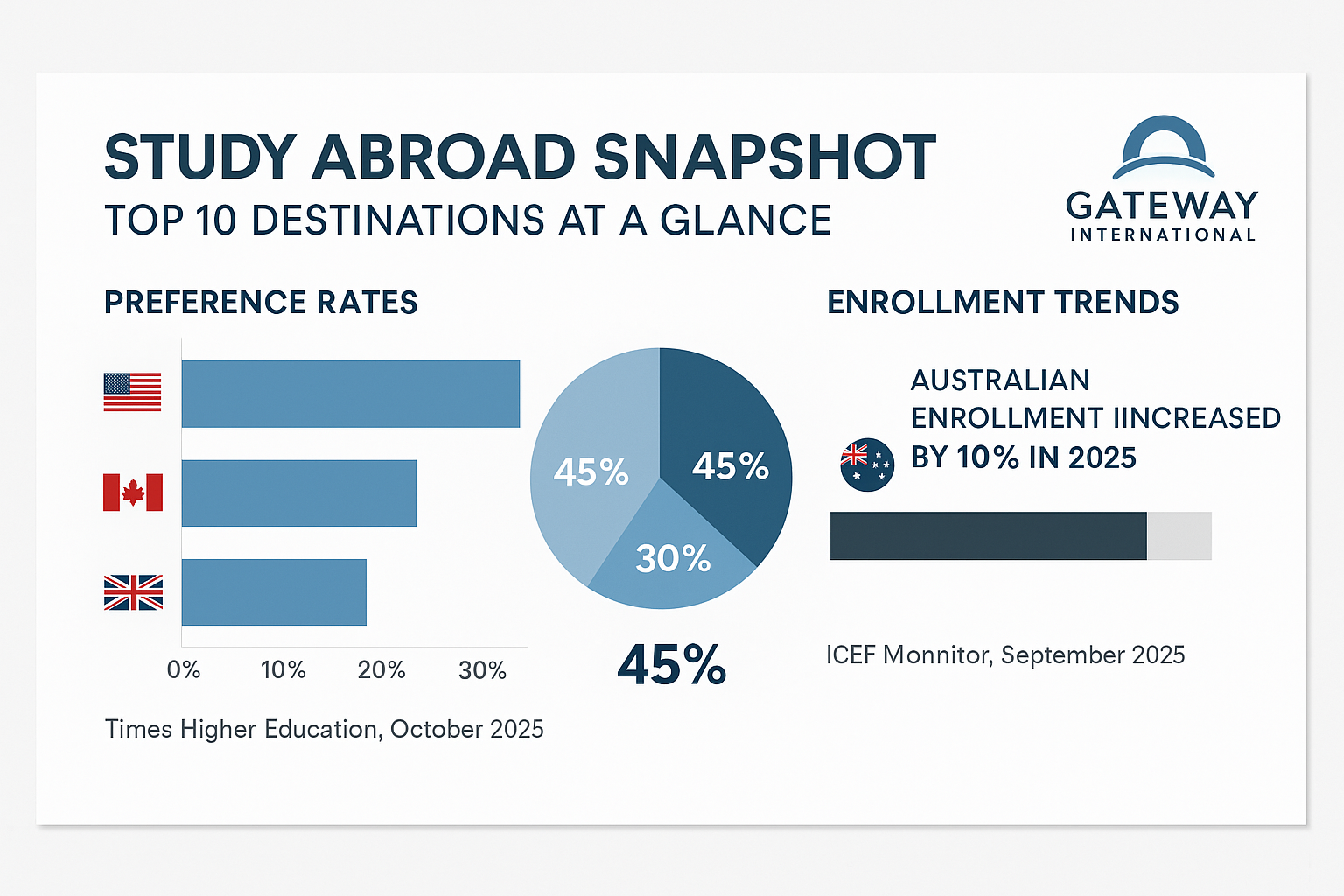
A visual snapshot comparing costs, quality, and Indian student communities across leading study destinations.
Europe’s Gems: Ireland, Netherlands, Finland, and Beyond
Yesterday, a parent from Pune asked me something that made me pause. “Why should my daughter go to Finland when everyone’s going to the US?”
Fair question. Back in 2007, I’d have asked the same thing.
The thing is, we’ve been watching this shift happen for years now. Netherlands started popping up in our applications around 2015. Just a trickle at first – maybe 20 students that whole year. Last month? We processed 312 applications for Dutch universities alone. The numbers tell a story, but the real change is deeper.
Finland caught my attention during a university fair in 2018. Their representative – can’t remember her name – explained how they teach. No rote learning. Students actually build things from day one. One of our students, Arjun from Chennai, is doing his Masters there now. Sends me videos of his robotics projects. The kid who struggled with CBSE practicals is now teaching Finnish students about automation.
Ireland’s different. Post-study work visa of 2 years. That matters. Especially when UK keeps changing rules every six months. We’ve placed probably 4,000+ students there since we started tracking properly. Tech companies everywhere. Not just Dublin – Cork, Galway too.
Netherlands though? That’s where things get interesting. English-taught programs that actually mean it. Not like some European universities where professors switch to local language mid-lecture. Living costs hurt less than UK. Amsterdam’s expensive, sure. But Eindhoven? Groningen? ₹60,000-70,000 per month and you’re sorted.
Here’s what bugs me – consultants pushing only US/UK/Canada. These smaller European countries need different applications. Netherlands wants to know WHY their specific program. Not generic SOPs. Finland cares more about your projects than your percentage. Ireland… they actually read recommendation letters.
We built separate workflows for each country after messing up too many times. Dutch universities hate late documents. Finnish ones need apostilled transcripts. Irish universities want everything uploaded to PAC. Small details that waste months if you don’t know.
The real advantage? Competition’s lower. While everyone fights for that US admit, smart students quietly get into TU Delft or Trinity Dublin. Same global recognition. Better lifestyle. And parents can actually visit without selling property.
Gateway’s approach evolved because these markets demanded it. Can’t use US templates for European applications. Different game entirely.
Emerging Hotspots: UAE and Switzerland – What’s the Buzz About?
2022, Dubai airport. I’m watching this massive queue of Indian students heading to universities I’d never heard of five years ago. That’s when it clicked – the education map is changing fast.
UAE wasn’t even on our radar when we started Gateway. Now? We’re processing 300+ applications monthly just for Dubai. The speed of change there is mental. They built entire university cities while we were still debating curriculum updates in India.
What’s pulling students there? Simple math really. European-quality education at 40% less cost. Plus you’re 4 hours from home, not 14. Parents love that bit.
The infrastructure development is insane. NYU Abu Dhabi, Sorbonne Abu Dhabi – these aren’t branch campuses anymore. They’re offering the exact same degrees. Same faculty rotation. But here’s the kicker – living costs are predictable. No surprise £2000 rent hikes like London.
Switzerland though… that’s a different game entirely.
Yes, it’s expensive. Like “check your bank balance twice” expensive. But the ROI calculations our students share? Hospitality grads starting at CHF 80,000. Tech roles even higher. The Swiss system is brutally practical – internships aren’t optional fluff, they’re paid and mandatory.
One student, Arjun from Pune, told me something interesting last month. “Sir, in Switzerland, being average means you’re excellent by global standards.” Their quality baseline is just… different.
The visa process for both? Refreshingly straightforward compared to the US lottery system. UAE gives you clear pathways to work permits. Switzerland’s graduate visa lets you stay 6 months to job hunt.
Actually, what really excites me is how these countries handle Indian students. No fake diversity quotas. They want talent, they make it clear, they deliver on promises.
We’ve started dedicated UAE and Switzerland desks at Gateway because the queries tripled this year. The patterns are clear – students want quality without the traditional Western education drama.
Fair warning though: UAE’s heat will test you (45°C is normal), and Switzerland’s German/French requirements catch many off-guard. But if you’re looking beyond the US-UK duopoly? These two are genuinely worth exploring.
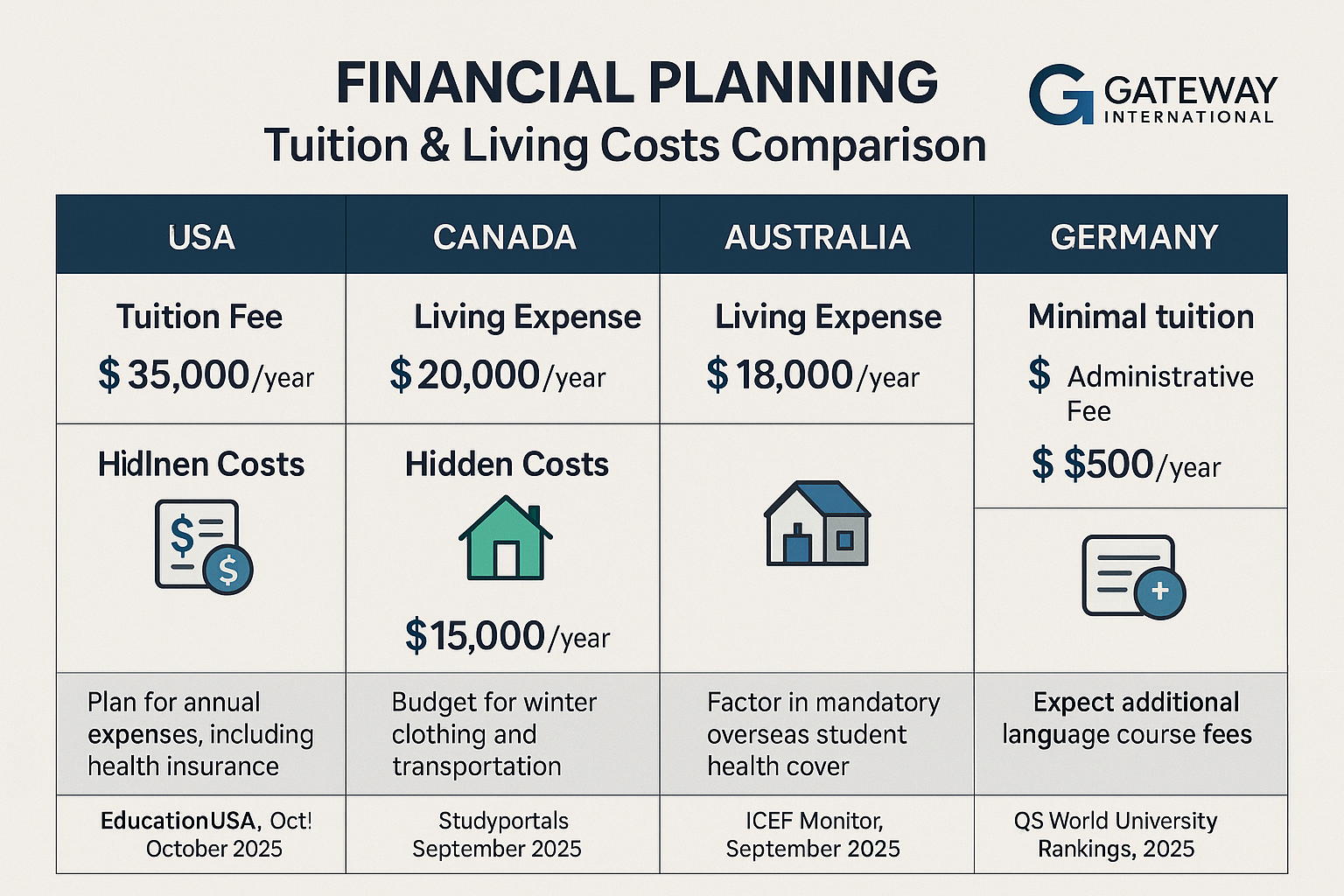
Plan your budget with a detailed breakdown of costs across top study destinations.
Seize Your Global Future with Gateway International
You know what’s funny? After 17 years in this business, I still get the same WhatsApp at midnight. “Sir, I got into University of Toronto but my parents want me to try for MIT.”
Every. Single. Year.
Here’s the thing – picking a country isn’t like picking a smartphone. You can’t just return it if you don’t like the camera quality. When students come to Gateway, they’re usually overwhelmed. 10 countries, 500 universities, infinite possibilities. Their Excel sheets have Excel sheets.
Last Tuesday, this kid from Pune calls me. Smart guy, 92% in boards. His consultant (not us) had promised him Stanford. ₹50,000 later, reality hit. Stanford wants perfect scores AND you should’ve probably invented something by age 16.
We see this pattern constantly. Students chase rankings while ignoring basics like:
- Can you actually afford 4 years there?
- Will you get a job after graduating?
- Does your cousin in New Jersey count as “family support”?
The admission process? That’s actually the easy part. We’ve processed… maybe 40,000 applications since 2007? The tech handles most of it now. What technology can’t do is sit with your parents and explain why Netherlands makes more sense than USA for their budget.
Yesterday during our team meeting, someone mentioned we’d helped students get into universities in 31 countries. Honestly, I’d forgotten about Malta. But that’s the point – there’s no single “best” country. There’s only what works for YOU.
Students think they need perfect SOPs, flawless LORs, astronomical scores. Sure, those help. But I’ve seen average students thrive in “lesser-known” countries while toppers struggle at Ivy Leagues. The difference? They picked places that matched their reality, not their Instagram dreams.
Gateway exists because this process shouldn’t require selling family gold. Our counselors (real humans, not chatbots) have probably made every mistake possible. Now they help you avoid them.
The world’s waiting. Your admission letter is possible. But first, let’s figure out which country actually makes sense for your situation. Not your neighbor’s son. Not your coaching center’s poster child.
You.
Ready to sort through the chaos? Let’s talk. First consultation’s free. We’ll figure out your actual options, not fantasy destinations.

Ready to Start Your Study Abroad Journey?
Get personalized counseling from our experts to navigate country-specific requirements, scholarships, and applications with ease!
Contact Us Today
Frequently Asked Questions
What are some of the safest countries to study abroad in 2025?▶
In 2025, countries like Canada, Germany, and the Netherlands are considered safe options for students. Canada, in particular, is praised for its welcoming environment, while Germany offers free education and a strong alumni network. Students should consider personal safety and the living conditions when choosing a destination.
How do post-graduation work permits vary by country?▶
Post-graduation work permits differ significantly among countries. In Canada, graduates can get permits lasting up to three years, while Germany offers an 18-month job seeker visa. The US has a more complicated path, especially with its H-1B visa lottery, which can lead to high rejection rates.
What should students focus on when choosing a university abroad?▶
Students should prioritize factors such as personal safety, post-study work opportunities, university reputation, and realistic budgeting. It’s essential to evaluate not just rankings but also the local job market, living costs, and potential support systems.
Why is it important to understand different scholarship options?▶
Understanding scholarship options can greatly alleviate financial burdens. Many countries and universities offer various scholarships, which can significantly reduce tuition costs. Researching these opportunities early can give students a competitive edge in their applications.
How can Gateway International support students in their study abroad journey?▶
Gateway International offers personalized counseling to help students navigate the complexities of studying abroad. Their expertise includes understanding country-specific requirements, providing insights on scholarship opportunities, and simplifying the application process, ensuring students make informed decisions without unnecessary stress.
Author: Mr. Abhinav Jain, the innovative Founder and Director of Gateway International and Edysor, has been a trailblazer in international education since 2007. His innovative ideas created Edysor which became an AI platform that both automated and improved admission procedures. Gateway International’s director Abhinav Jain has modified education-technology interaction via his system integration of rapid application management combined with intelligent document examination and cutting-edge voice computer interface. Through his leadership he established globally efficient university admission processes while driving innovative changes throughout various sectors.