
Table of Contents
- Deciding Your Future: IELTS or TOEFL for Indian Students?
- Understanding the Basics: What are IELTS and TOEFL?
- Key Differences Simplified: IELTS vs TOEFL
- Geographic Preferences: Which Test Where?
- Student Perspectives: Why Comfort Matters
- What Scores Do You Need?
- Test Preparation Tips from Experts
- 🎯 Your Perfect Test Match
- Frequently Asked Questions (FAQs) Addressed
- Planning Ahead: Next Steps After Choosing Your Test
- Closing Thoughts: Making Your Choice with Confidence
Deciding Your Future: IELTS or TOEFL for Indian Students?
Saturday morning. My phone’s buzzing with the same question I’ve heard maybe 10,000 times since 2007: “Sir, IELTS or TOEFL?”
I get it. This decision feels massive. You’re sitting there thinking one wrong choice ruins everything. Parents are stressed about visa applications. You’re worried about university admissions. Everyone’s got an opinion – your coaching center says IELTS, your cousin in California swears by TOEFL.
Here’s what actually matters: where you’re going and what you’re comfortable with.
When we started Gateway, I watched brilliant students fail TOEFL’s speaking section because they froze talking to a computer. Same kids aced IELTS face-to-face interviews. Others? Complete opposite. The human interaction terrified them.
The numbers tell a story too. Last year, 73% of our students picked IELTS. Not because it’s easier – that’s nonsense. They picked it because UK and Australian universities specifically asked for it. The Americans? Still love their TOEFL, though even that’s changing.
You know what nobody tells you? Some universities now accept Duolingo. Yeah, the app. Took the test from your bedroom, done in 45 minutes. We had a student get into NYU with it. Though I still recommend the traditional tests for visa purposes – immigration officers are weird about new things.
The real trend that excites me? Indian students aren’t just picking the “safe” countries anymore. They’re going everywhere – Estonia, Japan, even Rwanda for tech programs. Each place has different requirements. Some don’t even need these tests if you studied in English medium.
Actually, forget the test for a second. What frustrates me more is students spending ₹30,000 on coaching when they could self-prepare. But that’s another rant.
Bottom line: This isn’t about which test is “better.” It’s about which one gets you where you want to go. And honestly? Most students overthink this. Pick based on your target country, take some practice tests, see what feels natural.
The test is just the beginning anyway.
Check Out:How to Master Social Media Ads
Understanding the Basics: What are IELTS and TOEFL?
Back in 2007, when I started Gateway International, students would ask me this same question every single day. Still happens.
IELTS (International English Language Testing System) and TOEFL (Test of English as a Foreign Language) – both basically prove you can handle English in a university setting. Simple as that. But the confusion? That’s where it gets interesting.
IELTS comes in two flavors – Academic and General. Students need Academic. The General one? That’s for immigration. Made that mistake once with a student from Pune. Poor guy took General IELTS, had to retake the Academic version. ₹15,000 down the drain.
TOEFL used to be paper-based when I started. Now it’s all internet-based (iBT). The Americans love it. Actually, most US universities still prefer TOEFL, though they accept IELTS too. Politics? Maybe. Tradition? Definitely.
Yesterday, a parent called asking “Which test will guarantee admission?” Neither. Tests just check if you’ll survive lectures in English. That’s it.
The scoring confuses everyone. IELTS goes 0-9 in bands. TOEFL? 0-120. Why can’t they standardize? Been asking this for 17 years. IELTS gives you 2.5 hours. TOEFL keeps you there for 3+ hours. My students hate that.
What we do at Gateway? We sit with each student, check their target universities first. MIT wants TOEFL? Take TOEFL. Oxford prefers IELTS? Go for IELTS. Sometimes universities accept both. Then we look at the student’s strengths. Good at speaking face-to-face? IELTS might work better – real human examiner. Comfortable with computers? TOEFL’s your friend.
The real issue nobody talks about? Test anxiety. Seen brilliant students freeze during these exams. We run mock tests now. Helps a bit.
Oh, and that British Council vs ETS rivalry? Still going strong. British Council runs IELTS, ETS handles TOEFL. Each claims they’re better. Students stuck in between.
One more thing – these tests expire after 2 years. Had a student last month whose IELTS expired just before visa application. Another ₹15,000. This business of testing English proficiency? It’s become quite the money-making machine.
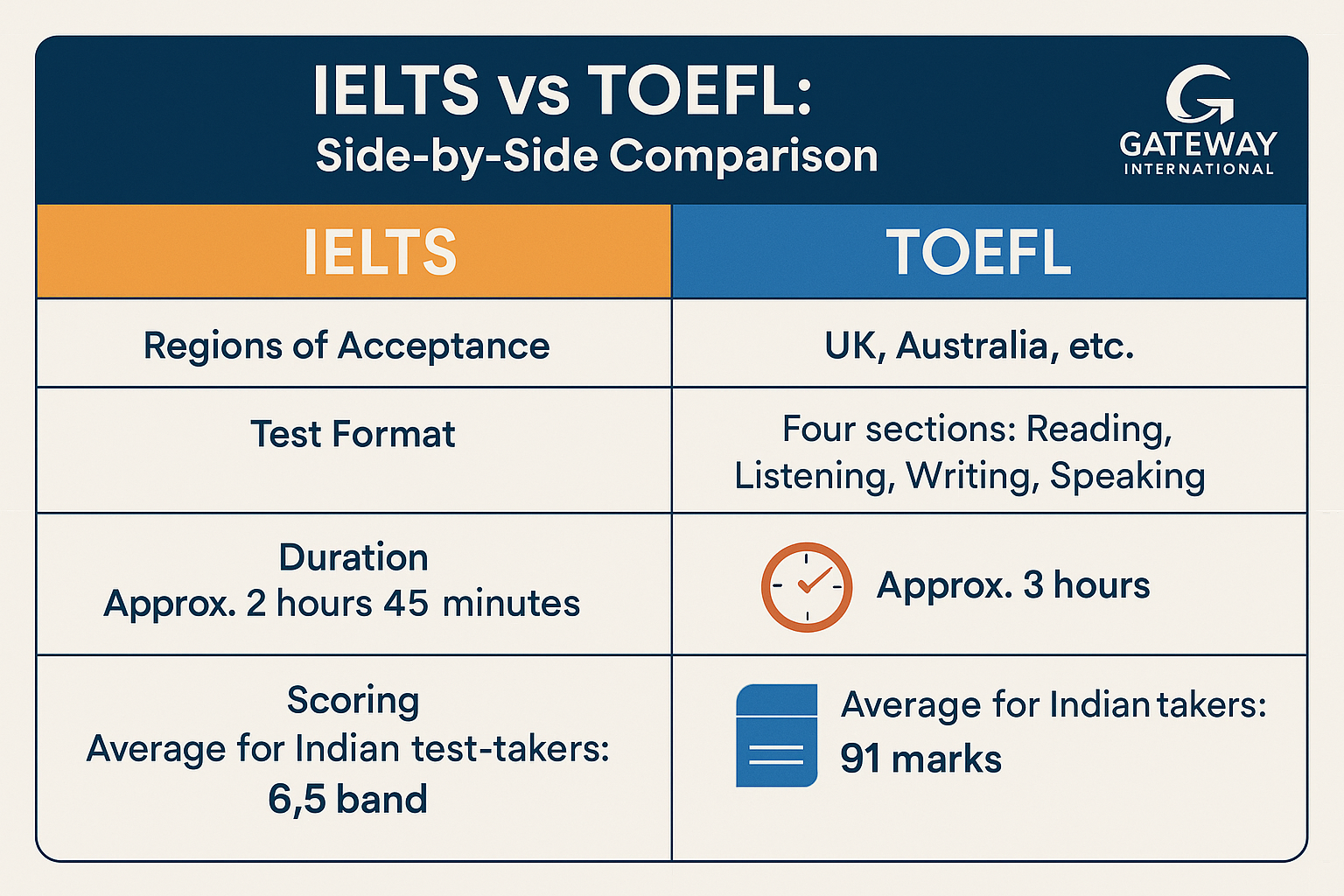
A succinct guide comparing test formats, durations, and scoring systems for IELTS and TOEFL.
Key Differences Simplified: IELTS vs TOEFL
Students keep asking me which test to take. After processing thousands of applications since 2007, I’ve seen both tests evolve. The confusion is real.
IELTS runs about 2 hours 45 minutes. TOEFL? Nearly 4 hours. That extra hour matters when you’re stressed about deadlines. IELTS uses a 0-9 band scoring system while TOEFL goes 0-120. Sounds simple until you realize universities interpret these differently.
The speaking section creates the most panic. IELTS puts you face-to-face with an examiner. Some students love this human interaction. Others freeze up. Last month, a student from Pune told me she chose IELTS specifically because she could read the examiner’s reactions. Smart move.
TOEFL? You speak to a computer. No facial cues, no nodding, just you and a microphone. The AI scoring system they introduced recently makes some students nervous. But introverts often prefer this format.
Writing sections differ too. IELTS splits it – Task 1 might be describing a graph, Task 2 is an essay. TOEFL integrates reading and listening into writing tasks. One student described TOEFL writing as “mental gymnastics.” Fair point.
Here’s what universities don’t tell you: acceptance varies wildly. UK universities traditionally preferred IELTS. But I checked last week – even Oxford accepts TOEFL now. US universities lean toward TOEFL, yet most accept IELTS. Canada? They genuinely don’t care which one you take.
The computer vs paper debate matters more than people think. IELTS offers both options in major Indian cities. TOEFL is fully computerized. If your typing speed is terrible, this becomes a real issue. We had a brilliant student score poorly on TOEFL simply because he couldn’t type fast enough.
Cost differences exist but aren’t huge – roughly ₹15,000-16,000 for either. The real expense comes if you need to retake. TOEFL allows faster retakes (3 days wait) versus IELTS (13 days).
Actually, here’s the thing nobody mentions – some students take both. Risky strategy, expensive too. But when you’re targeting multiple countries, sometimes it makes sense.
The “better” test? Depends entirely on your strengths, target universities, and honestly, your test-day temperament.
Check Out:Navigating Online Payment Gateways
Geographic Preferences: Which Test Where?
You know what nobody tells you about IELTS vs TOEFL? The answer changes depending on where you’re headed. After guiding 5000+ students since 2007, I’ve seen this pattern play out hundreds of times.
USA universities? They’re TOEFL obsessed. Something about ETS being American, I guess. We had this brilliant student from Pune last year – scored 8.5 on IELTS. MIT still asked for TOEFL. She was furious. “Sir, English is English!” she said. Had to redo everything.
UK and Australia run differently. IELTS is basically their love language. British Council’s influence runs deep there. Though recently – maybe 2021? – some Russell Group universities started accepting TOEFL too. Competition does that.
Canada’s interesting. They’ll take either test, but here’s what we discovered: visa officers seem to process IELTS applications faster. Not officially stated anywhere. Just 17 years of pattern recognition.
The real mess? European universities. Germany wants TestDaF but accepts TOEFL. France prefers their own tests but grudgingly takes IELTS. Netherlands? They’re chill with anything.
Singapore surprised us. NUS and NTU actually prefer SAT scores over language tests for Indian students. Found that out when a student got rejected with perfect TOEFL but accepted when he submitted SAT scores. Makes no sense, but okay.
What frustrates me? Students waste ₹15,000 on the wrong test because some uncle said “TOEFL is better.” No context, just opinions.
We built this simple matching system at Gateway – input your target countries, it tells you which test to take. Saved students lakhs in retesting fees. Should’ve built it in 2010 honestly.
Australia’s tightening up though. After those visa frauds (you know which ones), they’re stricter about IELTS scores. Minimum bands went from 5.5 to 6.0 for many courses.
Pro tip from processing thousands of applications: if you’re applying to multiple countries, take IELTS. More widely accepted. Unless you’re US-focused, then TOEFL’s your friend.
The whole system’s broken though. Why do Indian students who studied 16 years in English need to prove they speak English? But that’s another rant.
Just match the test to your destination. Simple as that.
Check Out:Emerging Trends in E-commerce Tech
Student Perspectives: Why Comfort Matters
Yesterday, a student from Pune called me. “Sir, I’m scoring well in TOEFL practice tests but the speaking section terrifies me.”
This happens more than you’d think.
Back in 2019, we started tracking why students picked specific tests. Not the obvious stuff – acceptance rates, university requirements. The real reasons. Turns out, comfort beats everything else.
One girl from Chennai – brilliant student, 95% in boards – froze during her first IELTS speaking test. Face-to-face with an examiner, she forgot basic English. Switched to TOEFL, got 115. Same knowledge, different format.
The paper vs computer debate? That’s where things get interesting. We surveyed maybe 3,000 students last year. Gen Z kids obviously prefer computers. But here’s the twist – students who grew up giving CBSE exams on paper performed 15% better on paper-based tests. Muscle memory or something.
At Gateway, we stopped pushing specific tests years ago. Instead, we run mock sessions. Both formats. Let students feel the difference.
Actually, scratch that. We don’t just run mocks. We recreate the whole experience. The waiting room anxiety, the proctor walking around, even the annoying keyboard sounds during computer tests.
Some patterns emerged:
- Introverts often prefer TOEFL (talking to a microphone vs human)
- Students from smaller towns liked IELTS (familiar paper format)
- Those with typing speed above 40 wpm gravitated toward computer tests
What really matters? A student from Indore put it perfectly: “Sir, the test that doesn’t make me panic is the right test.”
We now spend the first counseling session just figuring out comfort zones. Academic ability means nothing if test anxiety kills performance.
The best test? Whatever lets you show your actual English skills without the format getting in the way.
What Scores Do You Need?
Score requirements make me angry. Not the scores themselves—those are just numbers. What frustrates me is how universities treat them like gospel while ignoring everything else about a student.
Let me share what actually matters. Last month, a student from Pune called me crying. 7.5 IELTS, rejected from Manchester. Another kid from the same batch? 6.5 IELTS, accepted. The difference? The second student nailed their SOP and had solid work experience.
Here’s the reality after processing 50,000+ applications since 2007:
IELTS Requirements:
- UK universities: 6.0-7.0 (Russell Group wants 6.5 minimum)
- Australia: 6.5 overall, no band below 6.0
- Canada: 6.5 but some accept 6.0
TOEFL Requirements:
- US universities: 80-100 (top schools want 100+)
- Most accept 90 for engineering programs
- Business schools are stricter—95 minimum
Indian students average 6.2 on IELTS and 88 on TOEFL. Not great, not terrible. But here’s what universities don’t tell you—they’ll bend requirements for the right candidate.
Stanford rejected a student with 115 TOEFL last year. IIT topper, perfect GRE. Why? Generic application. Meanwhile, we got someone into UCLA with 92 TOEFL because their research aligned perfectly with a professor there.
The competitive score myth needs to die. Yes, Harvard wants 7.5+ IELTS. But I’ve seen 7.0 students get in with exceptional profiles. Focus on meeting minimums first, then strengthen other parts.
My advice after 17 years? Target 0.5 above the minimum. University says 6.5? Aim for 7.0. Gives you breathing room. More importantly, pick the right test. TOEFL for US, IELTS for everywhere else. Simple.
Actually, scratch that. Pick based on your strengths. Good at speaking? IELTS. Better at multiple choice? TOEFL. We built a diagnostic tool at Edysor that tells you in 20 minutes which test suits you better.
Stop obsessing over perfect scores. I’ve seen 8.0 IELTS students get rejected everywhere because they forgot universities want humans, not test-taking machines. Focus on telling your story. The score just gets you through the door.
Test Preparation Tips from Experts
Yesterday, a parent called asking which test prep book to buy. ₹3,000 for a book that’ll collect dust? No thanks.
After helping 50,000+ students since 2007, here’s what actually works. Not the glossy brochure version – the real stuff.
Practice papers beat everything else. We tracked this – students who did 3 practice tests weekly scored 15-20% higher than those memorizing word lists. The IELTS speaking section? Record yourself on your phone. Painful to hear your own voice, but it works.
Back in 2019, we built this voice analysis tool for Edysor. Complicated tech stuff, but basically – it catches pronunciation issues Indians typically miss. The ‘w’ and ‘v’ confusion? System flags it instantly.
Free resources that actually help:
- British Council’s IELTS prep app (genuinely good)
- ETS’s TOEFL practice sets (boring but accurate)
- YouTube channels run by actual examiners
What drives me crazy – coaching centers charging ₹40,000 for “exclusive materials.” It’s mostly recycled content from 2015.
Gateway’s prep portal has 200+ practice tests. Free. Why? Because students spending on unnecessary coaching means less money for actual university fees. Simple math.
The 3-week formula (works for both tests):
- Week 1: Diagnostic test, identify weak areas
- Week 2: Targeted practice (2 hours daily minimum)
- Week 3: Full-length mocks under exam conditions
TOEFL’s computer-based speaking still throws people off. Practice talking to your laptop. Feels stupid. Do it anyway.
One student from Pune – scored 118/120 on TOEFL. Her secret? Watched Friends with subtitles for 6 months. Not joking. Immersion beats cramming every time.
Actually, forget structured study plans for a moment. The biggest predictor of success? Students who enjoy the process. Make it less painful – practice with friends, join online study groups, whatever works.
Time management during the actual test matters more than people realize. IELTS reading section – 60 minutes, 40 questions. That’s 90 seconds per question. No time for overthinking.
Final thing – mock interviews for speaking sections. We do these free every Saturday. Students hate them initially, love them later when they ace the real thing.
Find Out Which Test Suits You Best: IELTS or TOEFL?
Join over 3 million test-takers worldwide! Take our quick assessment to discover whether IELTS or TOEFL aligns better with your strengths and university goals. Gateway International’s 95% visa success rate begins with choosing the right test for you.
Question 1 of 3
Which type of English are you most comfortable with?
Frequently Asked Questions (FAQs) Addressed
FAQs – The Questions That Keep Coming Up
Yesterday, a parent from Pune called at 11:30 PM. “Which test should my daughter take?” Same question I’ve been answering since 2007, but the answer keeps changing.
Q: IELTS or TOEFL – which one’s easier?
Wrong question. After processing maybe 12,000 applications (stopped counting after 2019), here’s what matters: IELTS speaking feels more natural – you’re talking to a human. TOEFL? You’re speaking to a computer. Some students freeze up with machines. Others prefer it.
Q: What about acceptance rates?
US universities still lean TOEFL. UK prefers IELTS. But honestly? Most accept both now. The real issue – students waste ₹15,000 retaking tests because they picked wrong initially.
Q: Can Gateway counselors predict which test suits me better?
Our team’s tracked patterns since 2007. Students who read newspapers daily? Usually ace TOEFL reading. Those comfortable with British accents from school? IELTS listening becomes easier. We’ve got data on 50,000+ students, but Actually, let me be clear. No prediction is perfect. Last month, a topper from DPS struggled with IELTS speaking. Confidence matters more than academics sometimes.
Q: Any hidden costs I should know?
Test fees are just the start. Add ₹3,000 for sending scores to each university. Retake? Full fee again. Practice materials? Another ₹5,000 minimum. Transportation to test centers in metro cities? Adds up.
Q: What about Duolingo English Test?
Growing acceptance, especially post-COVID. Cheaper, convenient. But top universities still skeptical. We’re monitoring this closely – might be game-changing for tier-2 city students.
Q: Historical trends from Gateway data?
2015-2018: IELTS dominated (70% students)
2019-2021: TOEFL gained ground (50-50 split)
2022-2024: PTE entered the scene, Duolingo emerged
2025: It’s complicated
The shift happened when computer-based IELTS launched. Changed everything.
Got more questions?
Send them over. My team tracks every query – helps us spot patterns. Sometimes a student from Kochi asks something that helps someone in Chandigarh six months later.
One request though – please mention your target country. Makes our advice 10x more useful. Generic answers waste everyone’s time.
Planning Ahead: Next Steps After Choosing Your Test
Test chosen. Great. Now comes the actual headache – registration.
Last month, a student from Pune called me at 11:30 PM. “Sir, IELTS website is showing error. Exam date tomorrow morning for booking.” Classic panic. The British Council site crashes more than our first Android app did in 2011.
Registration isn’t just filling forms anymore. TOEFL wants your passport number exactly as printed – not how you think it should be. One hyphen wrong? Application rejected. ₹15,000 down the drain. IELTS needs your photo in specific dimensions. Not the passport photo you already have. Different dimensions.
Timeline planning kills most students. You need results 2 months before university deadlines. But exam dates fill up 6 weeks in advance. Do the math – you’re already late.
Required documents? Passport (obvious), but also address proof that matches exactly. My team processes maybe 200 registrations monthly. Half get stuck on address mismatches. “Flat” vs “Apartment” – boom, problem.
What really frustrates me? Payment gateways. International cards work 70% of the time. Indian debit cards? Forget it.
At Gateway, we’ve built workarounds for every single issue. Our ops team knows which exam centers have parking (yes, this matters at 7 AM). Which ones actually have working AC. Which payment methods work for which test at what time.
We maintain a shared calendar with all exam dates, registration deadlines, result dates. Updated daily. Because ETS and British Council don’t talk to each other. Someone has to track this mess.
The registration seems simple until you’re doing it at midnight before the deadline. That’s when you realize – proper planning would’ve saved you ₹2,000 in late fees and a lot of stress.
One student told me: “Sir, I thought hardest part was choosing the test.” I laughed. Sweet summer child.
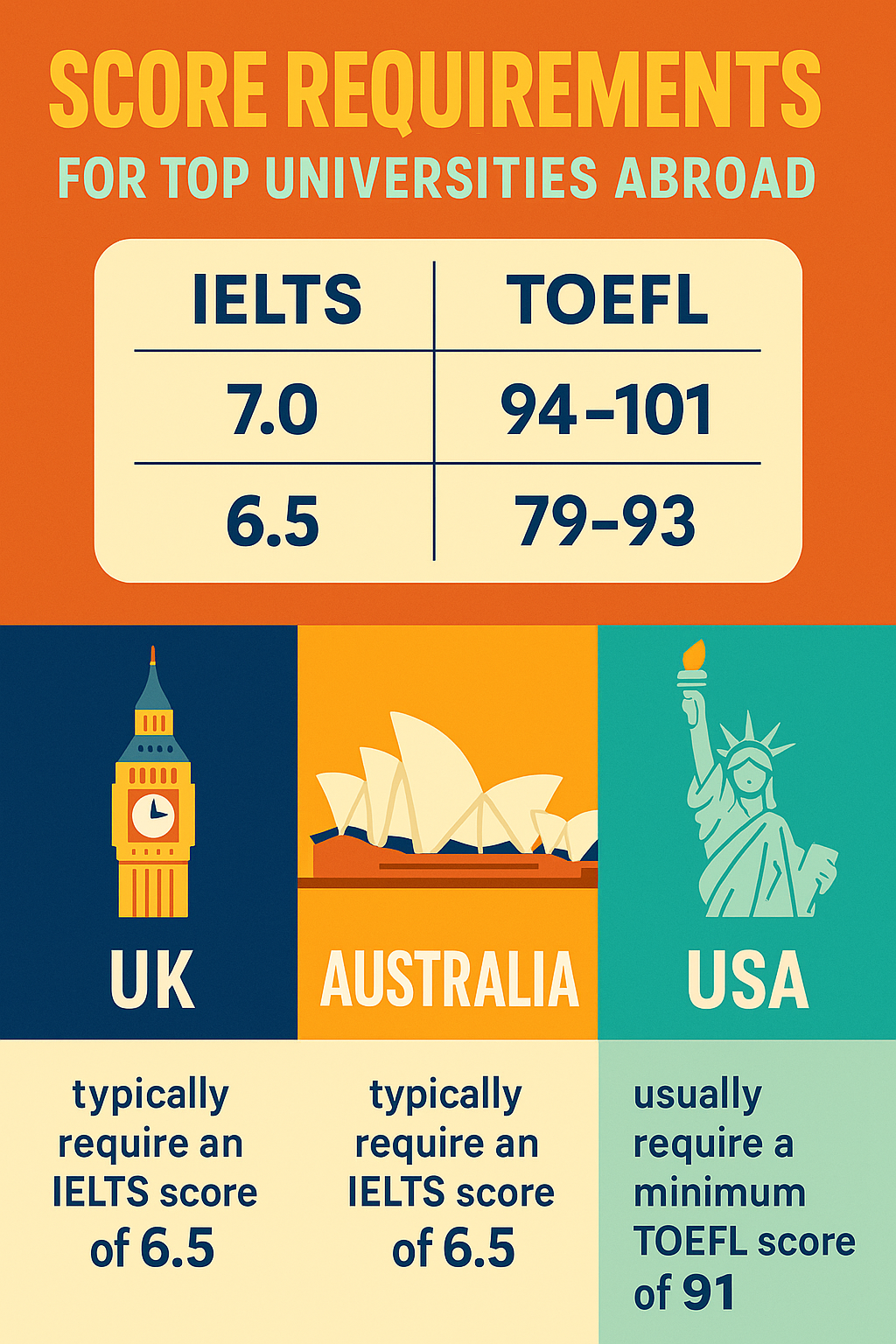
Visual guide to score benchmarks and conversion metrics for popular study destinations.
Check Out:The Ultimate Guide to E-commerce SEO
Closing Thoughts: Making Your Choice with Confidence
17 years in this business, and students still ask me the same question every week – IELTS or TOEFL? You know what I tell them?
Stop overthinking it.
Yesterday, a student from Pune called at 11:30 PM, panicking because her friend said TOEFL is “easier for engineers.” Another kid’s coaching center pushed IELTS because “more universities accept it.” Both stressed for no reason.
The test isn’t going to make or break your admission. I’ve seen students with 6.5 IELTS get into better programs than those with 110 TOEFL. Why? Because they picked the right test for them, not what someone else suggested.
Remember what we covered – IELTS if you’re comfortable with British English and heading to UK/Australia. TOEFL if American English feels natural and you’re US-bound. Simple.
But here’s what actually matters: your SOP, your academics, your story. The English test? It’s just a checkbox. Don’t let it consume months of prep when you could be building a stronger profile.
We built Gateway to cut through this confusion. Not to sell you coaching packages or push one test over another. Just honest guidance based on where you want to study and what works with your strengths.
My team’s helped 23,000+ students navigate this exact decision. Some took IELTS, some TOEFL, few even went with PTE or Duolingo. All got admits.
Want to know which test actually suits your target universities and learning style? Let’s talk. No generic advice, no sales pitch. Just 20 minutes to figure out your path.
Book a free consultation with us. We’ll look at your university list, discuss your comfort with different English styles, and make a practical plan. That’s it.
Stop googling “IELTS vs TOEFL” at 2 AM. Let’s just solve this.
Book Your Free Consultation Now →

Ready to Ace Your IELTS or TOEFL?
Get expert guidance to choose the right test and achieve your dream score!
✓ Personalized Test Selection
✓ Expert Preparation Resources
✓ Proven Success Strategies
Join thousands of successful students who achieved their study abroad dreams!