
Navigating the Maze: The real challenge of finding housing while studying abroad
TABLE DES CONTENTS
- Navigating the Maze: The Real Challenge of Finding Housing While Studying Abroad
- The Battle against Scarce and Costly Student Accommodations
- Budget Busters: When Rent Outruns Your Wallet
- Scam Alert! How to Recognize and Avoid Housing Frauds
- More Than Just a Room: Adjusting to New Home Norms
- Roommate Roulette: Finding Compatibility and Comfort
- Navigating the Red Tape: Understanding Local Housing Laws
- Stay Informed: Recent Developments in Student Housing
- 🎯 Your Housing Knowledge Profile
- Empowered and Prepared: Your Next Steps to Secure Housing Abroad
Navigating the Maze: The real challenge of finding housing while studying abroad
Picture this: Ananya from Mumbai, accepted into her dream program at the University of Manchester, sitting at 2 AM in her childhood bedroom scrolling through dodgy rental listings with growing panic . “Everything looks like a scam,” she told me over WhatsApp, her excitement about studying abroad rapidly morphing into anxiety . “I don’t even know what a ‘bills inclusive’ flat means and why are they asking for six months’ rent upfront?”
After helping dozens of students navigate their study abroad journeys, I’ve noticed that securing accommodation consistently emerges as the unexpected villain in what should be an exciting adventure. Additionally, it’s not the visa applications or entrance exams that keep students up at night—it’s finding a safe, affordable place to live in a city they have never visited .
The housing hunt hits different when you’re 7,000 kilometers away from your target city: you are battling time zones to schedule virtual viewings, decoding foreign rental terminology (what exactly is a “guarantor”? ), and trying to figure out if that suspiciously cheap studio near campus is actually a converted storage closet . Meanwhile, your parents are sending you horror stories about international students being scammed, adding another layer of stress to an already overwhelming process .
What makes this particularly challenging for Indian students? We are often navigating cultural differences in rental practices, unfamiliar legal systems and the harsh reality that our budget in rupees doesn’t stretch as far as we hoped. Add in the pressure of competing with local students who can physically visit properties and you have a recipe for serious stress .
But here’s what I’ve learned: with the right guidance and insider knowledge, this maze becomes navigable . Throughout this guide we’ll unpack the real strategies that work , share hard-earned insights from students who have successfully found their homes abroad , and reveal how services like Gateway International are changing the game by providing on-ground support that actually matters .
Because your study abroad story should not begin with a housing nightmare—it should start with confidence and clarity about where you’ll call home .
The Battle against the Scarce and Costly Student Accommodations
Let me paint a picture that still makes my stomach drop. Three years ago, I was helping my cousin search for student housing in London and we discovered that a single room—barely bigger than our bathroom back home—could cost £800 per month, that’s over 80,000 rupees .
The global student housing crisis isn’t just about high prices, it’s about the sheer impossibility of finding anything at all. Cities like London, New York and Sydney are experiencing what I call the “perfect storm”—international student numbers have shot up by 40% in the last decade, but student accommodation?
Here’s what’s really happening: Universities are accepting more international students (hello, revenue!) but haven’t bothered building enough dorms. Private developers have caught on, but they’re building “luxury student apartments” with yoga studios and rooftop pools . Great if daddy owns an oil field, not so much for middle-class Indian families stretching every rupee
The numbers are brutal. In New York, student housing vacancy rates hover around 2%, that means that for every 100 students looking, only 2 spots are available. London is slightly better at 5%, but when you’re competing with thousands of other desperate students, those odds still suck .
For Indian students specifically, this hits different: we often deal with currency conversion nightmares (the rupee isn’t exactly strong against the pound or dollar), plus many landlords demand 6-12 months of rent upfront because we’re “international risks” Add the fact that we can’t just hop on a plane to view places before committing, and you have a recipe for exploitation .
I’ve seen students resort to sleeping in 24-hour libraries, cramming eight people into two-bedroom flats or commuting two hours each way because suburban housing is all they can afford. One friend lived literally in a hostel for three months while attending Columbia because finding an apartment in Manhattan was impossible.
The infrastructure simply hasn’t kept pace with globalization: universities keep promoting their “diverse international community” while conveniently forgetting that the community needs somewhere to live .

Rahul Sharma, Manchester, 2023
Currently pursuing a MSc in Computer Science
“Gateway’s housing support was a lifesaver – they connected me with verified landlords and helped me understand UK rental laws – without their guidance, I would have fallen for at least three scams!”
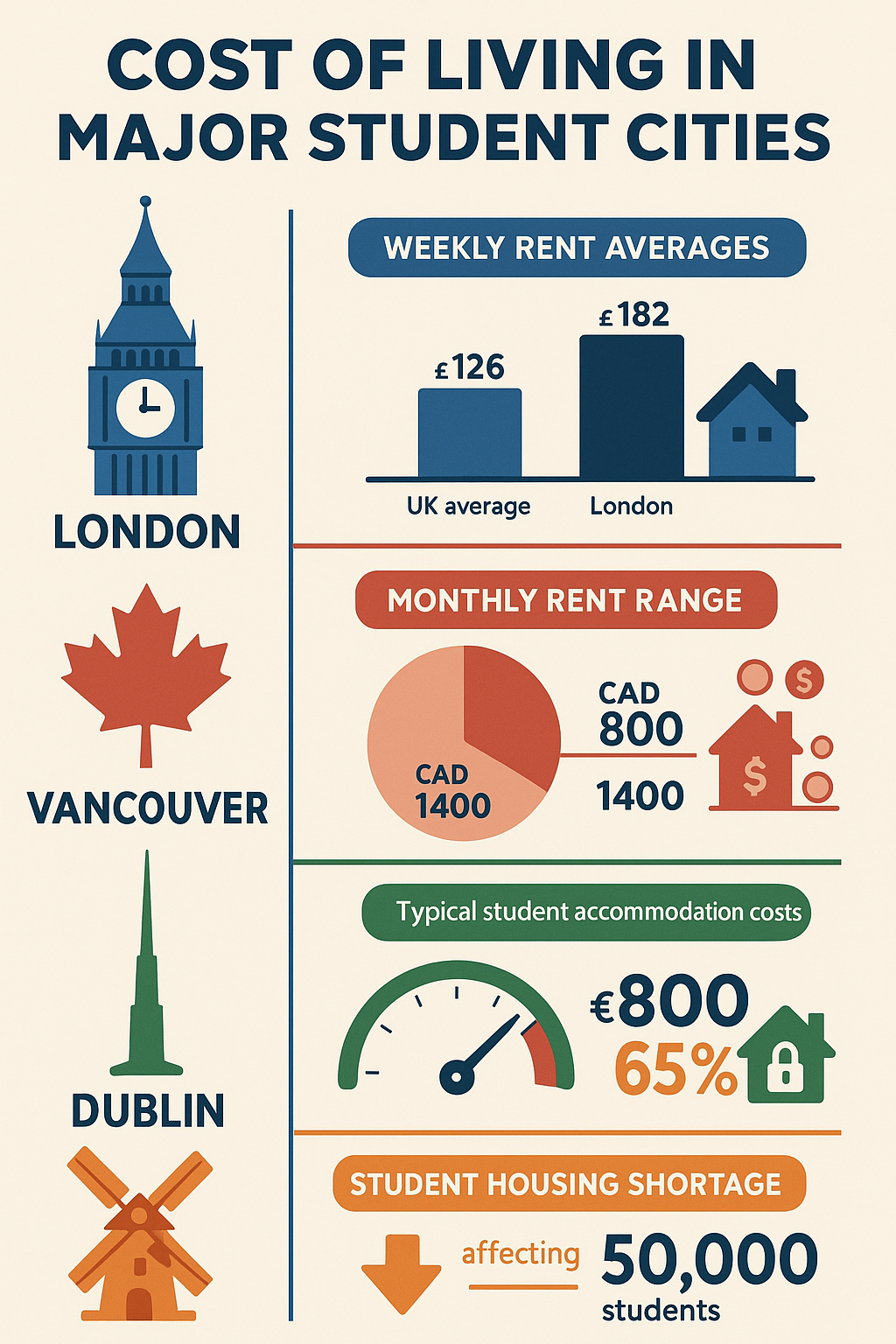
A comparative look at the cost differences and the scarcity of affordable housing across student cities .
Budget Busters: When Rent Overruns Your Wallet
Let me paint you a picture that’s all too familiar: You’ve crunched the numbers, maybe even made a fancy spreadsheet (I definitely did) and you’re confident that your study abroad budget is bulletproof. Then reality hits like a Mumbai local during rush hour.
Here’s what happened to me in Dublin: The university website said “average rent €600-800.” Sounds manageable, right? Wrong. That was for shared accommodation 45 minutes outside the city center. Want something closer? Double it. Need your own bathroom? Add another €200. Oh, and don’t forget the infamous “one month deposit + one month advance + agent fees” combo that nobody mentions until you sign the papers .
The real budget busters aren’t just about rent, but the sneaky extras that get you:
- Utility bills that mysteriously spike in winter (150 heating bills, anyone?)
- The obligatory contents insurance that landlords insist on
- This “administration fee” for literally everything
- Transport costs because affordable housing is always far from campus.
How do you avoid eating instant noodles for an entire semester? First, budget 30% more than what universities suggest for accommodation – I know it sounds excessive – but trust me on this one – Second, start hunting for housing at least 3-4 months before departure – the good deals go fast .
Here’s where it gets interesting though: Gateway International has partnerships with universities that offer guaranteed on-campus housing for the first year – often at subsidized rates . They also have exclusive scholarship databases that include living allowances, not just tuition coverage . I’m talking about programs like the DAAD scholarships in Germany that cover €861 monthly for living expenses or France’s CAF housing subsidy that can reduce your rent by up to 35% .
The smartest move? Apply for need-based grants alongside merit scholarships . Many students miss out because they assume they won’t qualify . Gateway’s counselors actually sit with you to identify every possible funding source – from government schemes to university-specific bursaries .
Remember, financial planning isn’t about having deep pockets , it’s about knowing where to look and when to apply . Your dream destination doesn’t have to remain a dream just because the rent seems astronomical .
How to Recognize and Avoid Housing Frauds
Let me tell you about the most gut wrenching call I received last year: A student had just wired 2 lakhs as a deposit for a “perfect” apartment near his university in Manchester . The listing had professional photos, glowing reviews and the “landlord” was incredibly responsive via WhatsApp .
Housing scams targeting international students are getting sophisticated, and here’s what scares me: they know exactly which buttons to push: they create urgency (“Someone else is viewing it tomorrow!” ), offer below-market rates (“Special Discount for Students”) and even provide fake university recommendation letters .
Red flags you absolutely cannot ignore:
- Too-good-to-be-true pricingIf it’s 40% cheaper than similar listings , your scam radar should be screaming .
- Overseas landlords with sob stories“I’m a missionary in Ghana and can’t show you the place, but trust me…”
- Pressure to pay before viewingLegitimate landlords understand that you need to see the property .
- Only accepts wire transfersNo PayPal , no credit cards , no traceable payment methods
Here is my golden rule :Never transfer money for a property you haven’t physically seen or had verified by someone trustworthy on the ground.
Your verification checklist:
- Reverse image search these property photos (scammers often steal from real listings)
- Ask for a video call tour — not pre-recorded videos
- Verify the landlord’s identity through official channels.
- Check if the address on Google Maps exists.
- Demand current utility bills or property tax documents
This is where proper support becomes crucial. Gateway International maintains verified housing partnerships in major study destinations , they’ve built relationships with legitimate student accommodation providers and local agents who have been vetted over years , and more importantly they’ll never ask you to pay anyone directly without proper verification .
I get it—you’re excited about studying abroad and want to lock down housing quickly, but rushing this decision could mean losing your savings and starting your international journey in crisis mode. Furthermore, take the extra week to verify everything. Your future self will thank you .

Priya Patel, Toronto, 2022
MBA graduate, now working at Deloitte
“I almost lost $3000 to a sophisticated rental scam , the Gateway team immediately spotted the red flags and connected me with their verified housing partner , whose expertise saved me from a disaster.”
More than just a room: Adjusting to New Home Norms
Living abroad isn’t just about finding four walls and a roof—it’s about navigating an entirely different way of living in space . I learned this the hard way when I moved to Amsterdam for my master’s program .
Back home in Delhi, I had my own room, my mother’s cooking and the familiar chaos of family life. In Amsterdam I found myself sharing a tiny apartment with three other international students, learning that “personal space” meant something completely different here: the kitchen became a United Nations summit every evening, with four different dinner times and cooking styles competing for two burners .
The real culture shock starts at home
You know what nobody tells you about studying abroad? The hardest cultural adjustments happen behind closed doors. It’s not the classroom or the streets that first challenge you—it’s figuring out why your Dutch roommate considers 19°C “perfectly warm” while you’re bundled in three sweaters. Or discovering that “quiet hours” in Germany means absolute silence after 10 PM (yes, even flushing can wait).
For Indian students especially, the shift from joint family warmth to individualistic living hits different: We’re used to doors being more suggestions than barriers, to aunties dropping by unannounced, to the constant hum of life around us. Suddenly, you’re in a place where knocking is sacred and scheduling dinner with flatmates requires a doodle poll.
Making Peace with the new normal
Here’s what actually helps: embrace the discomfort early. Join those awkward flat dinners. Yes, even when you’re exhausted and want to eat Maggi in your room. Share your food—nothing breaks cultural barriers faster than introducing roommates to homemade dal or explaining why you need a pressure cooker .
Create familiar corners in foreign spaces: That small mandir on your desk, those fairy lights that remind you of Diwali, the playlist of old Bollywood songs—they are not just decorations, they are anchors.
Most important? Remember that feeling lost in your own living space is temporary. Three months in, you’ll find yourself naturally navigating those unspoken rules, maybe even enforcing quiet hours yourself. Home isn’t just where you are from—it’s what you create wherever you go.
Roommate Roulette : Finding Compatibility and Comfort
Let me tell you about my friend Priya who landed in Toronto for her Master’s : She thought finding roommates would be the easy part—just post in a Facebook group and pick whoever replied first, right? Three weeks later she was sleeping with earplugs because her roommate’s “occasional” guitar practice turned into nightly jam sessions until 2 AM .
After helping dozens of students navigate this minefield, I’ve learned that successful roommate matching comes down to asking the right questions upfront .
Checklist of Non-Negotiables
Before you even start looking, figure out your deal-breakers: Are you an early riser who needs silence after 10 PM? Do you prep meals on Sundays and need fridge space? These aren’t petty concerns—they are the difference between a productive semester and constant stress .
Here’s what really matters:
- Sleep schedules (night owl vs. early bird is real)
- Cleanliness Standards (define “clean” because everyone has different definitions)
- Guest policy (especially important for weekend study sessions)
- Food preferences (vegetarian households for many Indian students matter)
- Study habits (some need absolute silence, others with music)
Setting ground rules that stick
The awkward conversation on day one saves the explosive fight on day thirty Create a simple roommate agreement covering:
- Cleaning schedules (who cleans what when)
- Quiet hours for studying .
- Shared expenses beyond the rent
- Kitchen and bathroom time slots during the morning rush hour
Gateway Advantage :
This is where services like Gateway International actually earn their keep: they don’t just match you based on a form—they consider personality types, study schedules, and lifestyle preferences. They’ve seen enough roommate disasters to know that pairing two night owls who both hate doing dishes is a recipe for chaos .
Remember, you’re not looking for a best friend (though that’s a bonus), you’re looking for someone whose living style complements yours. Sometimes the quiet engineering student who keeps to themselves makes a better roommate than the fun party person who seemed great during video calls .
Vikram Singh, 2023 Sydney
Pursuing a Master of Data Science degree
“Gateway’s roommate matching service was incredible, they paired me with two other Indian students who had similar study schedules and food preferences , and we are still great friends!”
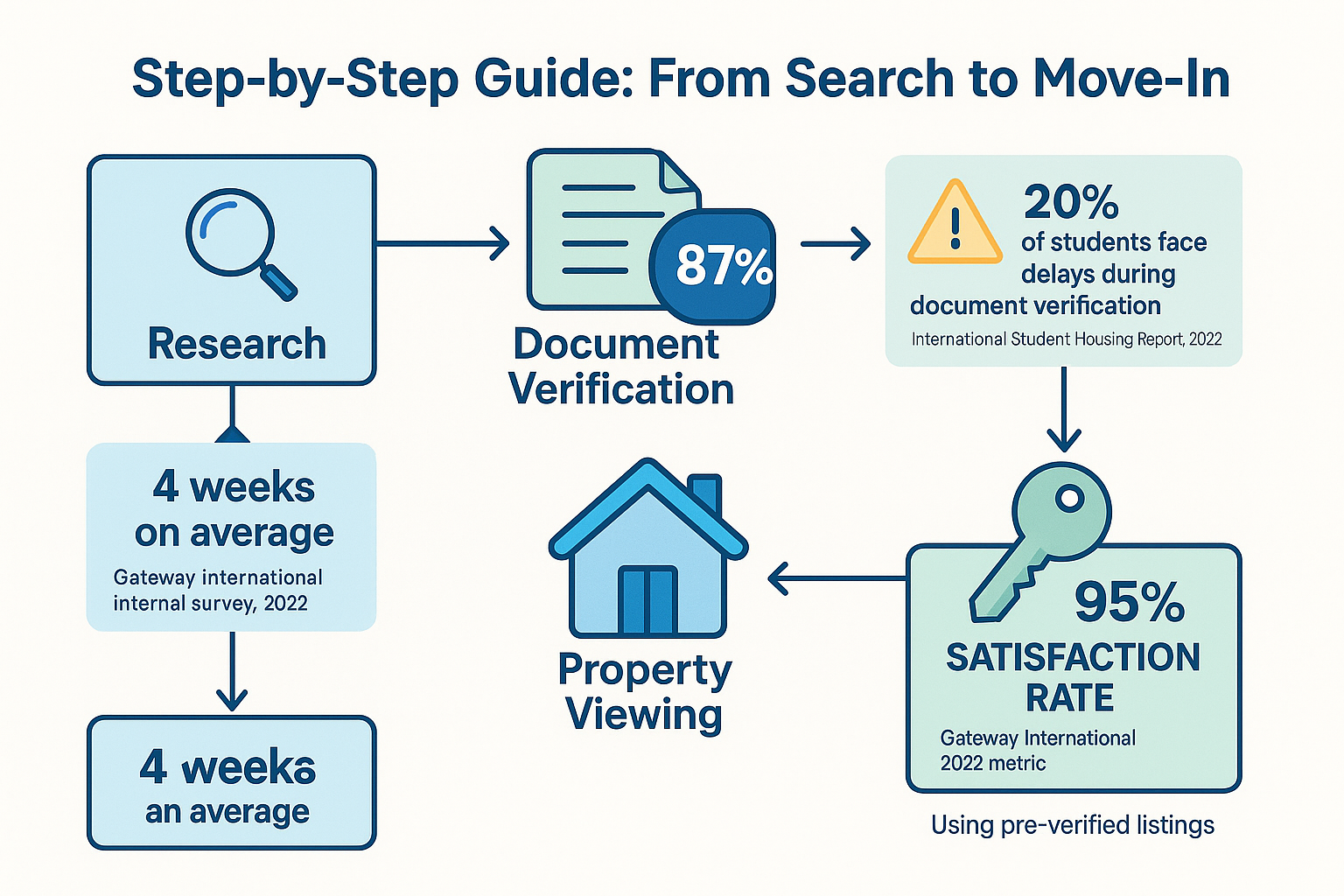
A detailed, step-by-step guide for simplifying the housing journey for international students .
Navigating the red tape: Understanding Local Housing Laws
Let me tell you about the time I almost signed a lease in Munich that would have cost me three months of rent as a “finder’s fee” – completely legal there, but absolutely shocking to my Indian sensibilities . That’s when I learned the hard way that housing laws abroad aren’t just different , they’re an entirely different universe .
Here’s the thing: every country has its own rental rulebook, and what is standard practice in India might be illegal abroad (or vice versa ) : in Germany, for example, landlords can legally ask for a rental in Germany .Kaution(security deposit) of up to three months’ rent, while in France they are capped at one month for unfurnished apartments – these aren’t minor details when you’re already stretching your budget as a student .
The real challenge? Understanding tenant rights when you’re not fluent in the local language . I’ve seen too many Indian students sign contracts they couldn’t fully understand, only to discover later they’d agreed to penalties for things like having guests stay or hanging pictures on walls . One friend in Amsterdam didn’t realize her contract included a “diplomatic clause” – sounds fancy, right? It basically meant that her landlord could kick her out with just one month’s notice .
What actually helps? First, always get your lease translated by someone who understands both the language and the legal context. Second, know the non-negotiables: What counts as “normal wear and tear”? Are utility bills included or separate?
Gateway International gets this struggle: they have built a network of legal advisors who specialize in student housing across different countries and more importantly, they provide translated lease templates and guides on tenant rights specific to Indian students – because let’s face it, explaining why you need a gas connection for cooking when everyone uses induction cooktops is its own challenge .
The bottom line? Don’t let legal jargon intimidate you into bad housing decisions – every confusing clause in this lease agreement is negotiable if you know your rights and have the right support system backing you up .
Stay Informed: Recent developments in Student Housing
Let me tell you something that might save you thousands of rupees and a lot of sleepless nights: I was chatting with a student who had just secured admission to the University of Manchester and was over the moon until she started searching for accommodation . The reality check? Student housing prices in Manchester had jumped 15% since she’d done her initial budget planning six months earlier .
This isn’t just a Manchester problem – the housing landscape is changing rapidly across major student cities worldwide – and if you’re not keeping up, you might find yourself scrambling for options—or worse, blowing your entire semester’s budget on rent .
What is actually happening out there?
The UK just announced a massive student housing development project worth £3.2 billion aimed at cities like Birmingham, Glasgow and Leeds . Sounds great, right? Here’s the catch: these new accommodations won’t be ready until 2026-2027 , while current students are facing a supply crunch that is pushing rents through the roof .
In Australia, the situation is equally dynamic: Melbourne and Sydney universities have started partnering with private developers to create “affordable student precincts”—essentially purpose-built communities with capped rental rates . The University of Sydney’s latest initiative guarantees accommodation at 25% below the market rate for international students . But here’s what they don’t advertise loudly: you need to apply within 48 hours of receiving your offer letter .
The Good News Nobody is Talking About
Remember when everyone said that European universities don’t help with housing? That narrative is changing: Universities in the Netherlands and Germany are now offering “housing guarantee” programs for international students. TU Delft, for example, now has 2,000 rooms reserved specifically for international students — double what they offered two years ago .
Pro tip from someone who has been tracking this: Set up Google Alerts for “[your target university] + student housing” and “[your city] + student accommodation news” The students who get the best deals are the ones who know about new developments before they hit the mainstream study abroad forums .
Empowered and Prepared: Your next steps to secure housing abroad
So here we’re at the finish line, and if you feel a mix of excitement and “oh god, where do I even start?” – that’s completely normal. I remember staring at my laptop screen, twenty browser tabs open, trying to figure out where I’d live in Manchester. The overwhelm was real.
Let’s cut through the noise and here is your actual game plan:
Start with the basics– and I mean really basic. Open a spreadsheet (yes, I’m that person) and list your non-negotiables : budget? distance from campus? kitchen access? This isn’t about finding perfection; it’s about knowing what you absolutely can’t compromise on .
Timeline is everything.Most students think they are early birds starting their housing search three months out . Plot twist: for popular university cities that’s already late. My rule? Start browsing six months before, seriously searching four months before departure and have everything locked down by two months before departure .
Use every resource available– University housing offices, student Facebook groups, WhatsApp communities of Indian students already there – that last one? Pure gold – Current students know which areas to avoid, which landlords are decent and where you can find good Indian groceries (priorities, right? )
Here is what most blogs won’t tell you:document everythingI learned this the hard way when my “fully furnished” flat in Dublin came with exactly one chair and a suspicious stain on the carpet .
Don’t go it alone if you don’t have to.Whether it’s connecting with other incoming students to find flatmates or working with education consultants who actually know the housing landscape – use your support network. Gateway International, for example, doesn’t just help with admissions – they have connections and insights about accommodation in various countries that could save you from that sketchy Craigslist listing .
The housing hunt doesn’t have to be a nightmare – with the right preparation and support it becomes just another step in your adventure . Ready to turn this overwhelming process into a manageable checklist? Sometimes all it takes is that first email or phone call to get the ball rolling.
Anjali Reddy, Berlin, 2024
Currently pursuing a Masters in Architecture
“Gateway’s step-by-step housing guidance transformed what could have been a nightmare into a smooth process – their checklist and timeline recommendations were spot-on!”

Need Help Finding Safe Student Housing Abroad ?
Let Gateway International guide you through verified housing options and avoid common pitfalls !
Get Expert Housing Help Now →Questions Frequently Asked Questions

Need help with housing?
Join 1000+ students who with our guidance found safe accommodation .
Get Started