
Post-Study Work Visas: What Every International Student Should Know in 2025
 By
Abhinav Jain,
Founder & Director, Gateway International |
IIT Delhi Alumni | 17+ Years Experience | 50,000+ Students Placed
By
Abhinav Jain,
Founder & Director, Gateway International |
IIT Delhi Alumni | 17+ Years Experience | 50,000+ Students Placed
Published: January 3, 2025 | 12 min read | ✓ Verified Expert
Table of Contents
- Introduction
- Understanding Post-Study Work Visas
- Country-Specific Work Visa Policies in 2025
- Common Challenges Faced by Indian Students
- Key Eligibility Requirements and Documentation
- Advantages and Opportunities
- Step-by-Step Application Process
- Strategic Considerations for Success
- Country Comparison Table
- Visa Extension and Transition Options
- Latest News and Policy Updates
- Conclusion
Introduction
Okay so picture this.
You just threw that graduation cap in the air—congrats btw!!—and suddenly everyone’s asking “what next beta?” and honestly, if I had a rupee for every time a student asked me about post-study work visas at 11 PM on WhatsApp, I’d probably own a beach house in Goa by now… but here we are, me typing this at 2:17 AM because my neighbor’s dog won’t stop barking and I figured might as well help you understand this whole circus properly.
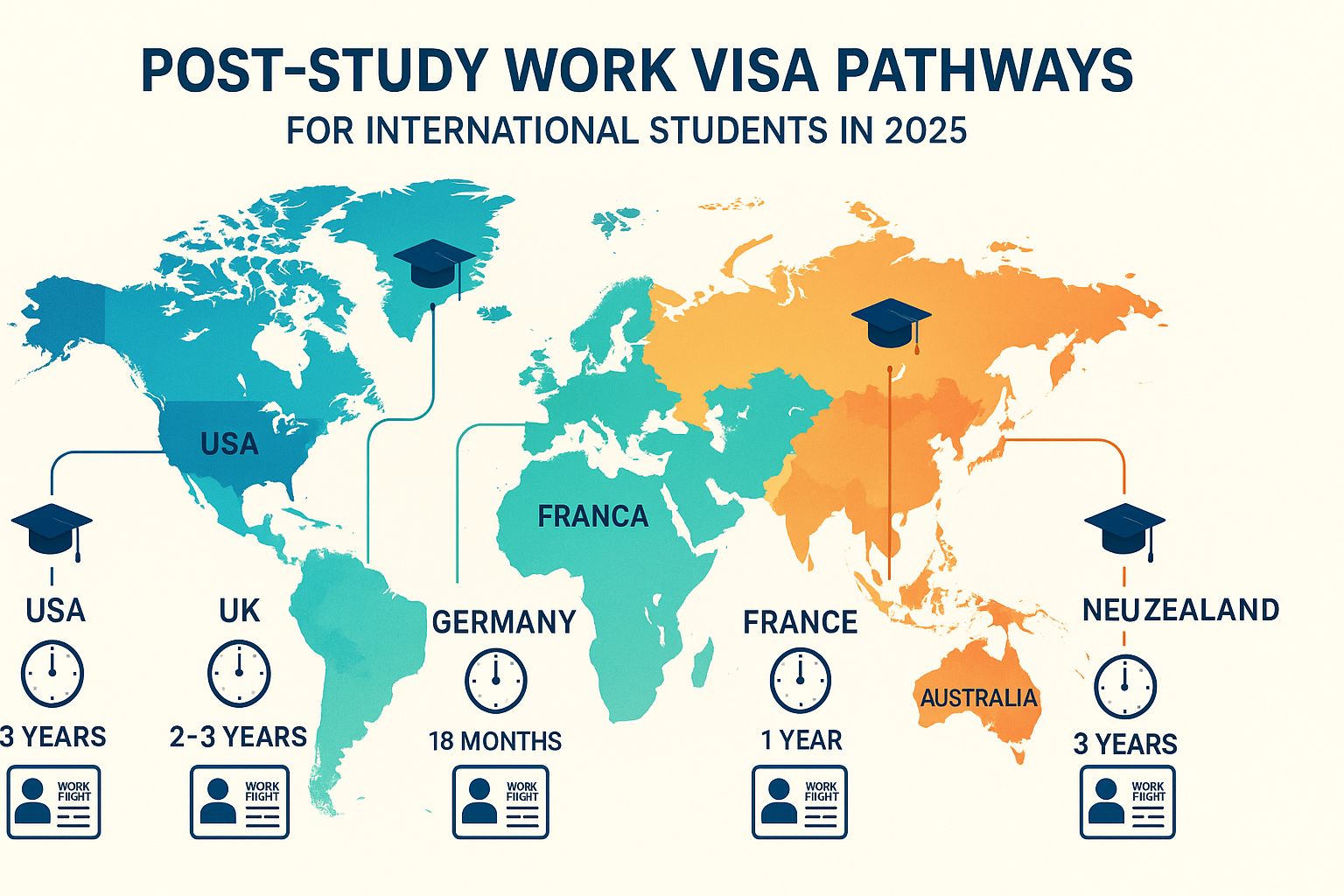
Look. I’ve been doing this for 17 years na? Seen literally 50,000+ students go through this exact same panic mode where they’re like “sir I spent 45 lakhs on my degree and now what??” And trust me, understanding post-study work visas isn’t just important—it’s like SUPER critical for making sure you don’t end up being that person who returns home immediately and then regrets it for the next decade while scrolling through LinkedIn seeing your batchmates living their best life abroad.
Did You Know?
According to recent data (which I literally just pulled up on my other tab), over 85% of international students consider post-study work opportunities as THE primary factor when choosing where to study. But but but… only like 40% actually understand the visa requirements before they graduate! The rest? They’re frantically googling at midnight like you probably are right now.
Understanding Post-Study Work Visas
Alright let me break this down in simple terms because honestly the official websites make it sound like rocket science when it’s really not that complicated…
Post-study work visa = basically your golden ticket to stay and work after you finish studying. Think of it as that buffer period between being a broke student surviving on Maggi and actually earning in dollars/pounds/euros whatever. No need for immediate employer sponsorship which is honestly such a relief because finding a job is stressful enough without having to beg companies to sponsor you from day 1.
wait wait wait let me explain properly—these visas serve multiple purposes:
- Career Launch Pad: Time to find a job without the “GET OUT” pressure
- Experience Builder: International work experience that makes your resume look all fancy
- Pathway to Permanence: Many countries use these as stepping stones to PR (more on this later when my brain is functioning better)
- ROI Maximizer: Finally recover that education loan your dad took from SBI!!
The whole landscape has changed SO much since I started in this field. Back in 2008-09, students had to literally have job offers before graduation or pack their bags. Now? Most countries are like “here, take 2-3 years, figure it out, we need your talent anyway” which is honestly how it should be na?

Rishita Dodiya
“After my MSc at Nottingham Trent, the UK Graduate visa gave me 2 whole years to explore options. Gateway International’s guidance on post-study work rights was invaluable—got a role within 3 months and now I’m on track for Skilled Worker visa!”
Country-Specific Work Visa Policies in 2025
Okay this is where it gets interesting and also where I need more coffee but my machine is making weird noises so chai it is…
🇬🇧 United Kingdom – Graduate Route Visa
UK remains hot favorite among Indian students, and honestly, for good reason only:
- Duration: 2 years for bachelor’s/master’s, 3 years for PhD (they really love PhDs there)
- Work Rights: COMPLETELY unrestricted—work anywhere, do anything, even start your pakoda stall if you want
- Application Window: Must apply before student visa expires (mark this in your calendar NOW)
- Cost: £822 plus that annoying Immigration Health Surcharge (roughly £624/year which is daylight robbery but whatever)
- Processing Time: 8 weeks normally, 5 days if you pay extra for priority (because capitalism)
Important Update for 2025:
Graduate Route unchanged BUT—and this is a big BUT—salary threshold for switching to Skilled Worker visa jumped to £38,700!! That’s like… a lot. Some exceptions for shortage occupations but still, plan accordingly or you’ll be in for a rude shock.
🇺🇸 United States – OPT and STEM OPT
Ah America… land of opportunities and also land of complicated immigration policies that make my head hurt even after doing this for years:
- Standard OPT: 12 months for everyone (yes yes, even liberal arts majors)
- STEM OPT Extension: Extra 24 months if you studied STEM (total 36 months which is actually pretty decent)
- Application Timeline: Can apply 90 days before program ends (don’t wait till last minute I’m warning you)
- Work Authorization: Must be related to your field (no, you can’t work at Starbucks with an engineering degree)
- Unemployment Limit: 90 days max during OPT, 150 for STEM (after that, bye bye visa status)
The beauty of US system? Flexibility to do internships, contract work, full-time, whatever floats your boat. Many students use OPT strategically to get into companies that’ll sponsor H-1B later… though with the lottery system, it’s basically gambling at this point but we don’t talk about that at 2 AM.
🇨🇦 Canada – Post-Graduation Work Permit (PGWP)
Canada… oh Canada… probably the most straightforward and generous program out there (bless them honestly):
- Duration: 8 months to 3 years depending on your program length (studied 2 years? Get 3 years PGWP, simple math)
- Open Work Permit: Work ANYWHERE, for ANYONE, in ANY province (freedom level 100)
- Pathway to PR: This is the real deal—Canadian experience counts big time for permanent residency
- Application Window: 180 days from getting transcripts (that’s 6 months for those who hate math)
- One-Time Only: You get PGWP once in lifetime so don’t mess it up!!
What makes Canada special? Clear pathway from PGWP → PR through Express Entry. Just 1 year skilled work experience and boom, you’re eligible for permanent residency. It’s almost too good to be true but it actually is true which is why everyone and their cousin wants to go to Canada these days…
🇦🇺 Australia – Temporary Graduate Visa (Subclass 485)
Australia—where they literally pay you extra for studying in middle of nowhere (regional areas) because cities are too crowded already:
- Bachelor’s degree: 2 years (standard)
- Master’s (coursework): 2 years (wait, same as bachelors? Yes. Don’t ask me why)
- Master’s (research): 3 years (finally some recognition for research)
- PhD: 4 years (okay now we’re talking)
- Regional Study Bonus: Extra 1-2 years if you studied in regional areas (Perth counts as regional btw, it’s not that bad)
sorry my cat just jumped on my laptop… where was i? Oh yeah, Australia rewards higher qualifications and regional study which actually makes sense if you think about it. Plus the weather is nice if you don’t mind everything trying to kill you (joking… mostly).
🇩🇪 Germany – 18-Month Residence Permit
Germany keeping it simple and efficient like their cars:
- Duration: 18 months flat for job seeking (no discrimination based on degree level, very democratic)
- Work Rights: Can work part-time while job hunting (pay your bills while searching)
- Language Advantage: No German required for visa BUT good luck finding jobs without it
- EU Blue Card: Fast-track to PR if you find qualified job (and by fast I mean German fast, so still some paperwork)
- Cost-Effective: Minimal fees compared to others (like 100 euros vs 1000s of dollars elsewhere)
German system especially good for STEM grads—engineering jobs everywhere, good work-life balance (they actually respect weekends there), and once you get EU Blue Card, whole Europe opens up. Plus, free education if you’re smart enough to study there in first place.
Common Challenges Faced by Indian Students
Alright let’s talk about the real stuff that nobody tells you in those glossy brochures…
1. The Documentation Maze
OMG the paperwork!! I swear they ask for documents that you didn’t even know existed. Bank statements from 6 months, transcripts attested by university, police clearance from every place you lived more than 6 months, your birth certificate (who even knows where that is??), and approximately 73 other papers that you’ll scramble to find at the last minute.
Students always always ALWAYS underestimate time needed for documentation. Then they’re running around like headless chickens trying to get attestations done while their visa deadline approaches… I’ve seen too many meltdowns over this.

Akshit Virdi
“Almost missed UK Graduate visa deadline because didn’t realize needed final transcripts stamped by university. Gateway International’s checklist saved me—they reminded 2 months in advance about every single document!”
2. Financial Pressure During Job Search
Nobody talks about this but… that transition period from student to working professional? Your bank account will cry. Student discounts gone. Accommodation suddenly costs more (no more university housing). Have to look professional (bye bye t-shirts and flip flops). And pressure to start earning because parents keep asking “how’s job search going beta?”
Most students budget for tuition and living expenses during study but forget to keep buffer for job search period. Then they’re surviving on instant noodles again which… been there, not fun.
3. Understanding Work Restrictions
Each country has specific rules and honestly they’re written by lawyers who probably enjoy making simple things complicated. US OPT requires work “directly related” to field of study—but what exactly counts as related? Nobody knows! I’ve seen computer science grads get rejected for data analyst roles because some officer decided it’s not related enough. Makes no sense but welcome to immigration law.
4. Timing and Deadlines
Missing deadlines is surprisingly common and it breaks my heart every time. Students busy with final exams, thesis submission, farewell parties, and suddenly realize their student visa expires next week and they haven’t applied for post-study visa yet. Game over. Pack your bags. All that money and effort wasted because you forgot one date.
Set 17 reminders. I’m serious. Phone, laptop, sticky notes on mirror, ask your roommate to remind you. Whatever it takes.
5. Regional vs Metropolitan Job Markets
Studied in lovely small university town? Great for Instagram, not so great for job hunting. Most opportunities cluster in big cities but guess what—that’s where rent will eat up 70% of your salary. It’s a catch-22 situation that nobody prepares you for.
ugh my eyes hurt from staring at this screen… but this is important so let me continue…
Confused About Documentation?
Don’t let paperwork stress derail your career plans. Our visa experts at Gateway International provide personalized checklists and timeline management for your post-study work visa.
Get Your Free Visa ConsultationKey Eligibility Requirements and Documentation
okay deep breath… this section is crucial so I’m going to try to be systematic even though my brain feels like mush right now.
Universal Requirements Across All Countries:
| Requirement | Details | Pro Tips |
|---|---|---|
| Valid Student Status | Must have completed program successfully | Get completion letter immediately after results—don’t wait!! |
| Timely Application | Apply within specified window (varies by country) | Set reminders 3 months before deadline, not 3 days |
| Clean Immigration History | No visa violations during studies | Keep ALL I-20s, CAS letters safely—you’ll need them |
| Financial Proof | Show ability to support yourself | Maintain consistent bank balance 3 months minimum |
| Health Requirements | Medical insurance, health checks where required | Don’t let insurance lapse between visas—rookie mistake |
Essential Documents Checklist:
📋 Master Document List
- ✓ Passport (valid 6+ months beyond intended stay—check NOW)
- ✓ Current visa/residence permit (obviosly)
- ✓ Degree certificate or completion letter (get multiple copies)
- ✓ Academic transcripts (ALL semesters, yes even that one you failed)
- ✓ Language test scores (if applicable—some expired? Too bad, take again)
- ✓ Bank statements (3-6 months usually, some want more because why not)
- ✓ Police clearance certificates (fun fact: some countries want from India AND study country)
- ✓ Medical examination results (country-specific, Australia loves these)
- ✓ Passport-size photographs (check specifications—wrong size = rejection)
- ✓ Application forms (fill carefully, one typo can delay months)
- ✓ Fee payment receipts (keep copies, they sometimes “lose” records)
Advantages and Opportunities
Finally some good news!! Let’s talk about why all this hassle is actually worth it…
1. Global Work Experience – Your Career Accelerator
Working abroad isn’t just about money (though money is nice too obviously). It’s about becoming that person who can handle anything. Different work culture? Bring it on. International team meetings? You got this. Suddenly you’re not just another BTech/MBA graduate—you’re someone with GLOBAL EXPOSURE *insert jazz hands*
I’ve seen average students become exceptional professionals just because they learned to navigate international work environments. That confidence you gain? Priceless. Plus your LinkedIn profile looks fancy with international experience and we all know LinkedIn is basically professional Facebook now…
2. Financial Freedom and Savings Potential
Let’s talk numbers because numbers don’t lie. Software developer in US on OPT? $70,000-90,000 starting (that’s like 60-75 lakhs INR hello!!). Even after rent, food, occasional splurging on things you don’t need from Amazon, you can save 15-25 lakhs per year easily. Education loan? Cleared in 2 years. Parents’ retirement fund? Started. That Europe trip you’ve been planning since first year? Finally happening.
But but but—don’t go crazy with lifestyle inflation. I’ve seen kids earning in dollars but saving nothing because suddenly they NEED that $200 Canada Goose jacket. Be smart na?
3. Pathway to Permanent Residency
This is the big one. Post-study work visa = foot in the door for PR in most countries. Canada explicitly says “work here for a year and apply for PR”—it’s literally that straightforward. Even countries like UK, Australia making it easier if you have local work experience.
Think long term. That 2-3 year work visa could lead to permanent residency, then citizenship, then your kids growing up with opportunities you could only dream of. Deep stuff for 3 AM but that’s reality.
4. Skill Enhancement and Industry Exposure
You know what’s cool? Working on actual cutting-edge stuff instead of textbook problems. AI projects that actually get deployed. Financial models that move millions. Healthcare tech that saves lives. This exposure is what separates you from peers back home still doing “digital transformation” projects that nobody understands.
wait my roommate just asked me to keep it down… typing quieter now (is that even a thing?)
Priya Sharma
“3-year PGWP in Canada transformed everything. Started as junior analyst, became senior consultant. AI projects exposure in Toronto gave skills that got me director position when returned to India. ROI on education? Recovered in just 18 months!”
5. Building International Networks
Your colleagues become your global network. That random guy from Brazil in your team? He might offer you a job in São Paulo 5 years later. Your Chinese roommate? Future business partner. These connections are worth more than any degree honestly.
6. Personal Growth and Confidence
Living alone in foreign country, managing finances, dealing with different cultures, surviving winter when you’ve lived in Chennai all your life… these experiences build character. You become more confident, adaptable, and honestly just a more interesting person. Your Tinder bio practically writes itself (kidding… or am I?)

Find Your Best Post-Study Work Visa Option
Answer a few questions to discover which country’s post-study work visa best matches your career goals and preferences. Our smart assessment considers visa duration, work flexibility, and pathway to residency.
Question 1 of 4
What’s your field of study?
Step-by-Step Application Process
Alright buckle up because this is where rubber meets road and also where most students mess up spectacularly…
Phase 1: Pre-Graduation Preparation (3-6 Months Before)
✅ Action Items:
- Research visa options: Don’t just read official websites—join Facebook groups, Reddit threads where real people share real experiences
- Document collection: Start NOW not later (I’m looking at you procrastinators)
- Financial planning: Calculate how much you need for application + survival money for job hunting period
- Timeline mapping: Use Google Calendar, physical diary, tattoo on your arm—whatever works
- Network building: Connect with alumni who’ve done this—they know secrets Google doesn’t
Phase 2: Application Preparation (1-2 Months Before)
This is crunch time and no, you can’t wing it:
- Confirm Eligibility: Double-check, triple-check, ask your friend to check
- Complete Applications: One typo = weeks of delay (learned this hard way)
- Prepare Supporting Documents: Get everything notarized/attested—yes it’s annoying but necessary
- Write Cover Letters: Some countries want to know your “plans”—be vague but convincing
- Book Appointments: Biometrics slots fill fast, don’t be that person scrambling last minute
Phase 3: Submission and Follow-up
The submission process varies but these principles are universal truths:
- Submit Early: Not on deadline day when servers crash and you’re crying
- Keep Copies: Digital AND physical—paranoia is your friend here
- Track Status: Check online portals obsessively (but maybe not at 3 AM like I do)
- Respond Promptly: They ask for additional docs? Send yesterday
- Stay Legal: Don’t let current visa expire while waiting—rookie mistake with serious consequences
⚠️ Common Mistakes to Avoid:
- Letting student visa expire before applying (seriously why do people do this??)
- Working illegally while application pending (they WILL find out)
- Providing inconsistent information across documents (computers catch everything now)
- Missing biometric appointments (no excuse accepted, not even “I overslept”)
- Forgetting to update contact info (then wondering why you didn’t get updates)
Strategic Considerations for Success
OK listen up because this is the stuff that separates successful students from those posting sad stories on Quora…
1. The Early Bird Advantage
Start job hunting in final semester itself!! I cannot stress this enough. Everyone waits for visa approval but smart ones already have interviews lined up. Companies have long hiring processes—sometimes 3-4 months from application to offer. Starting early means multiple chances at success instead of desperate last-minute applications to any company that’ll take you.
2. Location Strategy
Big cities = more opportunities but also more competition and crazy expensive. Second-tier cities might be goldmine—less competition, lower costs, companies desperate for talent. Don’t just follow herd to London/NYC/Toronto. Sometimes Birmingham/Austin/Calgary offers better quality of life and savings potential.
coffee break brb… ok so where was I?
3. Skill Gap Analysis
That gap between academic knowledge and industry requirements? It’s real and it’s huge. Use initial months to upskill—online courses, certifications, whatever. The transition period is perfect for this because you have time and motivation. Don’t waste it binge-watching Netflix (okay maybe a little Netflix but mostly learning).
4. The Power of Professional Associations
Join professional bodies in your field IMMEDIATELY after graduation. They have job boards, networking events, mentorship programs—basically everything you need but don’t know you need. Many offer student/new grad rates that are super affordable. It’s like having insider access to job market.
5. Documentation for Future Visas
Think beyond immediate visa na? Document EVERYTHING—pay stubs, tax returns, employment letters, project details, performance reviews. When applying for work visas or PR later, you’ll need proof of everything. That project you led? Get it in writing. That promotion? Official letter please. Future you will thank present you.
Country Comparison Table
Made this table after my 5th cup of chai because visuals help when brain is fried:
| Country | Visa Name | Duration | Work Restrictions | Cost (USD) | PR Pathway |
|---|---|---|---|---|---|
| 🇬🇧 UK | Graduate Route | 2 years (3 for PhD) | None—complete freedom!! | $1,000-1,200 | Via Skilled Worker (tough) |
| 🇺🇸 USA | OPT/STEM OPT | 12-36 months | Field-related only (strict) | $410 | H-1B lottery (good luck) |
| 🇨🇦 Canada | PGWP | 8 months – 3 years | Open work permit | $255 | Express Entry (best option) |
| 🇦🇺 Australia | Subclass 485 | 2-4 years | Unrestricted | $1,680 (ouch) | Skilled Migration |
| 🇩🇪 Germany | Job Seeking Permit | 18 months | Part-time allowed | $100 (bless them) | EU Blue Card |
| 🇫🇷 France | APS Visa | 12 months | Any employment | $99 | Talent Passport |
| 🇳🇿 New Zealand | Post-Study Work | 1-3 years | Open conditions | $375 | Skilled Migrant |
Create Your Winning Statement of Purpose
A compelling SOP can make the difference in your visa application. Use Gateway International’s free AI-powered SOP generator to craft a professional statement that highlights your career goals.
Generate Your SOP FreeVisa Extension and Transition Options
Your post-study visa ending doesn’t mean game over—it’s just level 2 beginning…
Transitioning to Work Visas
Most countries let you switch from post-study to employer-sponsored visas but—and this is important—you need job offer meeting certain criteria. Not just any job at local grocery store (though respect to grocery store workers, just not valid for visa purposes).
- UK: Need job paying £38,700+ (or £30,960 for some roles but it’s complicated)
- USA: H-1B lottery where odds are worse than IPL auction
- Canada: Just need job offer—no lottery, no drama (Canada being sensible as usual)
- Australia: Employer nomination required which means company really needs to want you
- Germany: EU Blue Card if you earn enough (around €56,800 but less for shortage occupations)
The Permanent Residency Timeline
For those playing long game (smart move btw), here’s realistic timeline:
| Country | Work Experience Needed | Typical Timeline to PR | Success Rate |
|---|---|---|---|
| Canada | 1 year skilled work | 2-3 years total | High (70%+) |
| Australia | 2-3 years skilled | 3-5 years total | Moderate (50%+) |
| UK | 5 years continuous | 5-6 years total | Moderate (40%+) |
| Germany | 2 years with Blue Card | 2-5 years total | High (60%+) |
| USA | Varies by category | 5-15 years (country-dependent) | Low (Indian queue is… let’s not talk about it) |
Alternative Pathways
Don’t put all eggs in one basket only. Smart students explore multiple options simultaneously:
- Entrepreneurship Visas: UK, Canada, Netherlands offer startup visas if you have “innovative” idea (definition of innovative varies wildly)
- Investment Routes: Have rich parents? Some countries offer residency through investment (Portugal, Greece etc)
- Partner/Spouse Visas: Fall in love with citizen/PR holder (but genuinely please, immigration fraud is serious)
- Further Education: Another degree can reset your post-study work eligibility (expensive but works)
- Intra-Company Transfers: Join MNC that can shuffle you between offices like corporate chess
Latest News and Policy Updates
📰 Latest Updates – January 2025
- BBC News: UK maintains Graduate Route despite review—international students can breathe easy as 2-year post-study visa stays unchanged for 2025 intakes
- CNN: US Congress discussing STEM OPT extension to 4 years—bipartisan support growing (miracles do happen)
- Times of India: Record 325,000 Indian students chose Canada in 2024, PGWP remains biggest attraction despite minor tweaks
- NDTV Education: Germany streamlines job-seeker visa process for Indian grads—processing cut to 4 weeks (German efficiency finally!)
- Financial Times: Australia extends work rights by 2 years for healthcare and engineering grads (skill shortage benefits you)
- Study International: New Zealand goes fully digital for post-study work visa applications from March 2025 (no more paper forms!!)

Ready to Plan Your Post-Study Career?
Don’t leave your future to chance. Gateway International’s expert counselors have helped over 50,000 students navigate post-study work visas successfully. Get personalized guidance for your specific situation.
Book Your Free ConsultationConclusion
So here’s the thing…
Your post-study work visa isn’t just some bureaucratic formality—it’s literally your launching pad to everything you dreamed about when you first decided to study abroad. The opportunities are INSANE but only if you plan properly and don’t mess up the basics.
Look, I’ve seen thousands of students over 17 years. The successful ones? They didn’t have some secret formula or extraordinary talent. They just understood the system, prepared thoroughly, and grabbed opportunities when they came. That expensive degree you’re getting? Post-study work experience is what transforms it from expensive paper to actual career catalyst.
Whether you choose UK’s flexibility, US’s tech opportunities, Canada’s PR pathway, or anywhere else—just make sure you’re making informed decision, not following what your friend’s cousin did. Your journey is unique na?
At Gateway International, we’ve literally held hands of 50,000+ students through this exact journey. We know where people mess up, what works, what doesn’t. We’re here to make sure you’re not just another applicant but someone who’s prepared to squeeze every opportunity from their international education.
Your graduation isn’t the end—it’s literally just the beginning. Make it count!!
(Also please start documentation early. I’m begging you. My heart can’t take more last-minute panic calls.)
About the Author
Abhinav Jain
Founder & Director at Gateway International | IIT Delhi Alumni | 17+ Years in International Education
With over 50,000 successful student placements across 600+ universities worldwide, Abhinav has dedicated his career to making international education accessible to Indian students. His expertise in post-study work visas and career planning has helped thousands of students build successful international careers.
Frequently Asked Questions
Yes yes most countries made special provisions!! UK, Canada, Australia accept online study between 2020-2022 as qualifying for post-study visas. BUT—you must have completed at least some portion in-country. Rules keep changing so check latest guidelines. Don’t assume anything in immigration law.
Depends on country na? UK and Canada—you can stay unemployed entire period, no issues (just your bank balance crying). US OPT has strict 90-day limit after which visa gets cancelled. Use unemployment time wisely—upskill, volunteer in your field, network like crazy. Sitting at home watching Netflix won’t help (trust me, I tried).
Generally yes BUT—always check if visa is multiple-entry and valid for re-entry. For US OPT, need valid employment and proper docs. Some people leave during unemployment and can’t return—don’t be those people. Always carry employment letters, pay stubs when traveling. Immigration officers love documentation.
Canada wins hands down!! Just 1 year skilled work experience = eligible for Express Entry. Australia good with points system. Germany fast-tracks through EU Blue Card. US… well… if you’re Indian, prepare for loooong wait (like 10-15 years long). UK possible but getting tougher with higher salary requirements.
We provide A to Z support—from pre-departure orientation about work rights to actual visa application assistance after graduation. Document prep, timeline management, mock interviews, career counseling—everything. Plus our network of 50,000+ alumni means real insights from people who’ve done this journey. We don’t just process applications, we ensure you succeed. Too many students wing it and regret later… don’t be them!