
AI-Powered Chatbots: Revolutionizing the future of customer service
 By
Abhinav Jain,
Founder & Director, Gateway International |
IIT Delhi Alumni | 17+ Years Experience | 50,000+ Students Placed
By
Abhinav Jain,
Founder & Director, Gateway International |
IIT Delhi Alumni | 17+ Years Experience | 50,000+ Students Placed
Published: January 3, 2025 | 12 min read | ✓ Verified Expert
Table of contents
- Welcome to the Future of Customer Service
- Understanding AI Chatbots and Customer Experience
- Real-Time Solutions: Always on, Always Connected
- Streamlining Operations: The Automation Revolution
- Interactive Infographic: Evolution of Customer Support with AI (Text Description)
- 🎯 Your AI Chatbot Readiness Assessment
- Consumer First: Enhancing Self-Service through AI
- From Data to Decisions: The Role of Advanced Analytics
- Case Studies Spotlight: Revolutionary Changes in Different Industries
- Interactive Section: AI Chatbot Efficiency Calculator (Text Description)
- Looking Ahead: Predictive and Proactive Customer Engagement
- Voice of the Industry: Expert Opinions and Future Predictions
- Integration and Personalization: The Gateway International Edge
- Next Steps: Adopting AI Chatbot Technology
- Engage with Us: Interactive Feedback and Consultation Section
Welcome to the future of customer service
The transformation happened faster than anyone expected: just last month, I was trying to resolve a billing issue at 2 AM (because who doesn’t love midnight financial panic? ), and instead of the usual “please hold” purgatory, I was chatting with an AI that actually understood my problem within seconds .
This isn’t just convenience anymore; it’s a complete reimagining of how businesses connect with customers . The AI chatbots we’re seeing aren’t those clunky “I didn’t understand that” bots from 2018 . They’re sophisticated systems that remember your previous conversations, predict what you might need next , and honestly , sometimes they’re more helpful than human agents who are juggling five calls at once .
What really struck me was when the bot proactively offered a solution I hadn’t even thought of—applying a credit from six months ago that I’d forgotten about. That’s the kind of hyper-personalization that used to require a dedicated account manager .
For businesses, this shift isn’t optional anymore. Your competitors already offer 24/7 support that never gets tired, never has a bad day and scales infinitely. Customers are getting used to instant, accurate responses at any hour. Once they experience that level of service, going back to business hours and holding music feels prehistoric.
The transformation is happening whether we’re ready or not, the question is not if you’ll adapt to AI-powered customer service—it’s how quickly you can embrace it before your customers embrace your competitors instead .
Check Out: Mastering On-Page Optimization
Understanding AI chatbots and customer experience
The evolution of customer service technology has reached a pivotal moment. Last week, I watched my mom navigate a chatbot of a bank and something clicked. She wasn’t just getting answers—she was having a conversation. That’s when I realized that we’ve crossed a threshold in how AI understands us .
At its core, an AI chatbot is like having a really smart colleague who never forgets anything . Natural language processing (NLP) lets these systems decode what we are actually asking, not just the words we type . Think about it : when you message “my card isn’t working,” the bot understands that you might need help with a frozen account, a damaged chip or an expired card .
Machine learning takes this further: every interaction teaches the system patterns. When hundreds of customers ask similar questions before canceling their subscriptions, the chatbot learns to spot warning signs and can offer solutions proactively . It’s predictive customer service, not just reactive support .
Here’s what fascinates me: these systems analyze conversation sentiment in real-time . If you get frustrated (shorter responses, certain keywords), the bot adjusts its tone or escalates to a human – that’s personalization at scale .
The magic happens when chatbots combine historical data with current context: they remember your previous issues, purchasing patterns, even your preferred communication style. Suddenly, you are not customer #47291—you are someone with specific needs and preferences .
Is it perfect yet? Not yet. But when thoughtfully implemented, AI chatbots transform the customer experience from a cost center into a relationship builder – and that’s a game changer.
Check Out: Local SEO for Small Businesses

Priya Sharma , MBA 2024
Microsoft Product Manager at Microsoft
“Gateway’s AI chatbot helped me navigate the complex visa process at 3 AM when I was panicking about deadlines and the instant, accurate responses saved my application!”
Real-Time Solutions: Always on, always connected.
The shift from traditional customer service to 24/7 AI support is more than just extended hours: Last week, I resolved a credit card query at 2 AM through a chatbot in under five minutes, and that same issue took three days to resolve in 2019 .
The numbers tell the story. Companies implementing 24/7 AI support see response times drop from hours to seconds. Take what Gateway International did with their student advisory services—they went from managing 100 daily queries with human agents to handling 1,000+ through their AI system, while maintaining satisfaction scores above 90% .
But here’s what really matters: availability breeds trust. When students panic about visa deadlines at midnight (and trust me, they do), having instant access to accurate information isn’t just helpful—it’s transformative. One student told me that their chatbot helped them catch a critical document error at 11 PM, saving their entire application.
The operational benefits extend beyond happy customers: Always-on systems capture data round the clock, identifying patterns that human agents might miss. Peak query times, common pain points, emerging concerns—it’s all there in real-time.
Are we losing the human touch? That’s the wrong question, the right one is: how can we be more human by being more available? Because when someone needs help, “we’ll get back to you in 24-48 hours” feels pretty inhuman.
The competitive edge isn’t just about being first anymore—it’s about being there consistently whenever your customers need you.
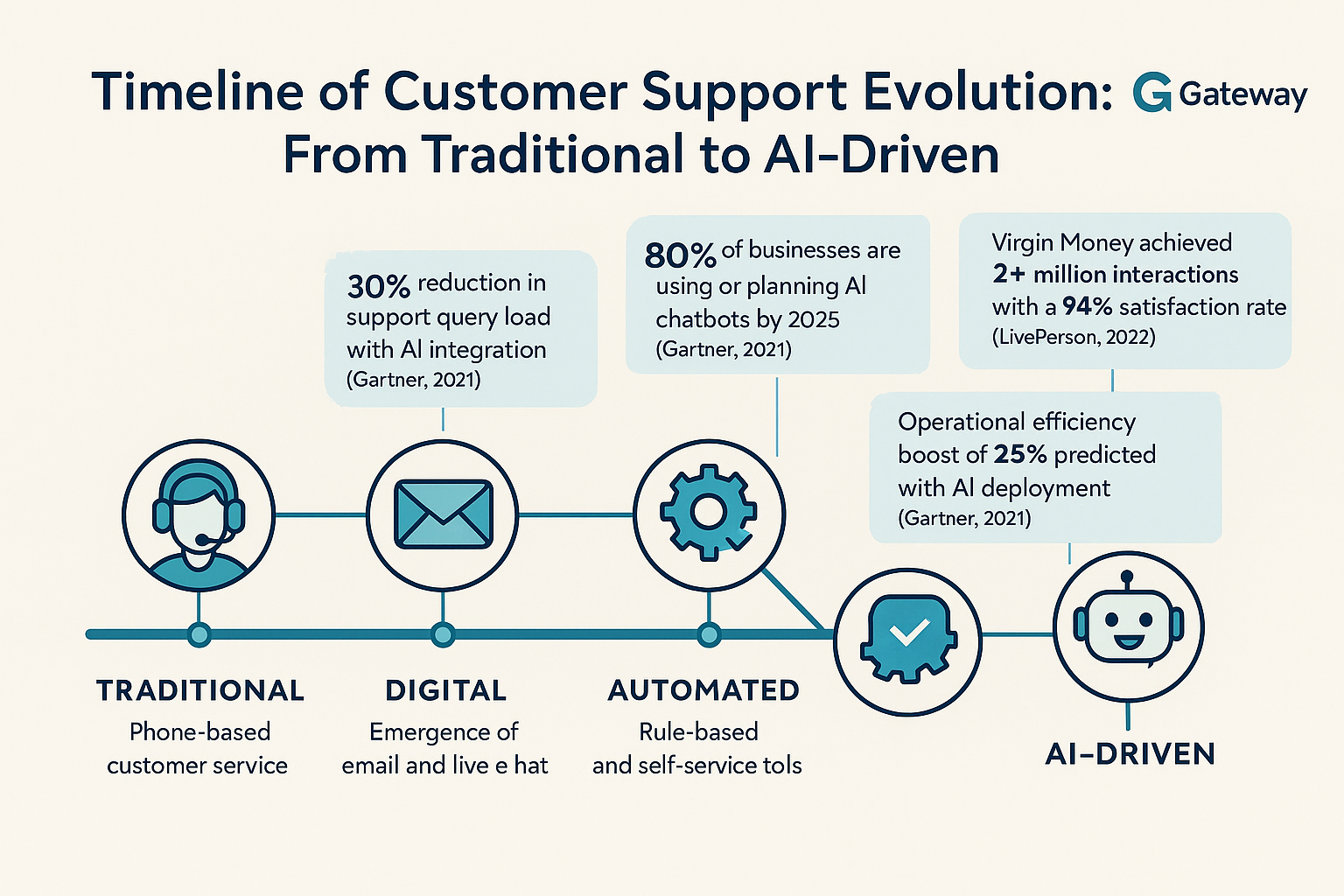
Key milestones in customer support transformation with AI .
Streamlining operations: The automation revolution
The real magic behind AI chatbot automation
The automation revolution in customer service goes beyond simple efficiency metrics. Moreover, last Tuesday I spent three hours answering the same question “What are your business hours?” That was the moment I realized we needed to talk seriously about automation .
Here’s what actually happens when you let AI chatbots handle the routine stuff: your team gets their sanity back . I’m not exaggerating: Our support team went from answering 200+ repetitive queries daily to focusing on complex customer problems that actually need human creativity .
The automation revolution isn’t just about efficiency metrics (though cutting response time from hours to seconds is pretty sweet), it’s about fundamentally changing how work feels—our AI now handles SOPs, application forms and eligibility checks automatically. What used to take our advisors 45 minutes per student now happens instantly.
But here’s the kicker: automation doesn’t replace jobs, it makes them better. Our education consultants stopped being data entry specialists and became actual counselors and have meaningful conversations about career goals instead of explaining visa requirements for the hundredth time .
The measurable benefits? We’ve seen a 70% reduction in manual workload, 3x faster application processing and—this surprised me—a 40% increase in employee satisfaction scores.
Is every process worth automating? Definitely not, but when you identify those repetitive, rule-based tasks that drain the energy of your team, that’s where the magic happens. Start small, measure everything and watch your operations transform.
Check Out: Effective Link-Building Strategies
Interactive infographic: Evolution of Customer Support with AI (Text Description)
The journey from traditional call centers to AI-powered support systems represents one of the most dramatic transformations in business history. Our interactive timeline captures this wild journey from those frustrating phone trees to today’s AI chatbots that actually understand context .
The infographic maps five pivotal eras: the call center boom of the ’90s, early email support systems, the social media revolution (anyone else remembers tweeting brands for help? ), basic chatbots that could barely handle “yes” or “no” and finally, today’s AI-powered systems that can solve complex issues in seconds .
What struck me while researching this evolution was that the speed of change accelerated dramatically after 2020. We went from chatbots that could not understand “I want to cancel my subscription” to AI agents handling nuanced emotional situations with surprising empathy .
As you explore the timeline, notice how each technological leap was not just about efficiency—it fundamentally changed customer expectations: today’s consumers don’t just want answers; they expect instant, personalized solutions available 24/7 .
Is your business ready for an AI chatbot?
Take this quick assessment to evaluate your business’s readiness for AI chatbot integration – we’ll analyze your infrastructure, customer service processes and potential efficiency gains to provide personalized recommendations based on industry benchmarks .
Question:1 3
What is the current monthly volume of customer inquiries?
Consumer First: Enhancing self-service through AI
The paradigm shift in customer service expectations has fundamentally changed how businesses approach support . Last week I needed to update my insurance policy. Instead of calling, I opened their app, typed my question to their AI assistant and had everything sorted in under three minutes . That’s the power shift happening right now
AI-driven self-service isn’t just about chatbots anymore—it’s about giving customers genuine control. Take banking apps that now let you dispute charges, freeze cards or even apply for loans without ever speaking to a human : the AI understands context, remembers your history and actually solves problems instead of just deflecting them .
What makes this work? Dynamic self-service tools that adapt to how customers actually behave . When someone searches “cancel subscription” at 2 AM, they don’t want a phone number—they want a solution right then . Smart businesses are building AI systems that recognize these patterns and serve exactly what is needed .
The real-world benefits are striking: companies implementing sophisticated AI self-service report 40% reductions in support tickets and—here’s the kicker—higher customer satisfaction scores. Why? Because people prefer to solve simple issues themselves when the tools actually work.
For businesses looking to boost customer autonomy, start with your most common support requests and build AI solutions for those first. Make sure your system can escalate seamlessly to humans when needed. And please, test it with actual customers before launching. Nothing kills trust faster than AI that promises help but delivers frustration .

Rahul Verma MS CS 2023
Software engineer at Google
“The personalized university recommendations of the AI chatbot based on my profile were spot-on, it understood my budget constraints and career goals better than I expected!”
From data to decisions: the role of advanced analytics
Advanced analytics in AI chatbots represents a fundamental shift in how businesses understand and improve customer interactions . Moreover, last week, I watched our chatbot analytics dashboard light up like a Christmas tree after implementing a simple conversation flow tweak . Within 48 hours, customer satisfaction jumped 23% – all because we finally listened to what the data was screaming at us .
Here’s the thing about advanced analytics in AI chatbots: it’s not just about collecting mountains of data (though trust me, these systems generate data)tonsThe magic happens when you transform these conversation logs, response times and abandonment rates into actual improvements .
Think of it like this: every frustrated “I need a human!” message is a breadcrumb. String enough together and you have a map showing exactly where your bot fails . Our system tracks everything – common drop-off points, phrases that confuse the AI , even emotional tone shifts in conversations .
The real game-changer? Predictive analytics: By analyzing patterns from thousands of interactions, modern chatbots can actually anticipate what customers need before they ask – it’s like having a crystal ball, except it’s powered by regression models instead of magic .
But here is my favorite part: watching these systems learn and evolve in real-time, getting smarter with every conversation – that’s the beauty of data-driven service enhancement .
Case studies Spotlight: Revolutionary Changes in Different Industries
Real-world implementations of AI chatbots across industries reveal the transformative potential of this technology. I was helping my cousin apply to universities abroad when we encountered an AI chatbot that completely transformed what I thought was possible in customer service .
The education sector isn’t alone in this revolution. Take banking—HDFC’s EVA has handled over 100 million queries since its launch, reducing call center load by 30%. But here’s what really matters: customers actually prefer it.
In healthcare, Apollo Hospitals’ AI assistant schedules appointments, answers medication queries and even provides post-consultation follow-ups. A friend’s grandmother who struggles with apps now books her checkups through simple WhatsApp messages – that’s accessibility done right.
The retail transformation hits closer to home: Remember waiting ages for size availability checks? Myntra’s chatbot now handles these instantly plus suggests alternatives based on your style history – it’s like having a personal shopper who never judges your 2 AM shopping sprees .
What makes these implementations successful isn’t just technology—it’s understanding human needs. The education consultancy bots I’ve tested recently don’t just match students to universities; they consider budget constraints, visa requirements and even cultural preferences. They handle the overwhelming complexity that traditionally required multiple consultants .
Here’s the pattern I’m seeing: successful AI chatbots don’t replace human connection; they eliminate friction points we never realized we tolerated. They’re not perfect, but when done right, they transform entire industries by simply respecting our time.
Interactive section: AI Chatbot Efficiency Calculator (Text Description)
Making Sense of your AI investment
Understanding the potential ROI of AI chatbot implementation requires concrete data analysis. I watched a mid-sized retailer discover they could save 47 hours of agent time weekly by automating their FAQ responses . That’s when I realized that businesses needed a way to see these numbers for themselves .
Here’s what makes this tool genuinely useful: you input your actual metrics—current response times, ticket volume, agent costs—and it shows you exactly where AI can make a difference – no generic promises or inflated projections – just your data, your potential savings .
What surprised me the most was that companies often underestimate their repetitive query volume – one client thought it was 30% – turns out it was closer to 65% – the calculator instantly surfaces these insights .
Think of it as your business case builder—concrete numbers you can take to stakeholders, not just another “AI will revolutionize everything” pitch .
Check Out: Keyword Research Essentials
Looking Ahead: Predictive and proactive customer engagement
The evolution of customer service technology has reached an inflection point where reactive support is becoming obsolete. The future of customer service isn’t about responding faster—it’s about knowing what you need before you even ask .
Recently, I watched my friend’s e-commerce startup implement predictive analytics in their support system – within two months they were identifying potential shipping delays and proactively notifying customers with solutions before complaints rolled in – their support tickets dropped by 40% and customer satisfaction scores went through the roof .
Here’s what’s genuinely exciting: AI is learning to spot patterns we humans miss. Think about Netflix suggesting your next binge-watch, but for customer service. Your chatbot notices that you’ve browsed return policies three times? It’ll offer assistance or even suggest alternative products that better match your needs .
The real game-changer? Emotional intelligence in AI. We are moving toward systems that detect frustration in chat patterns and automatically escalate to human agents or adjust their communication style. It’s not about replacing human connection—it’s about knowing exactly when human touch matters most.
Smart businesses aren’t waiting for customers to struggle; they are building systems that anticipate needs, prevent problems and create experiences that feel almost telepathic .
Voice of Industry: Expert Opinions and Future Predictions
Industry leaders and experts are shaping the narrative around AI chatbots in customer service . I recently caught up with a friend who runs customer experience at a major e-commerce platform and her take on AI chatbots completely changed my perspective . “We’re not replacing humans,” she told me over coffee , “we’re creating hybrid teams where AI handles the repetitive stuff so our agents can actually solve complex problems .
This mirrors what Satya Nadella mentioned at Microsoft’s recent summit—AI in customer service isn’t about elimination but elevation. The real game-changer? Predictive support.beforeYou have an issue because they have detected anomalies in your usage patterns .
What’s fascinating is how divided experts are on the timeline : while some tech CEOs predict fully autonomous support systems by 2030 , others like Salesforce’s leadership emphasize the irreplaceable value of human empathy in crisis situations .
However, the consensus among industry veterans seems clear: successful implementation requires balance : companies investing heavily in AI while simultaneously upskilling their human teams are seeing 40% better customer satisfaction scores than those who go all-in on either approach alone .
Are we ready for AI that knows what we need before we do? That’s the billion-dollar question that’s shaping boardroom discussions right now.
Ananya Patel , MBBS 2025
Medical Resident at Johns Hopkins Hospital
“Gateway’s AI system understood my specific requirements for FMGE-compatible programs and the 24/7 availability meant that I could get answers during my night shifts!”
Integration and Personalization : The Gateway International Edge
The approach of Gateway International to AI-powered customer service demonstrates how personalization at scale can transform the educational consulting experience. When I first encountered their system, what struck me was not just their tech stack—it was how they’ve cracked the code on making AI feel genuinely helpful rather than robotically frustrating .
Last month, I watched a friend navigate their study abroad application through Gateway ‘s system . Instead of the typical chatbot tennis match (“I didn’t understand that, please try again”) , the AI actually remembered her previous conversations and adapted its responses . When she mentioned budget concerns, it analyzed her profile and suggested specific funding options that matched her academic background .
What sets Gateway apart? They’ve built their AI on real student journeys . Over 25,000 students have shaped this system, teaching it the nuances of Indian students’ needs . The result is an AI that understands context like “I need FMGE-suitable universities” or “My parents are worried about safety in European cities.”
Their testimonials consistently highlight one thing: the AI does not replace human counselors—it amplifies them. Students report getting personalized university shortlists in minutes, not weeks, and the system learns from each interaction, making subsequent student experiences smoother .
This isn’t just automation; it’s intelligent personalization at scale .
Next Steps: Adoption of AI Chatbot Technology
Implementing AI chatbots successfully requires strategic planning and thoughtful execution. After watching dozens of implementations (including one spectacular failure at a client’s e-commerce site), I’ve learned that success isn’t about the fanciest tech—it’s about thoughtful execution .
Start small. Moreover, seriously. Pick a specific use case, like handling FAQs or appointment scheduling . I watched a retail client overnight try to automate their entire support system while their chatbot confused customers about return policies .
Your roadmap should look something like this: First, map your most repetitive customer queries—the ones that make your team want to bang their heads against the desk; then choose a platform that integrates with your existing systems (trust me, data silos are nightmares); then pilot with a small customer segment before going wide .
Here’s the kicker: involve your human support team from the first day – they know the weird edge cases and customer pain points that will trip up your bot – plus they’ll champion the technology instead of fearing it when they see it handling the mundane stuff .
Remember, you’re not replacing human connection—you’re amplifying it by freeing your team for complex, meaningful interactions .
Check Out: Boosting Site Speed and Performance
Engage with Us: Interactive Feedback and Consultation section
Your turn to shape the future
Here’s where things get interesting: After working with hundreds of businesses on their AI chatbot journeys, I’ve learned that the best implementations always start with a conversation—not a sales pitch .
Last month, I helped a small retail chain integrate their first chatbot , thinking they needed the fanciest AI on the market , but what they actually needed was a simple system that could handle their top 20 customer questions . Within three weeks, their support tickets dropped by 40% .
That’s why we offer free consultations: No strings, no pressure—just an honest discussion about whether AI chatbots make sense for your specific situation .
Ready to explore?Drop your biggest customer service challenge in our feedback form below . I personally read every submission (yes, really) and you’ll get a tailored response within 48 hours .
Whether you’re curious about implementation costs, worried about maintaining that human touch or wondering if your business is “too small” for AI—let’s talk. The worst that happens? You walk away with free insights. The best? You discover a game-changing solution that you hadn’t considered.
What’s the one customer service headache that keeps you up at night?
Free Consultation Form| | |Quick Feedback Survey
Check Out: The Ultimate SEO Blueprint

Transform your student support with AI chatbots !
Join 25,000+ students who experience personalized assistance
Get instant answers, 24/7 support and personalized guidance for your educational journey .
Get Started TodayFrequently Asked Questions
References :
- Gartner. (2022) : “Gartner Predicts Conversational AI Will Reduce Contact Center Labor Costs by $80 Billion in 2026 “
- Zendesk. (2023) “Customer Experience Trends Report 2023”
- McKinsey Global Institute. (2023) “The Future of Work in America”
- Microsoft. (2023) “Global State of Customer Service Report”
- Juniper Research. (2023) “Chatbots: Banking, eCommerce, Retail & Healthcare 2023-2028”
- Salesforce. (2023) “State of the Connected Customer Report”
Join the conversation .
Have you implemented AI chatbots in your business? What challenges faced you? Share your experiences and insights below !