
Table of contents
- Embracing the Adventure: An Introduction to Living Abroad
- Understanding the Financial Implications of Studying Abroad
- The Psychological Toll: Emotional Exhaustion Explored
- Building a New Community in a Foreign Land
- Staying Connected with Home: Strategies to Combat Loneliness
- Navigating Cultural Differences with Confidence
- Financial Planning Deep Dive: Managing Your Budget Overseas
- 📊 Your Emotional Readiness Assessment
- Dealing with Stress and Anxiety: Support Systems and Resources
- Real Stories from the Field: Gateway Alumni Experiences
- Coping Mechanisms: Building Emotional and Financial Resilience
- Planning Your Journey: Costs, Cultures, and Emotional Considerations
Living abroad: A Complete Guide to Emotional & Financial Challenges for International Students
 By
Abhinav Jain,
Founder & Director, Gateway International |
IIT Delhi Alumni | 17+ Years Experience | 50,000+ Students Placed
By
Abhinav Jain,
Founder & Director, Gateway International |
IIT Delhi Alumni | 17+ Years Experience | 50,000+ Students Placed
Published: January 3, 2025 | 12 min read | ✓ Verified Expert
Embracing the adventure: An Introduction to Living Abroad
Picture this vivid scene: You’re scrolling through Instagram, seeing friends posting from Times Square or the Eiffel Tower and thinking, “That could be me.” The excitement is real—trust me, I’ve been there. But here’s what those perfectly filtered photos don’t show: the anxiety attacks at 3 AM about visa paperwork, or crying in a foreign grocery store because you can’t find anything familiar .
Living abroad isn’t just about collecting passport stamps, it’s a beautiful, messy contradiction—exhilarating freedom mixed with bone-deep exhaustion. You are simultaneously living your best life and questioning every decision that brought you there .
The financial reality? It hits different when you convert every purchase into rupees and watch your savings evaporate faster than Mumbai rain. But the emotional toll? That’s the part nobody prepares you for: the constant code-switching, explaining your culture, missing family weddings and feeling like you’re living between two worlds.
Here’s where smart planning becomes your lifeline. Companies like Gateway International understand this dual challenge—they’ve seen thousands of students navigate these waters. They know that it’s not just about getting you admitted; it’s about preparing you for the reality of transplanting your entire life.
Building emotional resilience isn’t optional—it’s survival. Whether it’s finding your tribe in a new city, maintaining connections back home or simply learning when to say “I need help” these strategies matter as much as your bank balance .
Ready to dive deeper? Let’s unpack what this adventure looks like really.
Understanding the financial implications of study abroad
Three years ago, I sat in a Delhi café with my laptop open to seventeen different tabs—currency converters, university fee structures and a spreadsheet that looked like it was having a nervous breakdown. The numbers kept climbing and I kept telling myself there had to be a way to make this work without selling a kidney .
Here’s what nobody tells you about studying abroad costs: it’s not just the big-ticket items that will get you: Sure, everyone knows about tuition fees (which can range from 5 lakhs to 40 lakhs annually depending on your destination), but it’s the death of a thousand cuts that really test your budget .
Take my first month in Manchester—I’d budgeted £800 for living expenses and felt pretty smart about my calculations. Consequently, reality check? I spent £1,200. Those “small” expenses add up fast: the £60 bedding set because your accommodation came unfurnished, the £40 kitchen essentials, the £15 student society memberships that somehow feel mandatory. And don’t even get me started on the emotional support coffee that becomes a daily £3 habit.

Rahul Sharma, MBA Finance 2023
Currently working at Deutsche Bank in London
“Gateway International’s financial planning worksheets were a lifesaver, they helped me understand the hidden costs that nobody talks about, and their realistic budgeting approach meant I wasn’t caught off-guard by unexpected expenses in my first semester .
But here’s where it gets interesting and less terrifying: countries like Germany, Norway and even parts of Eastern Europe offer surprisingly affordable options: public universities in Germany charge minimal fees (around €300-500 per semester), though living costs in cities like Munich will still run you €800-1,200 monthly , while Poland or Latvia can cut these living expenses nearly in half while still offering quality education .
The game-changer? Additionally, understanding that financial aid isn’t just for academic superstars I discovered merit-based scholarships I qualified for simply because I applied early: the Chevening Scholarship, DAAD funding, even university-specific grants—they’re out there, but you need to start hunting at least 8-12 months before your intended start date .
My advice? Create three budgets: optimistic, realistic, and worst-case scenario. Include a 20% buffer for the stuff you can’t predict (trust me, there’s always something). Track every expense for your first month abroad—it’s painful but eye-opening. And remember, part-time work rights vary by country; factor in potential earnings but don’t bank your entire budget on landing that perfect campus job .
The financial reality of studying abroad isn’t pretty, but it’s manageable with the right planning. Just don’t wait until you’re sitting in that café with seventeen tabs open to figure it out.
Check Out: Tips for Passing the TOEFL and IELTS Exams
Psychological Toll: Emotional Exhaustion Explored
Picture this all-too-familiar scene: It’s 3 AM, you’re staring at your laptop screen and suddenly you’re crying over a simple email from home—not because anything is wrong—just because your mom mentioned she made your favorite dal and you realized that you haven’t tasted it in eight months .
This emotional rollercoaster? Consequently, it’s not just you being dramatic, it’s your brain processing the constant strain of existence between two worlds.
When I first moved abroad for my masters, I thought that homesickness would be my biggest challenge. What I didn’t expect was the bone-deep exhaustion from constantly translating—not just languages, but entire ways of being. Every interaction required mental gymnastics: “Should I be more direct? Less direct? Why is everyone upset when I said I’d be there at 6-ish?”
The exhaustion manifests in sneaky ways:
- Decision fatigue from the choice between cultural responses
- Isolation that hits the hardest during your home country’s festivals
- Imposter syndrome is amplified by language barriers
- Physical symptoms such as headaches and insomnia
Here is what actually helped me (and countless others with whom I’ve connected):
Build your emotional first-aid kit.Mine included weekly video calls with specific friends—not just family. Friends get the struggle differently. I scheduled “comfort food Sundays” where I would cook something from home, even if it meant searching for curry leaves across three stores .
Recognize the warning signs early.When you start avoiding social situations or sleeping through the weekends, that’s not laziness—it’s depletion. Most universities offer free counseling services specifically for international students. Use them before you think you need them .
The truth? Moreover, this exhaustion is temporary, but ignoring it makes everything harder: Your feelings are valid, your struggles are real, and yes—you’ll make it through this stronger than you imagined.
Check Out: How to Prepare for Canadian Winters
Building a new community in a foreign land
My first Friday night in Dublin remains etched in my memory: I sat in my tiny studio apartment scrolling through Instagram stories of friends back home at their usual hangout spots while I ate instant noodles alone. The loneliness hit different when you are 7,000 kilometers from everyone who knows your favorite Chai order .
Building a community abroad isn’t just about making friends—it’s about creating your survival network. I learned this the hard way when I got food poisoning and had no one to call for help at 2 AM .
Here’s what actually worked for me: immediately join university clubs even if you’re not 100% interested . I joined the debate society despite being terrified of public speaking . Those weekly meetings became my anchor, giving structure to otherwise isolating weeks . The people I met there are still my closest friends three years later .
Don’t underestimate local community groups either – I found an Indian grocery store that hosted weekend cooking sessions – Suddenly I had aunties checking if I was eating properly and uncles offering career advice .
Gateway International gets this struggle—they connect incoming students with alumni networks before you even land. Having someone who has walked your path makes those first weeks less overwhelming. They also organize pre-departure meetups so you are not starting from zero.
Pro tip: Say yes to invitations even when Netflix seems more appealing – that random coffee invite could lead to your future roommate, study partner or friend who will teach you how to navigate the local healthcare system when you need it inevitably .
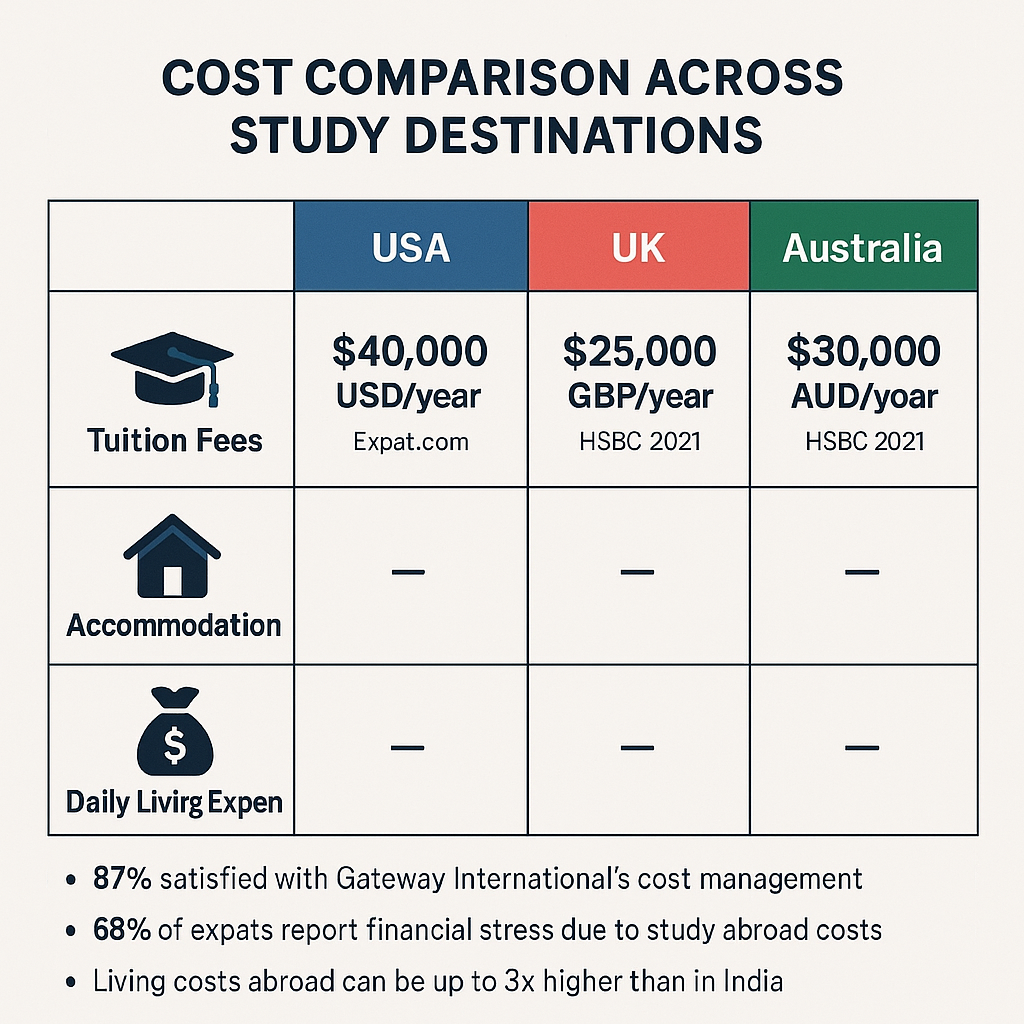
Compare key cost metrics across countries to plan your budget effectively .
Staying connected with home: Strategies to Combat Loneliness
The reality hits hard – the hardest part about living abroad isn’t figuring out the metro system or finding decent Indian food – it’s that gut-punch feeling when you realize that your best friend’s birthday party is happening 8,000 kilometers away and you watch it unfold through Instagram stories .
I learned this the hard way during my first Diwali abroad: while my family lit diyas back home, I was sitting in my tiny studio apartment, trying to make kheer in a microwave (spoiler: it didn’t work) when I realized that staying connected requires more than just occasional WhatsApp messages .
Schedule regular video callsInstead of generic “how are you” conversations, I started having virtual chai sessions with my mom every Sunday morning – we literally brew tea together on camera – It sounds silly, but these shared rituals create continuity across continents .
Create overlap moments.Time zones are brutal, but there’s usually a sweet spot: for me it’s my morning commute (their evening wind-down). Those 20-minute voice notes have become my lifeline – sharing daily frustrations, small victories or just rambling about the weather .
Join online communitiesFacebook groups might feel outdated, but they’re goldmines for finding people who understand why you crave pani puri at 2 AM. These connections often translate into real friendships – people who get both your worlds.
Here’s what nobody tells you: maintaining relationships across distances isn’t about constant communication, it’s about making the moments you connect feel intentional and meaningful – quality over quantity – always.
Check Out: Ultimate Guide to Studying in Canada
Navigating cultural differences with Confidence
You know that moment when you accidentally use your left hand to pass food in India or realize that you’ve been making too long direct eye contact in Japan? Yeah, I’ve been there. Cultural adaptation isn’t just about memorizing a list of dos and don’ts—it’s about developing a sixth sense for reading the room.
Here’s what actually works: Start with genuine curiosity rather than judgment. When I first moved to Germany, I was baffled by their directness , what initially felt rude , I later understood as refreshing honesty . One student I mentored in Seoul shared how she turned her confusion about Korean age calculations into conversation starters that helped her make friends .
The real game changer?Observe first, participate secondWatch how locals interact during meetings in cafes , on public transport , notice the small stuff—how close people stand, whether they interrupt or wait , if silence is comfortable or awkward .

Priya Patel MBA 2022
Marketing Manager at Amazon, Seattle.
“The cultural preparation sessions at Gateway International were eye-opening, they didn’t just tell us about American business culture—they helped us practice scenarios. When I started my internship, I felt confident navigating workplace dynamics that would have otherwise been overwhelming.”
But here’s the thing: you don’t need to become someone else – the students who thrive abroad are those who find the sweet spot between respecting local norms and staying authentic – think of it as adding new colors to your palette rather than painting over your canvas .
My advice? Join local hobby groups or sports clubs where shared interests naturally bridge cultural gaps. Make mistakes openly—most people appreciate the effort more than perfection. And remember that feeling like an outsider sometimes doesn’t mean you’re failing; it means you’re growing.
Cultural confidence isn’t about knowing everything—it’s about being comfortable with not knowing and curious enough to learn.
Financial planning Deep Dive: Managing Your Budget Overseas
Picture this scene: It’s 2 AM in Berlin and I’m frantically calculating if I can afford both groceries and the rent of next month. Sound familiar? Managing money abroad isn’t just about converting currencies—it’s about completely rewiring how you think about spending.
Here’s what nobody tells you about overseas budgeting: your financial anxiety multiplies when dealing with unfamiliar systems. That €50 dinner doesn’t just cost money; it costs mental energy calculating exchange rates, wondering if you are being overcharged and second-guessing every purchase.
The game of the real numbers
After tracking every cent for three years abroad, here is my monthly baseline budget breakdown:
- Rent : 40-45% (non-negotiable in most European cities)
- Grocery: 20-25% (cooking saves sanity and euros)
- Transport: 10-15% (student discount is gold)
- Emergency buffer: 15-20% (trust me on this one )
But here’s where it gets interesting—hidden costs will eat you alive: registration fees, mandatory health insurance, that “small” deposit for utilities that is actually two months rent. I learned to add 30% to any initial budget estimate. Pessimistic? Maybe. Realistic? Absolutely.
Practical survival strategies
Start with a dedicated expense tracking app—I use Splitwise for shared expenses and a simple spreadsheet for personal tracking. Every Sunday I review and categorize. Boring? Sure, but it has saved me from multiple financial meltdowns .
Immediately open a local bank account. Those “small” international transaction fees added up to €400 my first year. Also, negotiate everything—your rent, phone plan, even gym membership. Europeans expect it; Indians often don’t realize this.
The game-changer? Building a three-month emergency fund before leaving India. When my laptop died during the finals week, that fund meant the difference between a bad day and a catastrophic semester .
One last reality check: you’ll make financial mistakes : I accidentally paid my rent twice (long story involving SEPA transfers) The key isn’t avoiding all mistakes—it’s building enough cushion to survive them while keeping your sanity intact .
Emotional Readyness Quiz
Studying abroad is an exciting journey, but it comes with emotional challenges.Take this 5-minute assessment to assess your mental preparedness and get personalized strategies to thrive in your international education experience .
Question :1Of course.3
How typically do you handle being away from family and close friends?
Stress and Anxiety: Support Systems and Resources
The reality hit me hard—my first panic attack happened three weeks into my semester in Melbourne. I was sitting in a coffee shop trying to finish an assignment when suddenly I couldn’t breathe. The combination of academic pressure, being 7,000 kilometers from home and pretending everything was “totally fine” had finally caught up.
That moment taught me something crucial: having a support system isn’t optional when studying abroad—it’s survival.
Most universities offer counseling services specifically for international students, and here’s the thing—they actually get it. The counselor I eventually saw had worked with hundreds of students dealing with the exact same cocktail of homesickness, academic stress and cultural adjustment . No judgment, just practical help.
But professional support is just one piece: I learned to build what I call my “mental health toolkit”:
Daily anchors: Morning video calls with my mom became non-negotiable, even five minutes of hearing Hindi and seeing familiar faces grounded me.
Body basics: Sounds obvious, but eating proper meals (not just instant noodles) and walking around campus daily made a massive difference : Your brain needs fuel and movement .
Find your peopleJoin the international student WhatsApp groups. Seriously. When someone posts “Anyone else crying over assignments?” at 2 AM, you realize that you are not alone. These shared struggles create surprisingly strong bonds.
Proactive practicesDuring study breaks , I started using meditation apps . Ten minutes of guided breathing between chapters kept anxiety from snowballing .
Here’s what nobody tells you: seeking help isn’t admitting defeat—it’s strategic self-care. Whether it’s booking that counseling appointment, joining a support group or simply texting a friend when you’re struggling, these actions build resilience.
Your mental health directly impacts your academic success and overall experience. Treat it as the priority it is.
Real stories from the field: Gateway Alumni Experiences
When I first connected with Priya, a Gateway International alumna now working in Munich, she laughed about her initial weeks in Germany : “I thought I was prepared for everything – budget spreadsheets, visa documents, even basic German phrases – but nobody warned me about crying in a Lidl because I couldn’t figure out which milk was lactose-free .
Her story isn’t unique: Through Gateway’s alumni network, I’ve heard dozens of similar stories – students who arrived abroad with perfect GPAs and meticulous plans only to discover that emotional resilience matters just as much as financial planning .
Take Arjun, who studied in Dublin through Gateway’s Ireland program and shared how the alumni WhatsApp group of the consultancy became his lifeline during a particularly rough patch : “When my part-time job fell through in month two, I was ready to pack up, but three alumni immediately connected me with openings at their workplaces , and that network saved my degree.”
Vasu Kumar, Computer Science 2021 .
Software engineer at Microsoft, London
The homesickness was initially brutal, but Gateway’s alumni mentorship program paired me with someone who had been through the same journey. Learning to navigate this loneliness taught me more about myself than any classroom could. Their support network made all the difference.”
What strikes me most about these stories is that the transformation happens in unexpected ways. Vasu, whom Gateway helped place in the UK, told me: “The homesickness was initially brutal, but learning to navigate that loneliness taught me more about myself than any classroom could.”
These aren’t just feel-good stories – they’re roadmaps. Alumni consistently mention three survival tactics: joining cultural groups immediately (not “eventually”), video calling home on a schedule (random calls make homesickness worse) and finding that one comfort food spot that reminds you of home .
The strength of Gateway isn’t just in placing students; it’s in maintaining these connections: their alumni become an invisible support system, sharing apartment listings, job leads and most importantly, reassurance that the emotional rollercoaster is normal. Because sometimes knowing someone else has survived the same struggles makes all the difference.
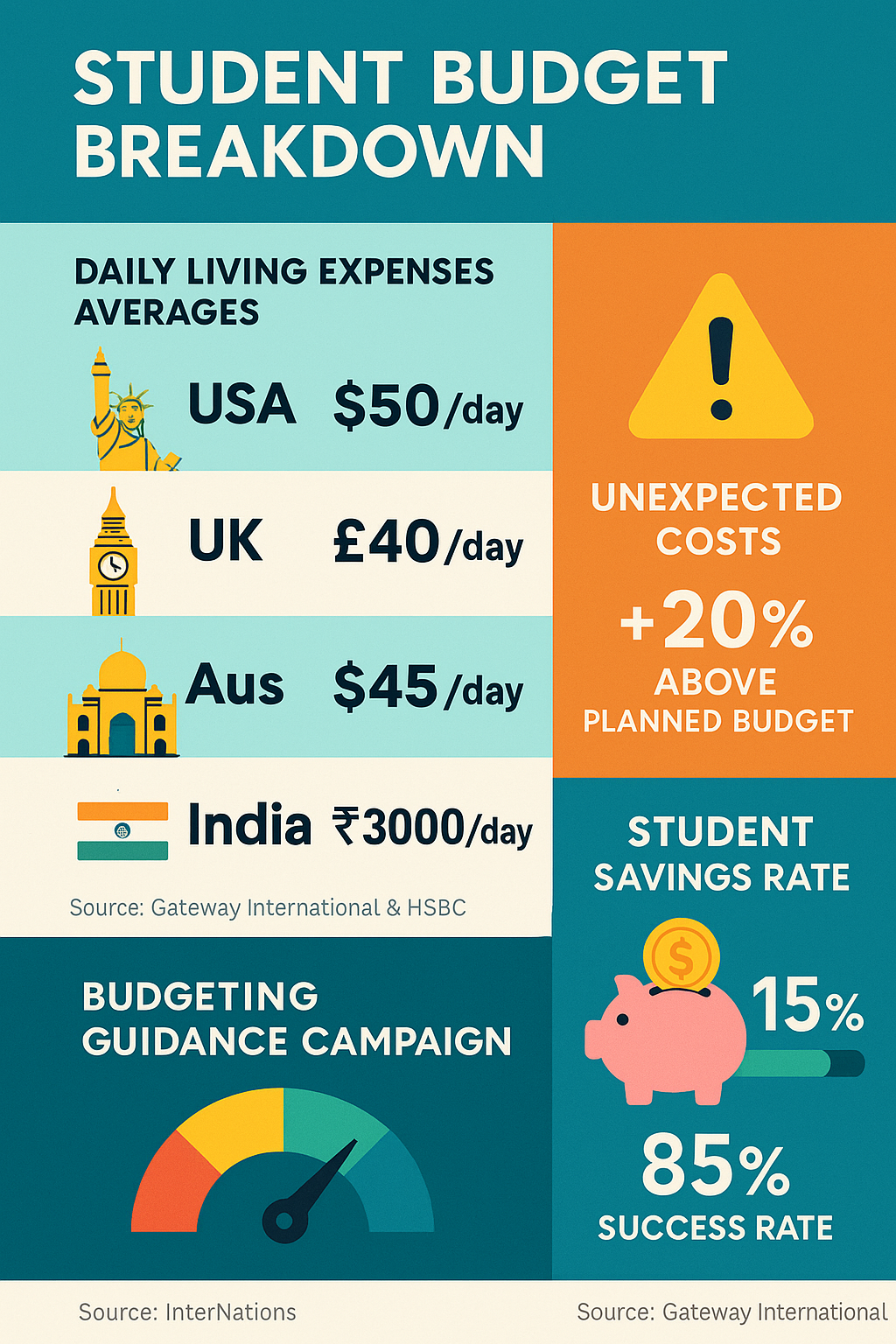
Visual Guide to Student Expenses and Budget Strategies
Coping Mechanisms: Building emotional and financial resilience
A vivid memory stays with me about my friend Priya who moved to Toronto last year and called me crying—not because of homesickness, but because she had just realized that her “emergency fund” wouldn’t cover a dental emergency . That’s when it hit both of us: resilience abroad isn’t just about toughening up emotionally; it’s about creating practical safety nets .
Here is what actually works (learned the hard way):
Financial Cushioning:
Start with the 20% rule—whatever budget you’ve calculated, add 20% for the unexpected. I know it sounds excessive, but trust me, surprise expenses abroad hit differently: one for true emergencies, another for “comfort purchases” (yes, that overpriced Indian grocery store matters for your sanity) .
Emotional Anchoring:
Schedule weekly video calls with your family—consistency matters more than duration. Consequently, join local Indian student groups, but also push yourself to connect with locals. The balance keeps you grounded while growing.
The Integration Practice:
Every Sunday I would do what I called my “check-in ritual”: review finances, journal three wins from the week and plan one new local experience. This simple routine became my stability anchor.
Gateway International offers free resources on building these frameworks — their financial planning worksheets are particularly helpful — and also conduct consultation sessions where you can discuss your specific situation .
Remember, resilience isn’t about being unbreakable; it’s about creating systems that catch you when things get tough, because they will get tough, and that’s okay when you’re prepared.
Check Out: Top Part-Time Jobs for Students in Toronto
Planning Your Journey: Costs, Cultures and Emotional Considerations
Wrapping up Your Study Abroad Blueprint
So here is where we land after this journey through the real costs of studying abroad: planning isn’t just about spreadsheets and visa forms—it’s about preparing yourself for the whole experience, messy bits included.
I remember sitting in a café in Munich, the calculator app open, trying to figure out if I could afford both dinner and the train ticket home. That moment taught me something crucial: financial planning isn’t just about tuition fees, it’s about having enough cushion for those unexpected moments—like when your laptop dies during the finals week or when you desperately need a flight home because your grandmother is sick .
Cultural adaptation? Consequently, that’s the silent budget killer nobody talks about. You’ll spend money trying to fit in, then more money seeking comfort foods from home. My advice? Build a “homesickness fund” into your budget. Sounds silly until you pay €15 for imported Maggi noodles .
Before leaving, I wish someone had told me to practice being uncomfortable . Start small—eat alone in restaurants, join clubs where you know nobody, navigate your own city without Google Maps These tiny acts of independence will serve you better than any pre-departure orientation .
Gateway International gets this holistic approach: they are not just pushing university brochures; they are helping students build complete roadmaps that account for the financial, cultural and emotional realities of studying abroad .
Your journey abroad will transform you, but only if you are prepared for all its dimensions—not just the Instagram-worthy ones.
About the author
Mr. Abhinav JainThe innovative Founder and Director of Gateway International and Edysor has been a trailblazer in international education since 2007 . His innovative ideas created Edysor , which became an AI platform that both automated and improved admission procedures . Gateway International Director Abhinav Jain has modified education-technology interaction through his system integration of rapid application management combined with intelligent document examination and cutting-edge voice computer interface . Through his leadership he established globally efficient university admission processes while driving innovative changes throughout various sectors .
Connect on LinkedIn| | |Learn More About Gateway International

Ready to Study With Confidence Abroad?
Get expert guidance on emotional and financial preparation for your international education journey .
Gateway International offers:
- Financial planning worksheets & budgeting tools
- Access to support networks and alumni connections
- Guidance for emotional challenges abroad
- Practical tips for building a community overseas
Join thousands of students who have successfully navigated their study abroad journey with Gateway International
Frequently Asked Questions
References :
- The Institute of International Education. (2024). Open Doors Report on International Educational Exchange.https://www.iie.org/Research-and-Insights/Open-Doors
- Journal of International Students. (2023). Emotional well-being of international students. Retrieved fromhttps://www.ojed.org/index.php/jis
- American College Health Association. (2024). Mental Health Resources for International Students.https://www.acha.org
Share your experience with us
Have you faced similar challenges while studying abroad?