
Find your perfect student accommodation abroad !
TABLE OF CONTENTS .
- Introduction: The Start of a New Chapter Away from Home
- The Accommodation Crisis: High Demand, Higher Stakes
- Financial Hurdles: Budgeting for Your Second Home
- Navigating Legal and Administrative Waters: Don’t Get Lost in Translation
- 🏠 Your Perfect Student Accommodation
- Safeguard Against Scams: Stay Alert, Stay Safe
- Cultural Adjustment: Shared Spaces, Diverse Faces
- Mental Health Matters: Support When You’re Far From Home
- Real Stories from the Gateway Family: Journeys of Home Finding
- Gateway’s Pledge: Your Home Away From Home
- Your Next Steps with Gateway: Let’s Secure Your New Home
Introduction: The beginning of a new chapter away from home
Imagine this: you just received your acceptance letter from that dream university abroad. The excitement is real—you’re already imagining yourself walking through campus, making new friends, experiencing a whole new culture. But then reality hits with a simple question: “Where am I going to live?”
I remember when my cousin got into a university in Manchester and the first thing my aunt asked was not about the course or weather—it was “Beta, where will you stay?” And honestly, that question kept the entire family up for weeks.
Finding accommodation abroad isn’t just about having a roof over your head, it’s about creating a space where you can actually focus on your studies without worrying if your landlord will suddenly hike the rent or if you’ll feel safe walking home after a late library session. For Indian students especially, it’s about finding that delicate balance between independence and comfort—somewhere that doesn’t make you homesick every single day.
The stakes are higher than most people realize: Bad accommodation can derail your entire abroad experience. Imagine trying to prepare for exams while dealing with noisy flatmates or worse, discovering that your “furnished” apartment means just a bed and nothing else . Not to mention the cultural adjustments—from figuring out heating systems to understanding tenancy agreements written in legal jargon that would confuse even native speakers .
What makes this particularly challenging for us is that we’re not just looking for a place; we need somewhere that feels secure, allows us to cook our comfort food when homesickness strikes and ideally does not require selling a kidney to afford. The emotional weight of being thousands of miles from home makes finding the right living situation crucial for both academic success and mental well-being .
According to recent studies by the Institute of International Education ,73% of international students cite accommodation as their primary concern when planning to study abroadThis statistic becomes even more pronounced for Indian students who often face additional challenges like dietary restrictions , cultural preferences and the need for community support systems .
The accommodation search typically begins months before departure, yet many students find themselves scrambling at the last minute: universities often guarantee housing only for first-year undergraduates, leaving graduate students and those in their second year to navigate the complex private rental market – this creates a perfect storm of stress, uncertainty and sometimes exploitation by unscrupulous landlords who know international students have limited options .
Check Out: Complete Student Accommodation Guide 2025
The accommodation crisis: high demand, higher stakes
The global student accommodation crisis has reached unprecedented levels. Last year alone, I watched countless students frantically refresh property websites at ungodly hours, competing with hundreds of others for single room listings that disappeared within minutes. The situation has become so dire that some students now choose universities based on accommodation availability rather than academic excellence .
The numbers paint a stark picture: in Sydney there is roughly one student accommodation spot for every three international students; London’s situation is even more challenging—some universities can only guarantee housing for 20% of their international intake; New York makes both look generous, with studio apartments near NYU costing more than the entire monthly income of most Indian families .
Recent data from UCAS show thatinternational student applications to UK universities have increased by 267% over the past decade, while purpose-built student accommodation has grown by only 89%This widening gap creates a hyper-competitive environment where students often settle for substandard housing just to secure a place to live .
The ripple effects extend far beyond just finding a roof over your head: students are now applying to universities based on accommodation availability first, academic reputation second , some are choosing smaller cities over their dream destinations , others are deferring admissions hoping the situation improves (spoiler: it rarely does).
What frustrates education consultants most is that universities are well aware of this crisis: they accept more international students than ever—Indian admissions to UK universities recently hit record highs—but haven’t increased housing capacity proportionally. It creates an unsustainable situation where academic institutions benefit from increased international enrollment while students bear the burden of finding suitable accommodation .
The competition has become so fierce that students are now paying deposits for rooms they’ve never seen, signing contracts without proper legal review and accepting living conditions they would never tolerate back home . In cities like Toronto and Melbourne, it’s not uncommon to find students paying premium prices for what amounts to a partitioned living room or a converted garage .

Rahul Verma, MSc in Computer Science 2023
Currently at Google in London
“I almost gave up my King’s College offer because I couldn’t find accommodation. Gateway’s team connected me with verified landlords and helped negotiate a fair lease – without their support, I would probably be studying somewhere else entirely.”
The stark truth is this: Your biggest challenge might not be getting into your dream university, but finding somewhere to sleep once you get there . This reality has fundamentally changed how students and families approach international education planning .
Financial Hurdles: Budgeting for your second home
Financial planning for student accommodation abroad involves far more than just calculating the monthly rent : the hidden costs can devastate even the most carefully planned budgets, turning what seemed like an affordable option into a financial nightmare .
Consider this breakdown from real student experiences: while universities advertise living costs, they rarely capture the full picture. A “affordable” London flat requiring a £2,000 deposit upfront plus the first and last month’s rent means students need £6,000 just to move in. Add agency fees, utility deposits and mandatory insurance and the initial cost can exceed £8,000 before buying a single textbook .
The game of the real numbers
When students come starry-eyed about studying in Australia or Canada, financial reality often provides a sobering wake-up call . Take Germany for example: While everyone focuses on the “free tuition” aspect, they forget that Munich’s monthly living costs can hit €1,200 , while smaller cities like Leipzig might only need €700 – that’s a 40,000 difference every month !
Recent surveys by SaveTheStudent show that58% of international students underestimate their living costs by at least 30%This miscalculation often forces students to compromise on accommodation quality, take on excessive part-time work or worse, drop out due to financial stress .
Your financial survival kit
Creating a realistic budget requires understanding both obvious and hidden costs . Start with three budget scenarios—optimistic, realistic and worst-case . Experience shows that most students land between realistic and worst-case scenarios .
- Hidden costs: Visa fees (£363 for UK), health insurance (€110/month in Germany), winter clothing (50,000 minimum for Canada)
- Emergency fundAt least 3 months of living expenses for unexpected situations .
- Currency fluctuationsBudget 10% extra for exchange rate surprises — the rupee volatility can significantly impact your budget .
- Setup costsBedding , kitchenware , initial groceries can easily exceed 30,000
Making it Work Without Breaking the Bank
Smart financial planning involves exploring all available funding sources. Many students miss out on opportunities simply because they don’t know where to look .
- Country-specific grants (Germany’s DAAD offers €934/month , Australia’s Endeavour provides AUD 3,000/month)
- Corporate Scholarships from Indian companies (Tata, Inlaks, JN Tata Endowment)
- Part-time work opportunities (Germany allows 120 full days/year, UK allows 20 hours/week during term)
- Teaching assistantships that often include accommodation benefits are

Priya Sharma , MBA 2024
Investment banking analyst, New York City
“Gateway’s financial planning workshop opened my eyes to hidden costs I’d never considered, their scholarship database helped me secure €15,000 in funding, making my dream of studying at INSEAD possible despite coming from a middle-class background.”
Gateway International maintains an updated database of these opportunities, but even if you are going solo, dedicate at least 20 hours to scholarship research . One successful application could save you lakhs .
Remember, financial planning isn’t about having rich parents—it’s about being smart with what you have. Strategic planning, thorough research and understanding all available options can make international education accessible even on a modest budget .
Navigating legal and administrative waters: Don’t Get Lost in Translation
International housing contracts represent one of the most overlooked challenges in studying abroad: These aren’t simply translated versions of Indian rental agreements—they are complex legal documents rooted in entirely different legal systems, cultural norms and tenant-landlord relationships .
Each country has its own peculiar requirements that can catch students off guard : in France, you might need a French guarantor earning three times the rent — nearly impossible for international students without local connections . In Japan, the concept of “key money” (reikin) means paying the landlord a non-refundable gift equivalent to 1-2 months’ rent, on top of deposits and advance rent .
The terminology itself becomes a minefield: a “deposit” in India might be 2-3 months of rent that you’ll get back; in some European countries it could include additional fees for furniture insurance, cleaning deposits and mysterious “administrative charges” that disappear into the ether. German contracts might mention “Nebenkosten” (additional costs) that can add 30% to your base rent for heating, water and building maintenance .
Common legal pitfalls that trap international students include
- Automatic renewal clausesMissing the notice period (often 3 months) means that you are locked in for another year .
- Subletting restrictions: That summer internship in another city? You might still owe full rent if subletting is prohibited .
- Maintenance responsibilitiesIn some countries, tenants must repaint walls and replace fixtures before moving out .
- Quiet hours and house rulesViolations can lead to immediate eviction without return of deposit .
Real-world examples highlight these challenges : a student in Amsterdam discovered that “furnished” meant exactly four pieces of furniture—bed, desk, chair and a lamp ; another in Berlin learned that hanging pictures with nails violated his lease terms , costing him €500 in “damage” fees .
Understanding local tenant rights becomes crucial: in the UK, landlords must place deposits in government-approved schemes; in Australia, bond money goes to a government authority, not the landlord; in the US, the security deposit limits vary by state—California caps it at 2 months’ rent, while New York allows only 1 month.
This is where professional guidance becomes invaluable: Gateway International’s pre-departure orientations don’t just give you a glossary of terms – they walk you through actual contracts from your destination country – they explain why that innocent-looking clause about “quiet hours” could cost you hundreds in fines or how subletting rules differ drastically between countries .
The key is understanding not just what you are signing, but the cultural and legal context behind it. What are your rights if something breaks? How much notice do you need to give? Can your landlord really keep your deposit for that tiny scratch? These questions need answers before you sign, not after.
What is your ideal student accommodation ?
Find your perfect student home abroad with our personalized quiz that analyzes your lifestyle, budget and preferences to match you with ideal accommodation options. With Gateway International’s expertise helping over 25,000 students avoid scams and find safe housing, discover your perfect home away from home
Question :1 3
What is your monthly accommodation budget?
Scams: Stay Alert, Stay Safe
Scams targeting international students have become increasingly sophisticated: Scammers understand the desperation and unfamiliarity that international students face, crafting elaborate schemes that can fool even cautious individuals .
A recent case perfectly illustrates the danger: Priya from Chennai found what seemed like the perfect apartment online—great location near campus, reasonable rent, available immediately. The landlord was super responsive, even offered a virtual tour. Just one catch: he needed the deposit immediately because “other students were interested.” She sent 80,000. The apartment didn’t exist.
This happens more often than you’d think – according to Action Fraud UKinternational students lost over £5.2 million to accommodation scams in 2023 aloneThe actual figure is likely higher as many victims don’t report out of embarrassment or visa concerns .
Red flags that should trigger immediate caution:
- Too-good-to-be-true pricingIf it’s 40% cheaper than similar listings , there’s usually a sinister reason .
- Pressure tactics“Send money now or lose it” is classic scammer behavior designed to bypass your rational thinking
- Wire transfers onlyLegitimate landlords accept multiple payment methods and understand that students need secure options .
- No local phone numberReal landlords have local contacts and are willing to meet or video call.
- Copy-pasted descriptionsRun suspicious text through Google—scammers reuse content across multiple fake listings
- Overseas landlords with sob stories“I’m a missionary in Africa” is a common scammer narrative .
Your comprehensive verification checklist:
- Video call the landlordShowing both their face and the interior of the property.
- Ask for official documentsRental agreement drafts , property ownership papers , utility bills
- Google Street ViewThe address—does it match the photos?
- Join university housing groupsAsk on Facebook if anyone knows the landlord or property .
- Use secure payment platformsThat offer dispute protection—never wire money to strangers
- Request referencesLegitimate landlords can provide these from previous tenants —
- Check local property registries—Many countries have online databases to verify ownership
Advanced scammers now use sophisticated techniques including fake video tours (pre-recorded from actual properties), phishing websites that mirror legitimate rental platforms and even fake references. They research university towns, use local phone numbers through VoIP services and create elaborate backstories .
What saved many students is institutional verification : Universities often maintain lists of known scammers and trusted accommodations ; many have dedicated international student services that can verify landlords or properties ; some even offer escrow services for international students .
Arjun Patel, engineering 2023
Saved £3,000 scam in Manchester
“The listing looked perfect and the ‘landlord’ had answers for everything. Gateway’s verification service discovered that the property photos were stolen from Airbnb and they helped me find legitimate accommodation and probably saved my entire study abroad dream.”
The golden rule remains unchanged: if someone won’t let you pay after arrival or through a secure method, walk away. Furthermore, yes, you might miss out on a genuine listing, but you’ll definitely avoid losing your hard-earned money to scammers who prey on student anxiety .
Check Out: 2025 Student Accommodation Scam Alert Guide
Cultural adjustment: shared spaces, diverse faces
Living with roommates from different cultural backgrounds transforms from an adventure into a masterclass in diplomacy faster than you can say “whose turn is it to clean?” The kitchen becomes a United Nations summit and the living room hosts more cultural negotiations than most embassies .
Real experiences highlight these challenges vividly : a student’s flat in Manchester included roommates from Nigeria, South Korea and Brazil whose first week together created a comedy of errors: the Korean roommate left notes about noise levels after 9 PM , the Brazilian couldn’t understand why anyone would eat dinner before 10 PM and weekend gospel music sessions became involuntary Sunday morning soundtracks .
Research from the British Council shows that67% of international students report cultural clashes in shared accommodation as a significant stress factorThese conflicts often arise not from malice , but from fundamentally different concepts of privacy , cleanliness , social interaction and daily routines .
Common cultural friction points include:
- Kitchen usageCooking times , food storage , dietary restrictions and aromatic cuisines
- Bathroom schedules: Morning routines , shower duration and cleanliness standards
- Guest policiesOvernight visitors , party frequency , and common area usage
- Noise levels: Study habits, music preferences and phone call volumes
- Personal spaceBorrowing items, entering rooms and privacy expectations
Successful multicultural living requires proactive communication and mutual respect.
Establish clear agreements earlyWithin the first week, have a house meeting to discuss expectations . Create a roommate agreement covering cleaning schedules , quiet hours , guest policies and shared expenses .
Create cultural exchange opportunitiesMonthly international dinners where each roommate cooks something from home build understanding and friendship . Additionally, sharing the stories behind your “weird” habits helps others understand and respect them .
Address conflicts directly but respectfullyWhen issues arise—and they will—address them immediately before resentment builds . Use statements of “I feel” rather than accusations . “I feel stressed when I can’t sleep due to noise” works better than “You’re too loud!”
Establish both shared and private spacesDesignate quiet hours but also “social hours” where the common room is fair game for music, calls home, or impromptu dance parties . Respect that some roommates need more alone time while others thrive on constant interaction .
The biggest lesson from successful multicultural living? Most cultural clashes aren’t about right or wrong—they’re about different normals. Once you accept that your way isn’t the only way, shared living becomes less about surviving and more about thriving. You might even end up with lifelong friends who will teach you to make jollof rice at 3 AM while discussing K-dramas in broken Portuguese .
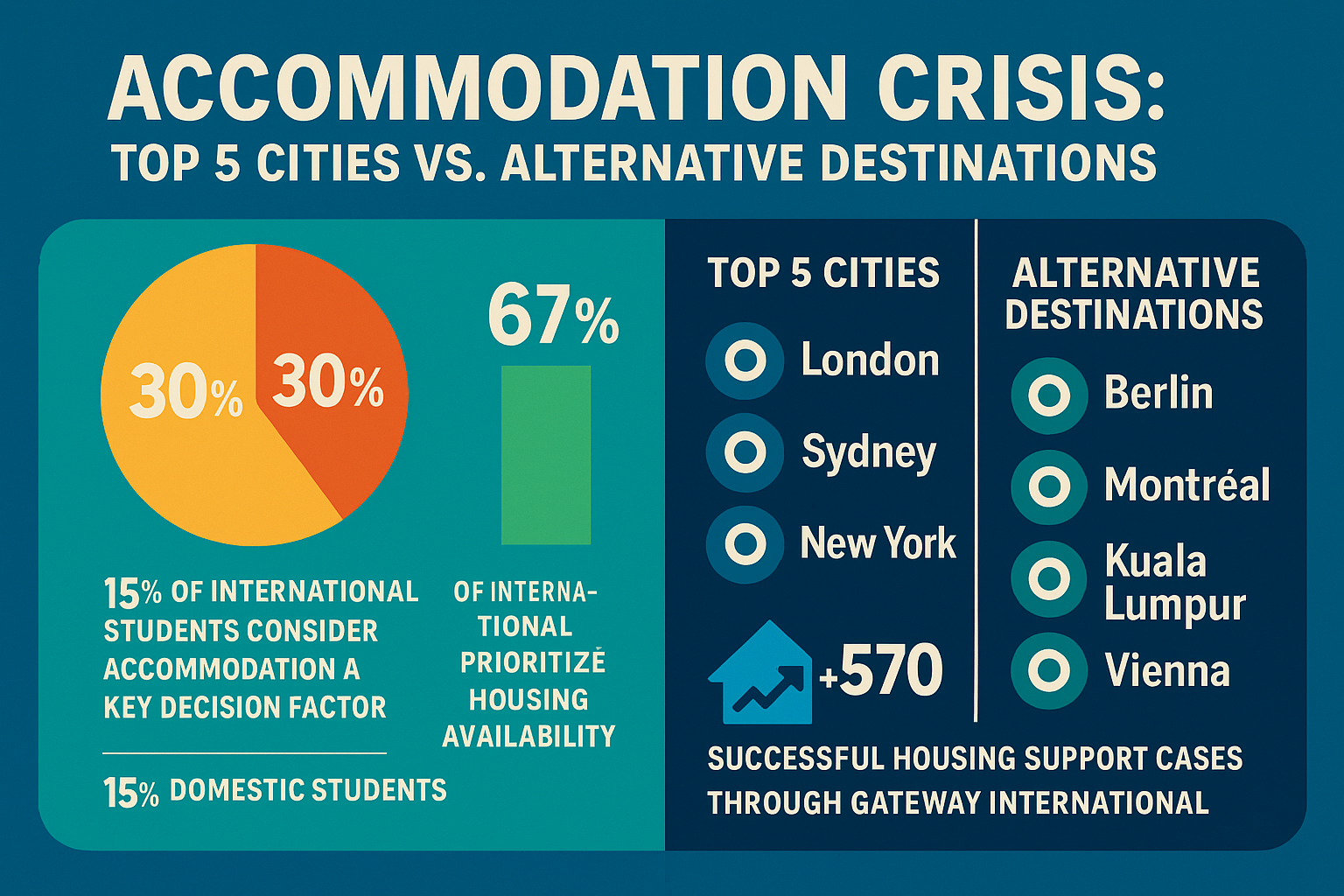
A comparative snapshot of housing crises in leading cities versus viable alternatives for Indian students .
Mental Health Matters: Support When You Are Far From Home
The psychological impact of accommodation stress on international students remains severely underestimated: when your living situation becomes a source of constant anxiety, it creates a domino effect that can derail your entire study abroad experience .
Consider Priya’s story—a friend who studied in Toronto. Three weeks into her program, she called sobbing at 2 AM IST because her landlord had given her 30 days to move out of the basement apartment he’d hidden during the viewing . She was not just losing her home; she was losing her mind trying to juggle apartment hunting with midterms while feeling completely alone .
Research conducted by the International Association of Student Affairs and Services reveals thatstudents dealing with housing stress report 40% higher rates of anxiety and depressionThe psychological toll extends beyond simple inconvenience—it fundamentally undermines the study abroad experience .
How accommodation stress manifests:
- Academic impact: Difficulty concentrating , missed classes while apartment hunting , declining grades
- Social isolationAvoiding social events due to embarrassment about living conditions or financial stress .
- Physical healthSleep deprivation , poor nutrition due to inadequate kitchen facilities , stress-related illnesses
- Financial anxietyConstant worry about making rent , unexpected housing costs depleting emergency funds
- Identity crisisQuestioning the decision to study abroad , feeling like a failure
The compound effect is particularly severe for international students already navigating cultural differences, academic pressure and separation from support systems. Add housing drama to this mix and it becomes a recipe for severe mental health challenges .
Proactive support systems make a crucial difference. Gateway International’s approach recognizes that mental health support is not optional—it is essential.
- Pre-arrival preparation addressing realistic expectations and coping strategies.
- 24/7 Helplines staffed by counselors familiar with international student challenges
- WhatsApp support groups connect students in the same city for peer support
- Direct connections to on-campus counseling services before problems escalate
- Emergency housing options to prevent homelessness anxiety
Sneha Reddy, Psychology 2024 .
Thriving at the University of Edinburgh
“When my first accommodation fell through, I spiraled into panic attacks. Gateway’s 24/7 support line connected me with a counselor who understood exactly what I was going through, found me emergency housing within 48 hours and helped me access university mental health services , which saved my degree.”
Building resilience requires both preparation and ongoing support . Successful strategies include
- Regular check-ins: Schedule weekly video calls with family or friends back home .
- Proactive counselingUse university mental health services preventively , not just in crisis .
- Community buildingJoin student organizations immediately to create local support networks .
- Stress managementDevelop coping mechanisms before problems arise—meditation, exercise, journaling .
- Financial buffers: Maintain emergency funds specifically for accommodation crises :
Remember that feeling overwhelmed in unsuitable housing isn’t weakness—it’s a normal response to an abnormal situation. The smart move is having support systems in place before you need them, not after a crisis strikes.
Real stories from the Gateway family: Journeys of Home Finding
Behind every successful international student lies a housing story that could fill a novel. These aren’t just anecdotes—they are roadmaps for future students navigating similar challenges .
Take Arjun from Pune , whose MIT acceptance nearly became a rejection due to Boston’s brutal housing market . With a budget of $1,200/month he discovered that would not even cover a shared room near campus . The stress of potentially declining MIT admission due to accommodation costs nearly broke him and his family .
Gateway’s intervention changed everything: they connected Arjun with an alumnus who had graduated two years earlier and lived in Somerville—a 20-minute commute from MIT but significantly more affordable. Not only did he find housing within budget, but he also gained a mentor who helped him navigate the American apartment hunting culture, understand lease terms and even negotiate a lower security deposit .
Then there’s Sneha’s Amsterdam adventure: her parents nearly had heart attacks when she mentioned sharing a flat with male roommates—completely normal in the Netherlands but scandalous back home in conservative Chennai. The cultural gap seemed insurmountable until Gateway arranged a video call between Sneha’s parents and a female Indian student who lived in similar arrangements . Hearing firsthand experiences from someone who understood both cultures bridged the gap .
Perhaps the most inspiring is Meera’s transformation to Toronto: after her “confirmed” accommodation fell through 48 hours before departure, she spent her first night in a 24-hour Tim Hortons, too proud to tell her parents. Gateway’s emergency response team found her temporary accommodation within hours and helped secure permanent housing within a week. Today she mentors new students, ensuring nobody else faces that terrifying first night alone .
These stories share common themes :
- Preparation isn’t always enoughEven meticulous planners face unexpected challenges :
- Community support mattersAlumni networks provide invaluable local knowledge .
- Cultural bridges helpHaving someone who understands both cultures smooths transitions .
- Quick response prevents crisis48-hour support windows can save entire study abroad dreams
What makes these stories powerful isn’t just the problems—it’s how these students turned their struggles into support systems for others: they are now answering panic messages at 2 AM, sharing apartment hunting tips in WhatsApp groups and proving that the Gateway family extends far beyond formal services .
The data backs up these individual stories: Gateway’s tracking shows that students who receive accommodation support report 73% higher satisfaction rates with their overall study abroad experience and are 2.5 times more likely to help future students with housing guidance, creating a self-sustaining support ecosystem .
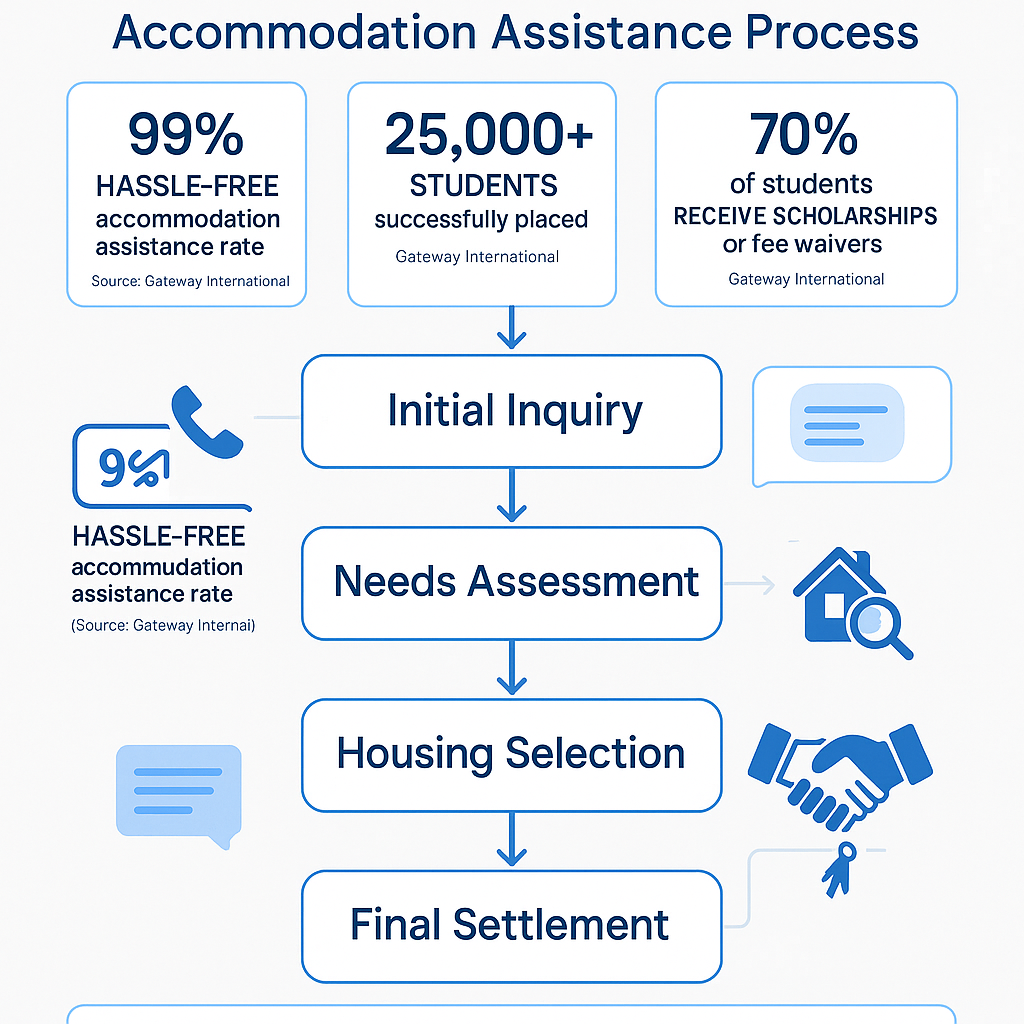
An easy-to-follow flowchart showing each step of the Gateway International accommodation assistance process .
Pledge of Gateway: Your Home Away From Home
Gateway International’s accommodation support transcends typical consultancy services and addresses not just finding a place to live, but also creating a foundation for academic and personal success abroad .
The numbers speak volumes: over 25,000 students have successfully placed on Trustpilot since 2007 and maintained a 99 TrustScore , but statistics only tell part of the story , the real difference lies in their end-to-end support system that begins before you even receive your visa .
Gateway’s comprehensive accommodation support includes:
Pre-departure preparation:Long before your flight, Gateway’s team analyzes the housing market of your destination city, identifies neighborhoods that match your preferences and budget and creates a customized housing strategy. Furthermore, they provide detailed area guides covering everything from grocery stores selling Indian products to proximity to places of worship .
Airport to accommodation service:Imagine landing in a foreign country, jet-lagged and overwhelmed, to find someone waiting with your name on a sign. Gateway’s representatives don’t just drive you to pre-arranged temporary accommodation—they orient you to the neighborhood, show you essential services and ensure that you are settled before leaving .
Temporary housing guarantee:Those first few weeks are crucial: Gateway arranges student-friendly temporary accommodation—not sketchy hostels or overpriced hotels, but actual livable spaces where you can rest, adjust to the time zone and search for permanent housing without panic . One student described his Melbourne temporary housing as “better than most permanent options I later saw.”
Verified permanent housing:Gateway maintains relationships with trusted landlords, property management companies and student housing providers across major education destinations . Every option is pre-verified for safety, legitimacy and value . They have blacklisted hundreds of properties and landlords based on student feedback , saving newcomers from known problems .
Legal and financial assistance:From explaining contract terms to helping to set up local bank accounts for rent payments, Gateway ensures that you understand every aspect of your housing commitment and even assists with utility connections, internet setup and registration with local authorities where required .
Ongoing support:The relationship doesn’t end when you sign a lease – Gateway continues to check in, helping resolve disputes, assisting with maintenance issues and even supporting students who need to change accommodation mid-program – 24/7 helpline means you are never truly alone, regardless of time zone .
Vasu Kumar , MBA 2023
Successfully settled at the London Business School
“Divya Ma’am didn’t just process my visa—she ensured that I reached the UK safely and settled into good accommodation. When my first landlord tried to keep my deposit unfairly, Gateway’s legal team intervened. That’s the difference between a service and genuine support.”
What truly distinguishes Gateway is their understanding that accommodation isn’t just about shelter—it’s about creating conditions for success. They recognize that a student struggling with housing cannot focus on academics, build friendships or enjoy the transformative experience of studying abroad .
Their commitment extends to continuous improvement. Regular feedback from students shapes service enhancements such as virtual reality property tours for students who can’t visit in person, partnerships with furniture rental companies for affordable furnishing options and mental health support specifically for accommodation-related stress .
Your next steps with Gateway: Let’s Secure Your New Home
After absorbing all this information about accommodation challenges, you might feel overwhelmed – that’s perfectly normal – and exactly why taking action now, rather than later, makes all the difference .
The most successful students start their accommodation planning 4-6 months before departure – this is not excessive caution – it’s strategic planning that opens better options, allows for thorough verification and eliminates last-minute panic .
Your immediate action plan:
Step 1: Book a free consultationThis isn’t a sales pitch—it’s a genuine assessment of your destination city, budget constraints, and personal preferences. They’ll create a customized housing shortlist that actually matches your needs, not generic listings that waste time .
Step 2: Attend the upcoming webinar seriesThe next session, “Hidden Housing Costs Nobody Tells You About” , reveals expenses like utility deposits, furniture rentals and administrative fees that can devastate unprepared budgets.
Step 3: Join Gateway’s exclusive housing networkWhere verified alumni and current students share real-time updates about available accommodation, trustworthy landlords and areas to avoid . This peer-to-peer intelligence is invaluable and unavailable through traditional channels .
Step 4: Secure your accommodation guarantee. Gateway’s pre-departure housing guarantee means that if your accommodation falls through last minute (more common than you’d think), they’ll find you safe temporary housing within 24 hours . This peace of mind is invaluable for both students and parents .
Step 5: Prepare your documentationGateway provides a comprehensive checklist of documents needed for various countries’ rental applications , which accelerates the process when perfect accommodation becomes available .
The game-changing difference? Gateway’s upcoming AI-powered matching system that analyzes your preferences, budget and destination to suggest accommodations with 89% satisfaction rates based on similar student profiles. Early access registrations open next month .
Don’t fall into the trap of thinking that accommodation will “sort itself out” The best options—safe, affordable, well-located—disappear fast. Students who start early not only secure better housing but often save 20-30% compared to last minute panic bookings .
Your dream of studying abroad shouldn’t become a nightmare of housing stress. Moreover, take control now, while you have options and support available. Your future self will thank you when you settle into your new home instead of scrambling for any available roof over your head .

Find your perfect student accommodation abroad!
Let Gateway International guide you to safe, verified housing options that are tailored to your needs.
- Personalized accommodation support
- Pre-departure orientation
- Verified & safe housing options
- Local student connections
Make your study abroad journey smoother with Gateway International .
Questions Frequently Asked Questions

Need help with housing?
Join 25,000+ students who have found their perfect home abroad
Get Started Today