
Finding the Perfect Place to Stay While Studying Abroad : Overcoming Accommodation Challenges
TABLE OF CONTENTS –
- Opening: A New Chapter, A New Challenge
- The Worldwide Accommodation Crisis
- High Costs in High Demand Zones
- Scammed and Stranded: The Risks of Overseas Rentals
- Navigating New Norms: Adjusting to Foreign Living Conditions
- Legal Labyrinths: Understanding Your Rights as a Tenant
- 📋 Your Housing Readiness Assessment
- Institutional Interventions: How Universities Can Help
- The Personal Touch: Gateway International’s Role
- Looking to the Future: Trends and Predictions
- Conclusion: Building More Than Just a Home
- Latest Industry Updates
Opening: A new chapter, A new challenge
Picture this: You just received your acceptance letter to study abroad, the excitement is real—you’re texting everyone, already planning what to pack, maybe even practicing the local language. Then reality hits: Where exactly are you going to live?
I remember scrolling at 2 AM through endless housing websites trying to decode rental terms in a language I barely understood, wondering if that “cozy studio near campus” was actually a glorified closet , and I wasn’t alone in this struggle .
Here’s what most people don’t tell you about studying abroad: securing accommodation often becomes the make-or-break factor of your entire experience. According to recent surveys, 73% of international students report housing as their primary source of stress — even higher than academic pressure or language barriers .
Why is finding a place to stay such a monumental challenge? It’s not just about having four walls and a roof; your accommodation sets the foundation for everything else—your daily commute, your social circle, your study environment, even your mental health. Choose wrong and you might spend months trapped in a lease that drains both your wallet and your energy .
The housing hunt hits different when you’re navigating it from thousands of miles away – you can’t just drop by for a quick viewing – you’re relying on photos that somehow make every room look bigger – reviews from strangers with different standards – and landlords who may or may not respond to your emails – and suddenly that acceptance letter feels less like a victory and more like the starting gun of a race you are not prepared for .
In this article, we’ll unpack why accommodation hunting has become the ultimate study abroad obstacle course , explore the hidden challenges that international students face , share strategies that actually work and reveal how to turn this daunting process into a manageable one .
The Worldwide Accommodation Crisis :
Let me paint a picture that’s all too familiar: Last month I was chatting with a student who had just secured admission to Trinity College Dublin and was ecstatic—until she started searching for housing. Consequently, three weeks later? Still searching, along with 8,000 other international students competing for roughly 2,500 available beds in the city .
This isn’t just Dublin’s problem – the global student housing shortage has reached crisis levels – and if you plan to study abroad, you need to know what you are walking into .
The numbers are staggering.In Amsterdam, student housing waitlists stretch to 18 months; Melbourne reports a 40% gap between available student beds and actual demand; Toronto? Additionally, don’t even get me started—international students are literally bidding each other for basement apartments at $2,000+ per month .
But here’s what really gets me: universities keep increasing international enrollment (because, let’s face it, international fees keep their lights on) without increasing the accommodation capacity proportionally – it’s like inviting 100 people to dinner when you only have 60 chairs.
So what’s driving this mess?
First, there’s the obvious supply-demand imbalance: Cities like London, Sydney and Vancouver have seen international student populations double in the past decade while housing construction crawled along at snail’s pace. Furthermore, second, local housing markets are already stretched thin—when locals can’t find affordable housing, international students are pushed even further down the priority list .
The implications? Students are accepting substandard housing, commuting 2+ hours daily or worse—deferring their dreams entirely. I’ve seen brilliant minds choose their universities based on housing availability rather than academic fit . That’s backwards, isn’t it?
Why should this matter to you specifically?Because accommodation isn’t just about having a roof over your head , it’s about safety, community, academic performance and mental health . When you spend 60% of your budget on housing or lose three hours daily to commuting, something has to give—usually your grades or your sanity.
The cities hardest hit—Dublin, Amsterdam, Vancouver, Sydney, Auckland—share common traits: prestigious universities, limited land and restrictive zoning laws . If these are on your list, start your housing search before you apply .

Trinity College Dublin 2023 Priya Sharma
Currently pursuing masters in data analytics
“Gateway International’s housing support was a lifesaver, they connected me with verified accommodation options months before I arrived in Dublin and without their help I would have been one of those students sleeping in hostels for weeks.”
High costs in high demand zones
Let me paint a picture that’s all too familiar: Last month I was video-calling my cousin who just started her Master’s in Amsterdam . Behind her cheerful updates about classes, I could see her “room” – basically a glorified closet for which she pays €800 a month for a space where she can touch both walls without fully extending her arms .
The numbers are brutal, honestly – in London you’re looking at £800-1,200 monthly for a decent shared flat – in Sydney AUD 1,500-2,000 if you want to live within 45 minutes of your university – and don’t even get me started on Manhattan – some Indian students there are paying $1,800 just to share a bedroom with a stranger .
Here’s what really gets me: these costs often exceed what fresh graduates earn back home . When you’re from a middle-class Indian family where your parent’s monthly income might be 1.5 lakhs , spending 80,000 on rent alone feels insane , yet the demand keeps pushing prices higher . International students flood these cities every semester and landlords know exactly how desperate we’re .
I’ve heard stories that would make your wallet cry: Priya from my hometown is studying in Toronto, sharing a basement with four other girls who pay CAD 700 monthly, and the landlord just announced a 15% increase for next year , because he knows twenty other students are ready to grab that space if they leave .
The financial planning part is where most of us mess up (myself included during my brief stint in Dublin): We calculate tuition, add a rough rent estimate and think we’re sorted.
- Security deposits (usually 2-3 months in advance)
- Utility bills that nobody mentions .
- The “international student tax” – that unofficial markup landlords add –
- Emergency funds for when your roommate suddenly moves out .
My advice? Start budgeting with worst-case scenarios. If universities say living costs are $1,000 monthly, budget for $1,500. Join Facebook groups for Indian students in your target city months before you leave . They’ll give you the real numbers, not the glossy brochure estimates .
Consider also less popular neighborhoods : Sure, living in central London sounds amazing, but zones 3-4 offer better deals and still keep you connected . Some students I know even chose cities like Glasgow over London or Montreal over Toronto – similar education quality, dramatically different price tags .
The harsh reality? High-demand zones will always be expensive, but with smart planning and realistic expectations, you can avoid the financial shock that hits too many of us abroad in month two .
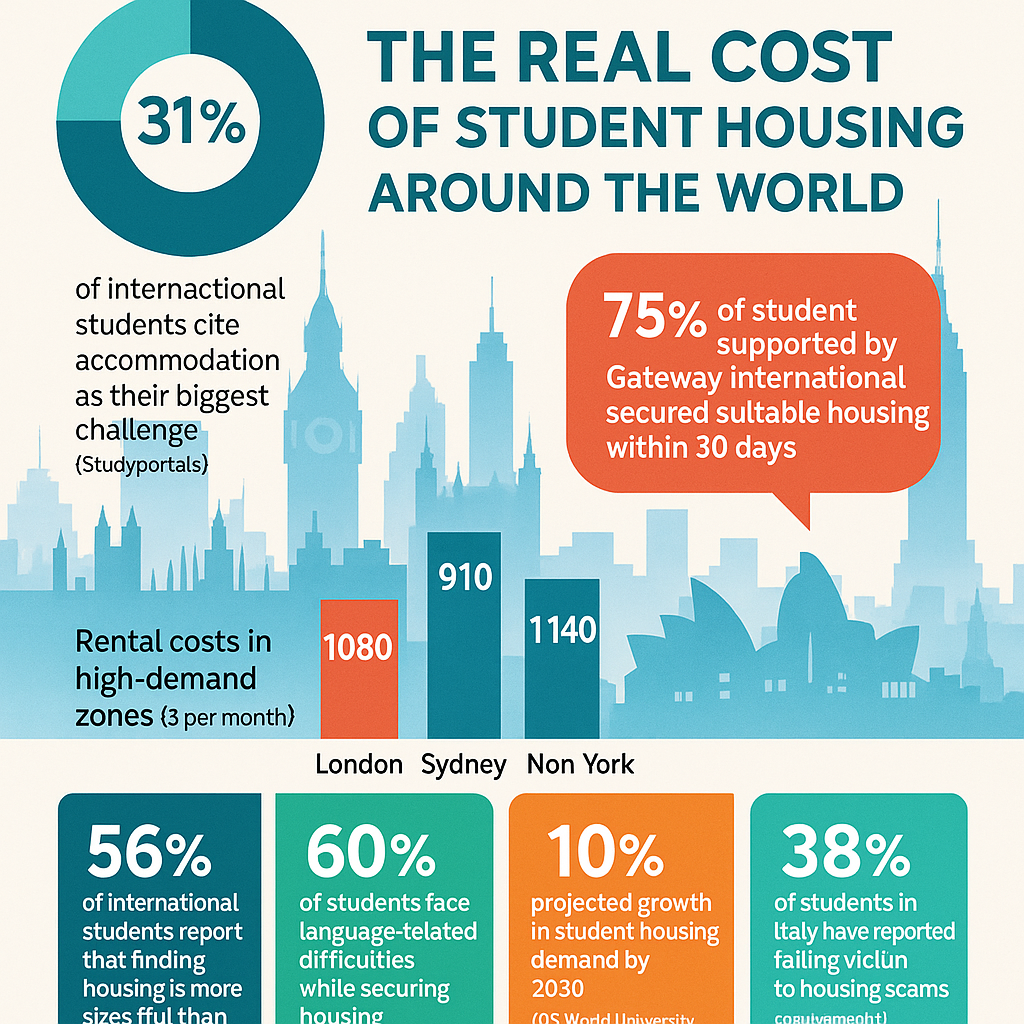
A comparison of rental costs in key cities highlighting affordability gaps for students .
Scammed and Stranded: The risks of overseas rental services
Let me tell you about Priya—a bright engineering student from Pune who thought she had secured the perfect apartment in Warsaw through Facebook Marketplace . She sent 80,000 as a deposit after a convincing video tour, only to arrive at an address that didn’t exist . The “landlord” had vanished along with her money and her faith in humanity .
Unfortunately, Priya’s story isn’t unique: The harsh reality is that international students are prime targets for rental scams because we are desperate, unfamiliar with local laws and often make decisions from thousands of miles away .
Red Flags You Can’t Afford to Miss
The “Too Good to Be True” TrapIf a studio apartment near campus costs half the market rate , there’s a catch : scammers bank on your excitement clouding your judgment . I’ve seen listings for €300/month apartments in Munich — where parking spots cost more than that .
The Pressure Play“Three other students are interested, so you need to decide TODAY.” Real landlords don’t operate like used car salesmen. Any legitimate rental will give you time to think, verify and maybe even visit .
The Document DodgeAsk for proof of ownership and watch scammers scramble—they’ll have excuses—traveling, privacy concerns, whatever. A genuine landlord can easily provide property documents or utility bills .
Your Anti-Scam arsenal
Never—and I mean never—transfer money without:
- Video calls inside the actual apartment (not pre-recorded tours)
- Verification of the landlord’s identity through official channels
- Getting everything in writing with the proper rental agreements
- Secure payment methods with buyer protection
Consider this: university housing might cost 20% more, but it’s 100% less likely to leave you sleeping at the airport. Many universities also maintain verified off-campus housing lists—boring, yes, but infinitely safer than that sketchy WhatsApp group everyone is sharing .
The bottom line? Your eagerness to start this amazing journey shouldn’t override your common sense: That perfect apartment will still be perfect after you have done your due diligence .

Rahul Verma, University of Warsaw, 2022
Graduate in Software Engineering
“I almost fell for a rental scam until Gateway International’s counselor warned me about the red flags and their verified housing partners saved me from losing thousands and starting my journey on the wrong foot.”
Navigating new Norms: Adjusting to Foreign Living Conditions
Let me tell you about my friend Priya’s first week in Munich: she had prepared for everything—visa, accommodation, even downloaded translation apps—but nothing prepared her for the washing machine situation: the communal laundry had instructions only in German, operated on a timer system she’d never seen and required exact change in coins. She ended up hand-washing clothes for two weeks until a kind neighbor showed her the ropes .
That’s the thing about adjusting to foreign living conditions—it’s rarely the big stuff that throws you off — it’s discovering that shops close at 8 PM sharp or that your definition of “personal space” might be wildly different from the locals — these small daily negotiations can feel overwhelming when they pile up .
The reality check hits different for everyone.Some students struggle with shared kitchens where cooking Indian food draws curious (sometimes judgmental) looks, others find the academic culture jarring—professors who expect you to challenge their ideas rather than just take notes . I remember a student telling me how she nearly cried when her Dutch professor said her presentation was “ok,” which in Dutch directness meant it was actually good .
What actually helps? Consequently, first, those orientation sessions that consultants organize aren’t just bureaucratic time-fillers – they cover practical gold like how to navigate health insurance claims or why you shouldn’t be offended when Germans don’t smile at strangers – students who attend these sessions report feeling less blindsided by cultural differences .
Building your survival toolkit starts before you leave.Join online communities of Indian students in your destination country and they will tell you which neighborhoods feel like home, where to find decent dal and how to handle that first winter when daylight becomes a rare commodity .
The students who thrive aren’t necessarily the most outgoing or adaptable — they accept that feeling uncomfortable is part of the process — they learn to laugh at their mistakes (like accidentally buying fabric softener thinking it was detergent) and celebrate small victories (opening a bank account in a foreign language).
During this adjustment, your living situation becomes your sanctuary. Whether it’s a dorm room or shared flat, making it feel like yours—even with small touches—matters more than you would think .
Legal labyrinths: Understanding Your Rights as a Tenant
Let me tell you about the time I almost signed my security deposit in Germany because I couldn’t understand what “Nebenkosten” meant: it’s additional costs and they can add 30% to your rent if you are not careful .
Here’s what nobody tells you about rental contracts abroad—they are not just in another language, they are in another legal universe. Each country has its own quirky rules about what landlords can and can’t do, and trust me, some of them will surprise you .
Know your non-negotiables
In most European countries, landlords can’t legally ask for more than three months of deposit , but here it gets interesting—in places like the Netherlands they often try anyway , because international students don’t know better : In the UK, deposit protection schemes are mandatory, meaning your money goes into a government-backed account, not your landlord’s pocket .
Red flags that should make you run
- Contracts that forbid visitors (illegal in most of the EU countries)
- Requests for cash only payments with no receipts
- Clauses about “wear and tear” that make you responsible for the existing damage
- Automatic renewal clauses are hidden in German legalese
Your legal lifelines
Most universities have free legal clinics specifically for housing issues. I discovered this after my Portuguese landlord tried to keep my deposit for “excessive electricity use” (apparently, using the heater in winter was excessive) The university’s legal team wrote a letter and I had my money back in a week .
Student unions often provide contract templates in English that aren’t just translations—they are explanations of what each clause actually means for you . In France, CAF (housing allowance) can cover up to 35% of your rent, but only if your contract meets specific requirements .
The protection game
Document everything. I mean everything. That water stain on the ceiling? Photo with timestamp. The wobbly table? Video evidence. Email these to your landlord within 48 hours of moving in. This is not paranoia—it’s protection.
Remember that most countries have tenant-favoring laws, especially for students. The trick is knowing that they exist. Your rights don’t disappear just because you are foreign; they just need to be translated—literally and legally.
Institutional Interventions : How Universities Can Help
I’ve seen firsthand how the right institutional support can transform a student’s entire abroad experience—and conversely how its absence can derail dreams before they even begin .
For example, when my friend studied at the University of Amsterdam, their international office assigned her a housing coordinator who spoke her language and understood the local rental market’s quirks . This wasn’t just about finding four walls and a roof; it was about navigating Dutch rental contracts, understanding deposit systems and avoiding the notorious Facebook housing scams targeting desperate international students .
Smart universities are now partnering directly with verified housing providers to create exclusive accommodation pools . These partnerships guarantee spots for international students and often include flexible lease terms that align with academic calendars. Some institutions even negotiate bulk rates, passing savings onto students who are already stretching every penny .
But here is what really moves the needle: pre-arrival support systems. Universities offering virtual housing fairs where students can tour accommodations and meet potential roommates months before landing are game-changers . Combined with comprehensive housing databases that include neighborhood safety ratings, proximity to campus and real student reviews, these tools transform an overwhelming process into a manageable one .
The most forward-thinking institutions are creating transition housing programs—temporary accommodation for the first few weeks while students find permanent housing . This buffer period eliminates the pressure of signing leases from thousands of miles away .
Financial support also matters : universities offering housing grants or interest-free loans specifically for deposits help level the playing field for students from diverse economic backgrounds . When institutions recognize that stable housing directly impacts academic success , everyone wins.
Ananya Patel, Amsterdam University 2023
International Business Student:
The housing liaison officer of the university was a lifesaver: she helped me understand Dutch rental laws, connected me with verified landlords and even attended viewings with me – this support made all the difference in finding safe, affordable housing .
The personal touch: the role of Gateway International
When I first started helping students navigate their study abroad applications, I kept hearing the same story: “I got accepted, but now I can’t find anywhere to live!” That’s when I realized how crucial having the right support system is.
Gateway International gets this – they’re not just pushing paperwork – they’ve built actual partnerships with universities that include housing assistance . Last month I spoke with Priya who was panicking about finding accommodation in Munich – Gateway connected her with their international student housing program and within two weeks she had a confirmed spot in a student residence .
What really sets them apart is that they maintain relationships with local housing coordinators at partner universities – would you rather scramble through sketchy Facebook groups looking for roommates or have someone who knows the system guide you to verified options?
Their counselors share practical details that most agencies skip: which neighborhoods are student-friendly, realistic budget expectations and even WhatsApp groups of current students who can give real advice. They’ve helped over 25,000 students and their 98.6% visa success rate isn’t just about paperwork – it’s because they ensure students have confirmed accommodation, making visa applications stronger .
Sometimes the difference between your dream education and a nightmare experience is having someone who has walked this path before .
Looking to the future: Trends and predictions
Here’s what is actually changing in student housing: virtual apartment tours are becoming the norm, not the exception. Furthermore, last month, I watched my cousin secure housing in Amsterdam without leaving Mumbai—she toured five apartments through VR headsets at a local agency.
Universities are finally catching on too: many are partnering with private housing platforms to guarantee spots for international students (about time! ) The real game-changer? AI-powered roommate matching based on study habits and lifestyle preferences, not just random assignments .
But here’s my prediction: co-living spaces for international students will explode by 2027 . Furthermore, think WeWork meets student housing — flexible leases, built-in communities and prices that won’t make your parents faint — some startups are already testing this in Berlin and Toronto .
The smartest move? Start building your housing network now through university forums and WhatsApp groups. Tomorrow’s best accommodations won’t be found on traditional sites—they’ll come through student-to-student connections powered by technology .
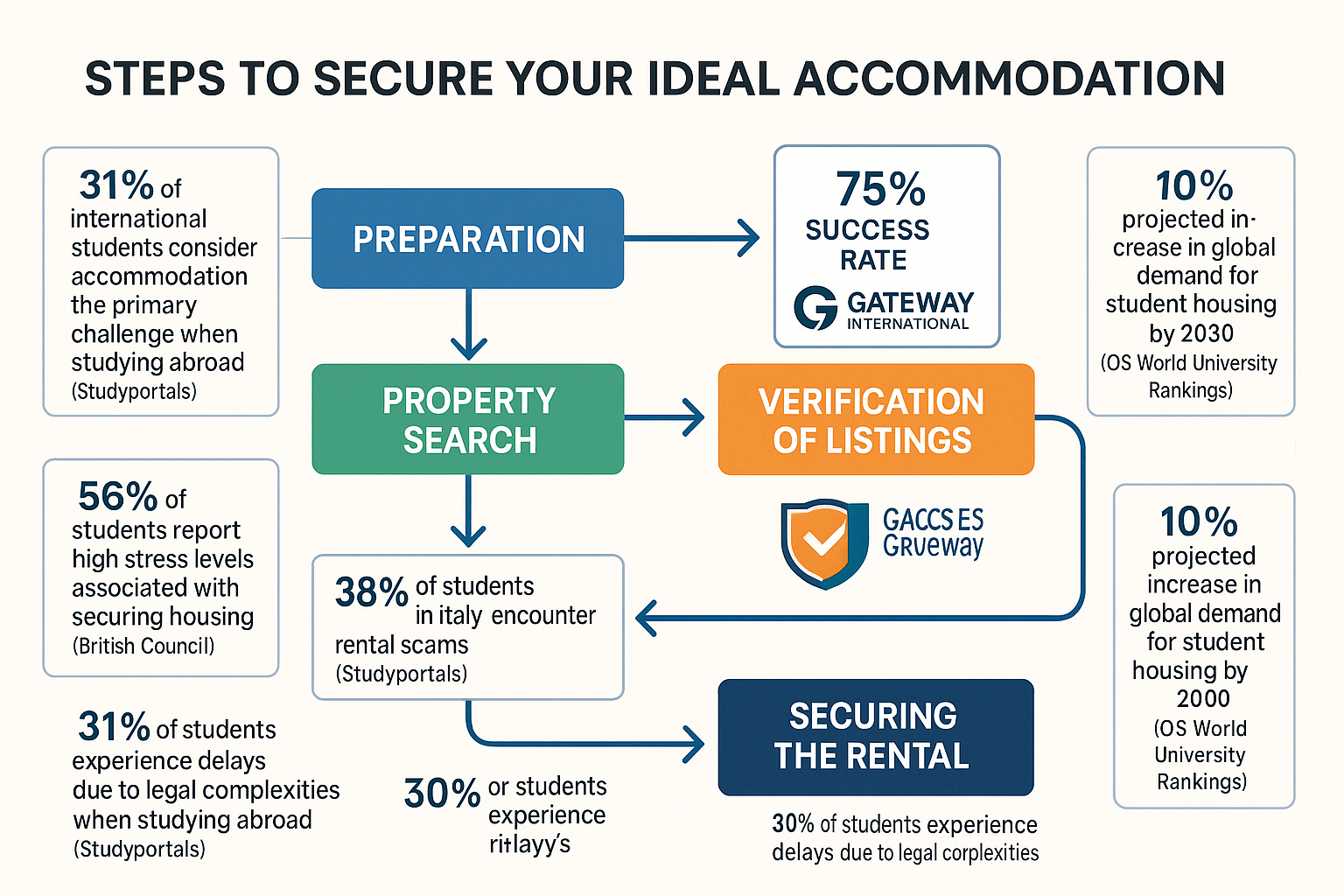
A flowchart that breaks down the process of finding, securing and legally validating housing abroad .
Conclusion: Building More Than Just A Home
Looking back at everything we’ve covered, I realize that finding accommodation abroad isn’t just about securing four walls and a roof . When I finally moved into my tiny studio in Berlin after weeks of viewings and rejections, unpacking felt like more than just settling in—it was claiming my space in a new world. Yes, the housing hunt will test your patience (and probably your sanity), but here’s what I’ve learned: you’re not just finding a place to
The latest industry updates
Quick heads-up on what is shaking in student housing right now:
- UK visa fees jumped 13%This year – budget accordingly .
- Social media checksStandard now for US student visas (yes, they are scrolling your Instagram)
- Post-study work rights extendedIn EU countries – now up to 24 months
- Tech-focused accommodationsEmerging near AI/ML program hubs
Stay informed, plan smarter .
Vikram Singh, parent of the student
Son is studying at TU Munich
“As a parent, the housing situation was my biggest worry – Gateway International’s team not only helped my son find verified accommodation , but also guided us through the entire process – their local connections and expertise gave us peace of mind.”

Find your perfect student accommodation abroad!
Let Gateway International guide you to safe, verified housing options through our trusted university partnerships .
Verified Listings Local market expertise Scam Protection
Start your journey with confidence – Contact us today !
Frequently asked Questions