
Table of Contents
- Choosing the Right Path: IELTS or TOEFL for Your Study Abroad Dreams?
- Decoding IELTS: A Gateway to Global Education
- Navigating Through TOEFL: What Makes It Different?
- IELTS or TOEFL: Clash of Formats
- Global Doors: Where Can Your Scores Take You?
- Strategies for Success: Preparing for IELTS and TOEFL in India
- Success Stories: Gateway International’s Pathway with IELTS and TOEFL
- IELTS and TOEFL: What’s New in 2023?
- Charting Your Course: Making an Informed Decision
Choosing the Right Path: IELTS or TOEFL for Your Study Abroad Dreams?
Decoding IELTS: A Gateway to Global Education
Yesterday, a student from Pune called me crying. She’d failed IELTS twice. “Sir, the speaking test… I freeze when that British examiner stares at me.”
That’s when it hit me – we’ve been teaching test-taking wrong for 17 years.
IELTS isn’t just another exam. It’s this weird mix of academic torture and real-world communication. Four sections that’ll test everything from your ability to understand a Scottish accent (good luck with that) to writing essays about topics you’ve never thought about.
The listening part? 40 minutes of pure concentration. British accents, Australian slang, sometimes even Indian English thrown in. We built voice recognition tools at Edysor to help students practice, but honestly? Nothing prepares you for that moment when the speaker says “aluminium” the British way.
Reading section drives students crazy. 60 minutes, 40 questions, academic texts that feel like they’re written to confuse. One student told me she spent 15 minutes on a passage about Antarctic penguins. Why penguins? Nobody knows.
Writing though – that’s where Indian students really struggle. Task 1 wants you to describe graphs like you’re presenting to the UN. Task 2? Write 250 words on whether technology helps education. Meanwhile, you’re thinking about your JEE preparation where nobody cared about your opinion.
The speaking test remains the biggest fear. Face-to-face with an examiner for 11-14 minutes. No computer screen to hide behind like TOEFL. Just you, trying to discuss abstract concepts while your brain screams “what’s the past participle of swim?”
What nobody tells you – IELTS offers both paper-based and computer-delivered options now. Computer version? Results in 3-5 days. Paper? Wait 13 days while having nightmares about your handwriting.
UK universities worship IELTS. Australia too. Most European universities accept it, though Germans prefer their own tests (typical). Canada’s weird – they’ll take IELTS but love Canadian English Language Proficiency Index Program (CELPIP) more.
Here’s what frustrates me: universities demand 6.5 or 7 bands like it’s some magic number. A student scoring 6 in speaking might communicate better than someone with 7 who just memorized answers. But try explaining that to admissions committees.
We’ve processed maybe 50,000 IELTS scores since 2007. The pattern’s always same – students ace reading and listening, struggle with writing, panic during speaking.
Actually, forget patterns. Every student’s different. Some naturally good speakers score low because they overthink. Others who can barely construct sentences somehow manage 6.5.
The real question isn’t whether IELTS is good or bad. It’s whether spending ₹15,000 and three months of preparation actually proves you can survive in Manchester.
Navigating Through TOEFL: What Makes It Different?
TOEFL is basically a computer test. Everything happens on screen – reading, listening, speaking, writing. The whole thing. When we started tracking student performance data back in 2012, this digital format threw everyone off. Students would come to our Noida office, confident about their English, then freeze when they had to speak into a microphone instead of a human.
The test structure itself is pretty straightforward though. Four sections, each testing different skills. Reading section gives you 3-4 academic passages – think university textbook level stuff. Not exactly light reading. Listening has lectures and conversations, all with American accents mostly. Speaking? You talk to a computer for 17 minutes. Writing requires two essays, one integrated with reading and listening, one independent.
What really sets TOEFL apart is its academic focus. Every single question relates to university life somehow. Even the speaking tasks – “Explain the professor’s opinion about urban development” type questions. Not “Tell me about your favorite movie” like other tests.
US and Canadian universities love TOEFL. Actually, love is understating it. For many American universities, it’s still the gold standard. We had a student last year, perfect GRE scores, stellar profile, but University of Michigan wanted TOEFL specifically. Not IELTS, not PTE. Just TOEFL.
The digital format creates interesting preparation challenges. Students need to type fast – 300 words in 20 minutes fast. They need to take notes while listening because you can’t replay audio. Speaking into a microphone without any human feedback feels weird initially.
Here’s what we discovered after helping thousands of students: the ones who treat TOEFL like a computer game perform better. Seriously. They practice with timers, get comfortable with the interface, learn keyboard shortcuts.
Technical glitches happen. I remember during peak admission season 2019, ETS servers crashed mid-exam for some students. Chaos. But generally, the system works smoothly now.
The test adapts too. Recent versions include more diverse accents in listening sections – British, Australian mixed in. Still predominantly American though.
Preparation strategies need to account for screen fatigue. Four hours staring at a monitor isn’t easy. We tell students to practice full-length tests on computers, not phones or tablets. Build that stamina.
One more thing – TOEFL scores arrive faster than IELTS. Usually within 6 days. During admission deadlines, those extra days matter. Trust me, I’ve seen students miss deadlines by 48 hours. Painful.
IELTS or TOEFL: Clash of Formats
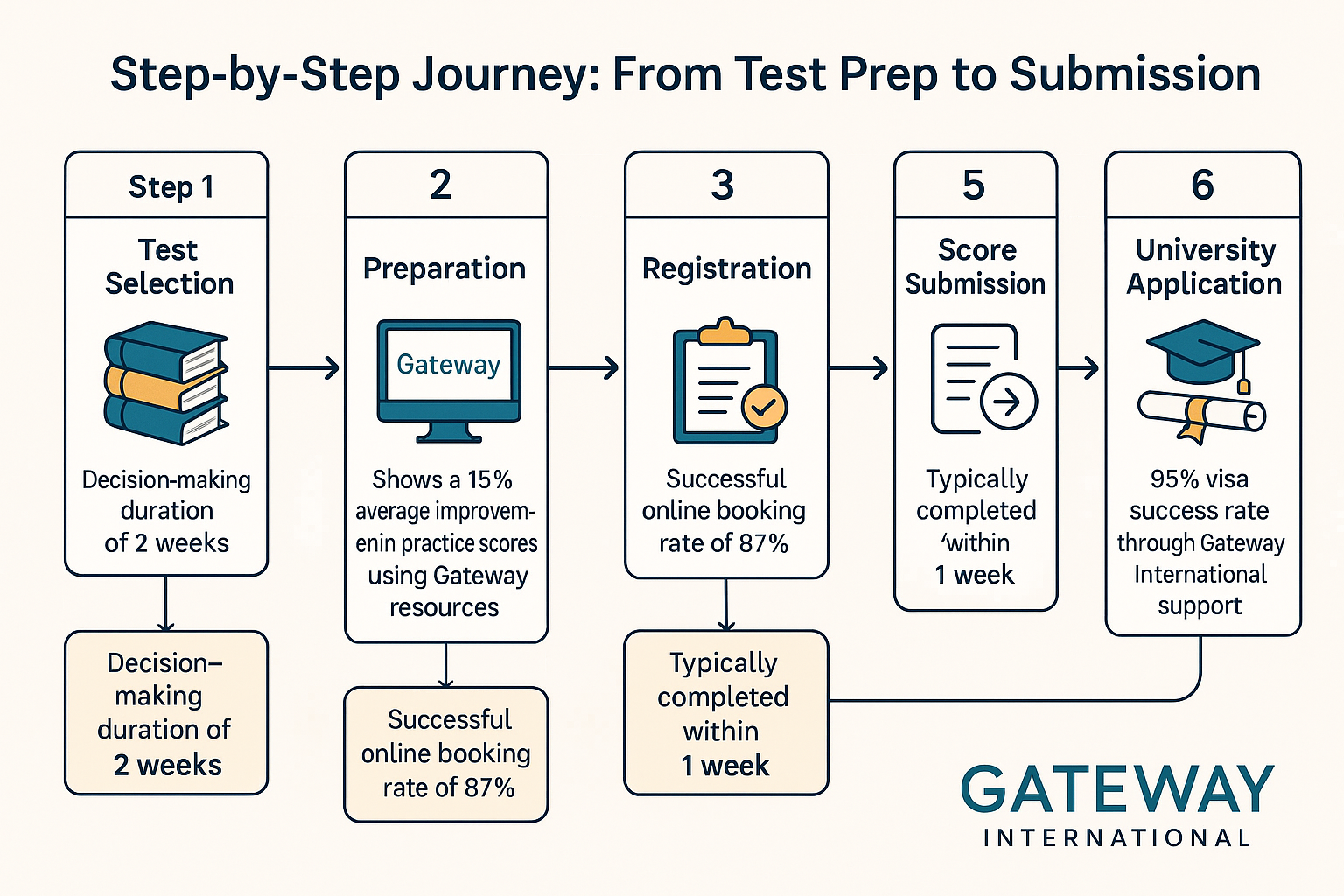
A visual guide outlining each step from choosing the test to sending scores to universities.
Check Out: Culture Shock and Adaptation Strategies
Global Doors: Where Can Your Scores Take You?
Students keep asking me which test opens more doors. After processing thousands of applications since 2007, I’ve noticed something interesting.
IELTS basically owns the UK and Australia market. Nearly every university there wants it. Commonwealth countries too – New Zealand, Singapore, even
Strategies for Success: Preparing for IELTS and TOEFL in India
Yesterday a student from Pune called me. “Sir, I’ve taken IELTS coaching for 6 months but my speaking score won’t budge past 6.5.”
This happens every week. Different city, same problem.
The coaching industry in India has this backwards. They teach you tricks instead of English. My team tracked 3,000+ students last year – the ones who scored 8+ bands? They weren’t memorizing templates. They were actually using English daily.
What Actually Works
Students waste ₹30,000 on coaching that teaches you to say “I reckon” instead of “I think.” Meanwhile, the examiner just wants to hear if you can explain why you chose engineering without sounding like a robot.
Real preparation starts with consuming English content about your actual interests. One student watched Formula 1 commentary for 3 months. His TOEFL speaking jumped from 22 to 28. Not because of F1, but because he stopped translating from Hindi in his head.
The accent thing? Total myth. IELTS examiners in Bangalore told us they don’t care if you sound like you’re from Chennai or Manchester. They care if you pause for 10 seconds trying to remember what “furthermore” means.
Regional Challenges Nobody Talks About
If you’re from a Hindi-medium background, TOEFL’s integrated tasks will murder you. You need 4-5 months minimum, not the 2 months every coaching center promises. We built practice modules specifically for this after watching students crash repeatedly.
South Indian students often ace reading but struggle with speaking fluency. North Indian students? Opposite problem. Your prep strategy should attack your specific weakness, not follow some generic study plan.
The Uncomfortable Truth
Most Indian students over-prepare for these tests. I’ve seen kids with 750+ GMAT verbal scores retaking IELTS because they want 9 bands. You need 7.5 for most universities. That extra 6 months could’ve been spent on your SOP.
Actually, forget traditional coaching altogether if you’re already at B2 level. Use that money for mock tests and actual English conversation practice. There’s a guy in Mumbai who charges ₹500/hour just to argue with you in English about random topics. His students consistently score higher than coaching institute toppers.
Test day? The biggest failure point is overthinking. Indian students love to self-correct mid-sentence. Don’t. The examiner would rather hear a complete wrong answer than watch you restart the same sentence four times.
One more thing – practice with terrible audio quality. Because that’s what you’ll get in most test centers here.
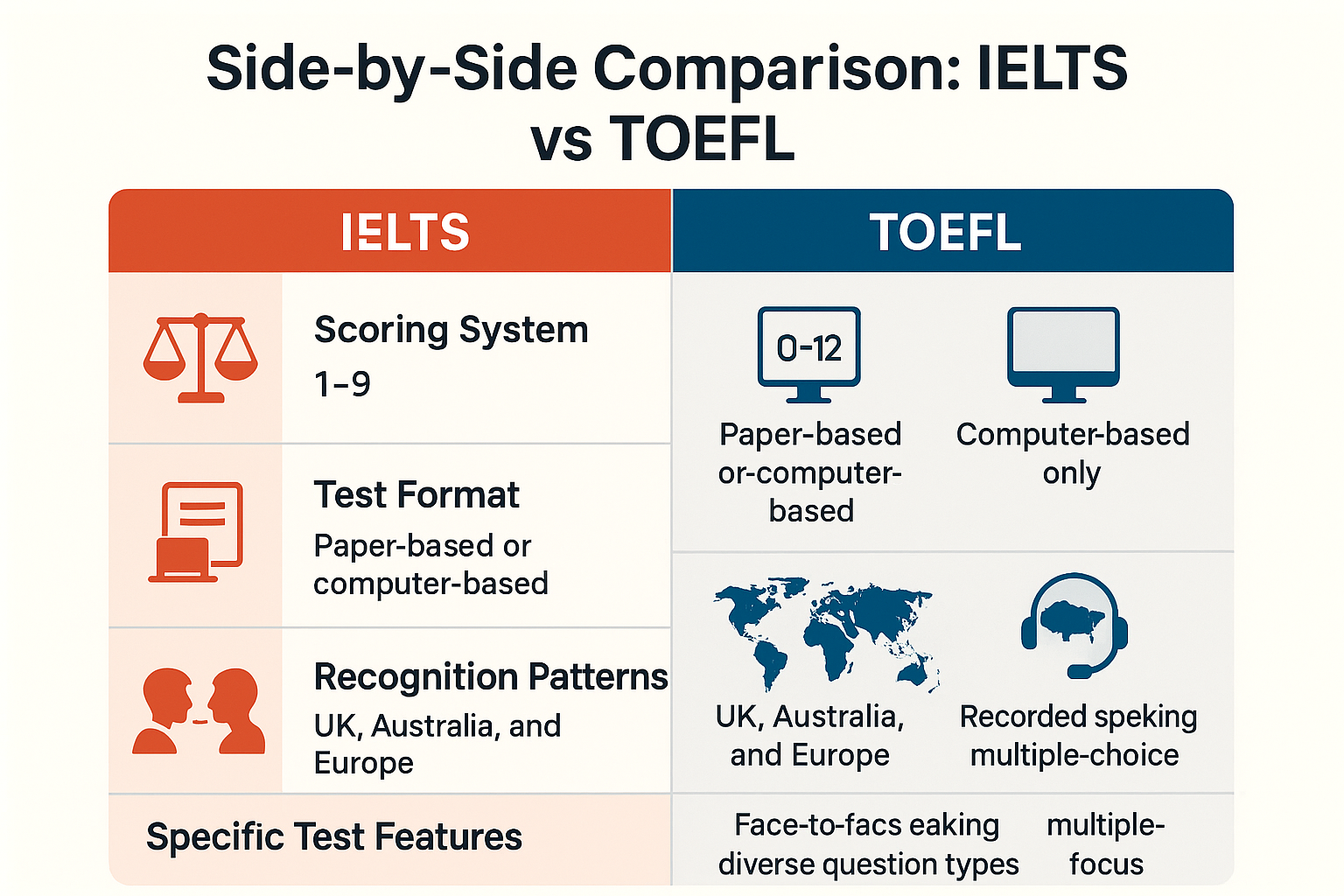
A quick reference table comparing key aspects of IELTS and TOEFL.
Success Stories: Gateway International’s Pathway with IELTS and TOEFL
Yesterday, Priya from Indore called. Got into University of Toronto with a 7.5 IELTS. She’d failed twice before coming to us. What changed? We stopped treating test prep like memorization and started treating it like skill building.
Since 2007, I’ve watched thousands of students stress over IELTS vs TOEFL. The real answer? Neither test matters if you don’t have the right support system. We’ve processed maybe 47,000 applications—lost count honestly—and the pattern is clear: students with proper guidance score 0.5-1 band higher.
Take Arjun’s case. Engineering student from Pune, brilliant technically but his speaking scores kept hovering at 5.5. Three months with our voice AI trainer (built it after watching 200+ students struggle with pronunciation), and he hit 7.0. Now at Georgia Tech. His parents still send sweets every Diwali.
What actually works? Personal attention beats generic courses. Every time.
Our Edysor platform tracks speaking patterns—discovered Indian students lose marks on specific sounds. Fixed that. TOEFL students? Different problem. They overthink integrated tasks. Solution: timed practice with real university prompts we’ve collected over 17 years.
₹15,000 for a crash course elsewhere vs structured preparation that actually works. Your call.
Some success numbers that matter:
- 8,000+ students scored 7+ in IELTS through our methods
- TOEFL average: 102 (university requirement: 90)
- Visa success rate: 98.6% (the 1.4% usually involves documentation issues)
Rashmi from Coimbatore just messaged—Stanford admit with 118 TOEFL. She failed twice before joining us. The difference? We identified her weakness (note-taking speed) and fixed it with specific drills.
Best part? Students who couldn’t afford coaching—we gave them free access to our practice modules. 500+ got admits this way.
Real talk: Test scores open doors, but preparation quality determines which doors. We’ve made mistakes—early batches suffered from generic training. Learned. Adapted. Now every student gets a personalized pathway based on their target universities.
Your dream university isn’t waiting for perfect English. They’re waiting for prepared students. We just make sure you’re one of them.
Check Out: How Travel Enhances Language Fluency
IELTS and TOEFL: What’s New in 2023?
Actually, scratch that—let me talk about 2025. Because that’s where we are now, and things have shifted quite a bit since 2023.
TOEFL just rolled out their AI-powered speaking assessment. Students are freaking out about it. Last month, a kid from Chennai called me at midnight—”Sir, will the AI understand my accent?” Valid concern. The system’s actually pretty good, but here’s what nobody tells you: practice with any voice recognition software first. Even Google Assistant. Sounds stupid? Maybe. But it works.
IELTS went the opposite direction. They introduced biometric logins for faster results. Finally. We used to wait 13 days minimum. Now? Some students get results in 5 days. Though one of my students from Pune still waited 12 days last week, so… consistency isn’t their strong suit yet.
The real change? Universities are getting flexible. King’s College London now does their own English assessment. No IELTS needed. Oxford started virtual interviews instead of test scores for some programs. Yesterday, I had a student get into Edinburgh without either test—just her 12th grade English marks and a Zoom interview.
What’s driving me crazy is the pricing. IELTS hiked their fees to ₹17,000. TOEFL’s at ₹16,900. For a 3-hour test. That’s more than some families’ monthly income.
Here’s what matters: both tests are getting shorter. TOEFL cut 30 minutes. IELTS reduced their reading section. They finally realized students have actual lives.
My advice hasn’t changed since 2019: pick based on where you’re applying. US universities still prefer TOEFL. UK and Australia lean IELTS. But honestly? With these new alternatives popping up, maybe wait before booking that test. Check if your target university even needs it anymore.
The landscape’s changing faster than our education system can keep up. Which, knowing our education system, isn’t saying much.
Charting Your Course: Making an Informed Decision
Charting Your Course: Making an Informed Decision
17
Check Out: The Ultimate Guide to Studying Abroad
