
Table of Contents
- Embarking on a Global Education Journey After Class 12
- Navigating Engineering Abroad: From Electronics to AI
- The Path to a Global Medical Degree: MBBS & Beyond
- Business Degrees Abroad: Opening Doors Worldwide
- Computer Science & IT: Gateways to the Tech World
- From Arts to Sciences: Diverse Courses for Every Aspirant
- Scholarships and Financial Aid: Studying Abroad Made Accessible
- Your Gateway to the World: Next Steps to Your Dream University
Embarking on a Global Education Journey After Class 12
2007. That’s when I started helping students go abroad. Back then, parents would literally cry at the airport. Now? They’re booking tickets to visit their kids in Toronto.
Yesterday, a student from Pune called. “Sir, I got 85% in boards. Can I study abroad?” The answer used to be complicated. Today, with 47 countries actively recruiting Indian students, it’s more about which country, not if.
The numbers are crazy. When we launched Gateway, maybe 50,000 Indian students went abroad annually. Last year? 7.5 lakh. That’s not a trend—that’s a revolution.
But here’s what bugs me. Students still think abroad = USA/UK. Meanwhile, Germany offers free education. France charges ₹20,000 per year. Singapore gives PR pathways. Yet everyone’s chasing the same five universities.
Actually, forget universities for a second. You know what transformed careers? Not the degree. The exposure. Working part-time in Melbourne teaches you more about professional communication than any soft skills course. Presenting to diverse classmates in Amsterdam? That confidence stays forever.
The real game-changer happened around 2019. Countries started competing for Indian students. Post-study work permits extended. Scholarship budgets doubled. Even visa processes went online—though some still crash during peak season.
Parents ask me, “Is it worth it?”
Wrong question.
The right question: “Can my child handle grocery shopping in -10°C?” Because that’s where growth happens. Not in classrooms. In Walmart aisles, figuring out which milk to buy.
Every batch, I see transformations. Shy kids from tier-2 cities leading university clubs. Commerce students switching to data science. Science students discovering passion for filmmaking.
That’s why we built Edysor. To show these possibilities. Because limiting yourself to engineering or medicine when the world offers 15,000+ programs?
That’s the real tragedy.
Navigating Engineering Abroad: From Electronics to AI
Engineering students calling me at midnight asking about AI programs is becoming a pattern. Just yesterday, a kid from Pune wanted to know if studying Electronics abroad still makes sense when everyone’s talking about AI.
The answer isn’t straightforward.
Back in 2007, Electronics Engineering was the thing. Parents pushed for it, companies hired aggressively. Now? Pure electronics roles are shrinking while AI-integrated positions explode. But here’s what students miss – you need that electronics foundation to build intelligent systems. The best AI engineers I’ve met? They started with circuits and signals.
Germany remains unbeatable for traditional engineering. Their universities – TU Munich, RWTH Aachen – combine electronics with AI beautifully. Plus, education’s practically free. Yes, you heard right. Living costs around €10,000 yearly, but no tuition. Compare that to US programs charging $50,000 just for fees.
For pure AI focus, Canada’s your best bet. University of Toronto, UBC – they’re producing serious talent. And they actually want you to stay after graduation. The US has Stanford and MIT, obviously brilliant, but visa uncertainties are killing student interest. We’ve had three students this month switch from US to Canada applications.
Singapore’s NUS is doing something interesting – they’re offering AI specializations within Electronics Engineering. Smart move. Students get hardware knowledge plus machine learning skills. Starting salaries? S$5,000-6,000 monthly. Not bad.
Entry requirements are frustrating everyone. IELTS 6.5 minimum, but competitive programs want 7.5. SAT for US (though many dropped it during COVID). German universities need TestDaF or DSH – language requirements even for English programs. Don’t ask me why.
Scholarships exist but competition’s brutal. DAAD for Germany, Vanier for Canada. Most need 85%+ in 12th boards. One student last year got full funding to TU Delft with 88% in CBSE. Another with 95% got rejected everywhere. Makes no sense sometimes.
My advice? Pick based on where you want to work eventually. Silicon Valley dreams? Go US despite visa hassles. Want European work-life balance? Germany or Netherlands. Need PR certainty? Canada wins.
The engineering landscape’s changing fast. What worked five years ago doesn’t anymore. But fundamentals remain – strong math, genuine interest in building things, and persistence through visa rejections.
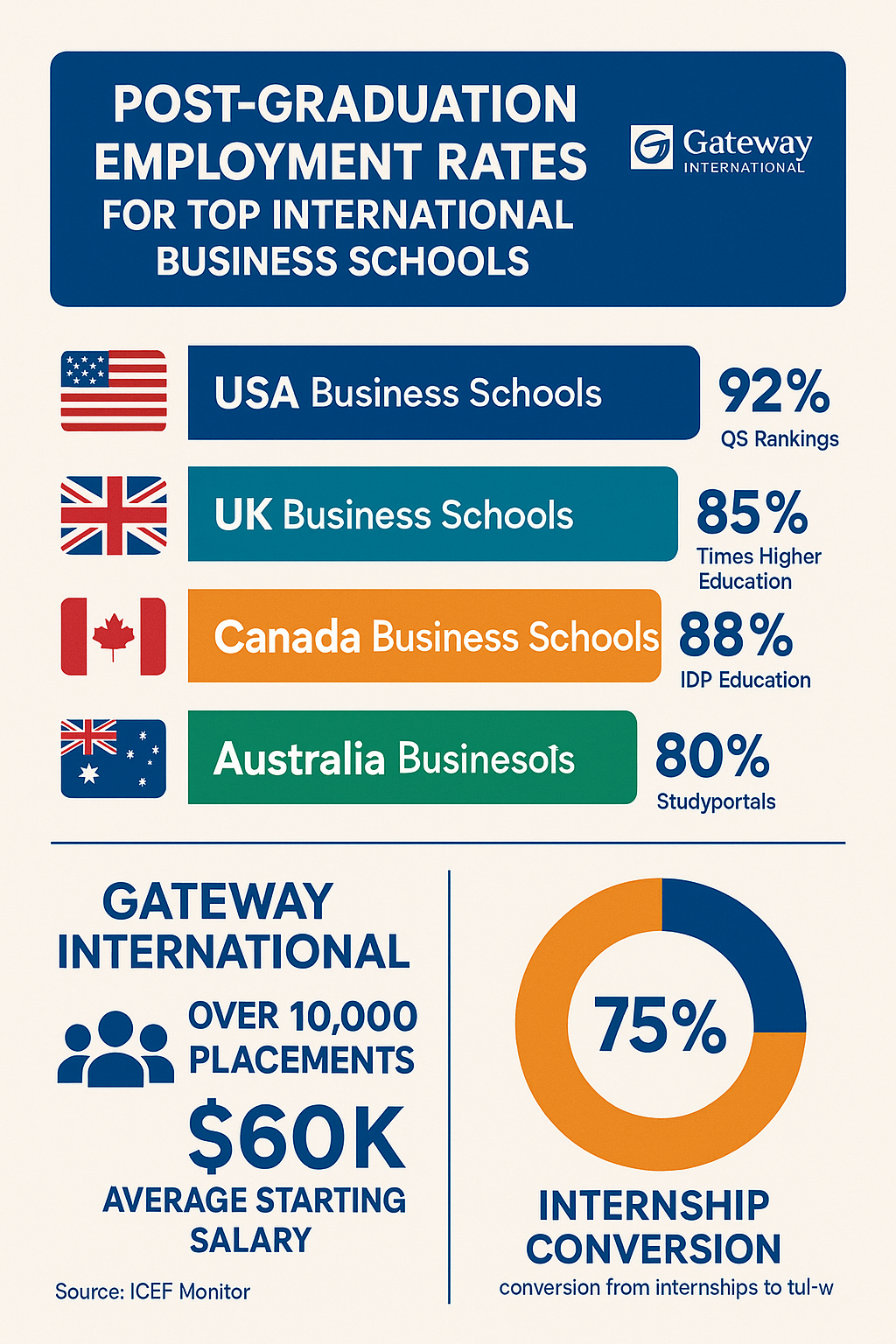
Visual representation of post-graduation employment statistics across leading countries for business studies.
The Path to a Global Medical Degree: MBBS & Beyond
Medical education abroad. Been helping students crack this code since 2007, and honestly? The system’s still a mess.
Last month, a parent called me – their daughter scored 580 in NEET. Not enough for government seats, private colleges asking ₹1.5 crore. “What about abroad?” they asked. That conversation happens 20 times a day now.
The Reality Nobody Talks About
Foreign medical degrees sound fantastic until you realize – coming back to practice in India means clearing FMGE. Pass rate? Around 16%. That number should scare you.
But here’s what I’ve learned after sending thousands of students abroad: pick the right country, right university, and prepare from day one – your chances jump to 60-70%.
Russia, Georgia, Philippines keep dominating our placement numbers. Why? They actually follow Indian medical curriculum patterns. A student from Tbilisi State just messaged yesterday – cleared FMGE first attempt. Her secret? Started FMGE prep in second year itself.
Breaking Down Your Options
UK medical schools – brilliant training, astronomical fees. We’re talking £40,000-50,000 per year. Unless you’ve got that budget, move on.
Eastern Europe (Georgia, Russia) – ₹20-25 lakhs total. English medium programs. Decent clinical exposure. But winters? -20°C isn’t fun when you’re from Chennai.
Philippines – tropical weather, American-style curriculum, around ₹15-20 lakhs. NEET-based scholarships now available. Worth exploring.
The admission process varies wildly. UK wants UKCAT/BMAT scores. Most others accept NEET qualifying marks. Some don’t even need NEET (though you’ll still need it for practicing in India later).
What Actually Matters
Forget university rankings. Check three things:
- NMC recognition (non-negotiable)
- Medium of instruction (trust me, studying medicine in Russian is a nightmare)
- Indian student success rate in FMGE
One more thing – cultural adjustment hits different when you’re dissecting cadavers in -15°C weather. A Mumbai student once called crying from Kazakhstan. Homesickness plus medical school pressure? Brutal combination.
Start preparing 18 months before intake. Get your documents apostilled (that process alone takes 2 months). And please, verify everything through official channels. Too many fake consultants out there selling dreams.
The path exists. It’s just messier than anyone admits.
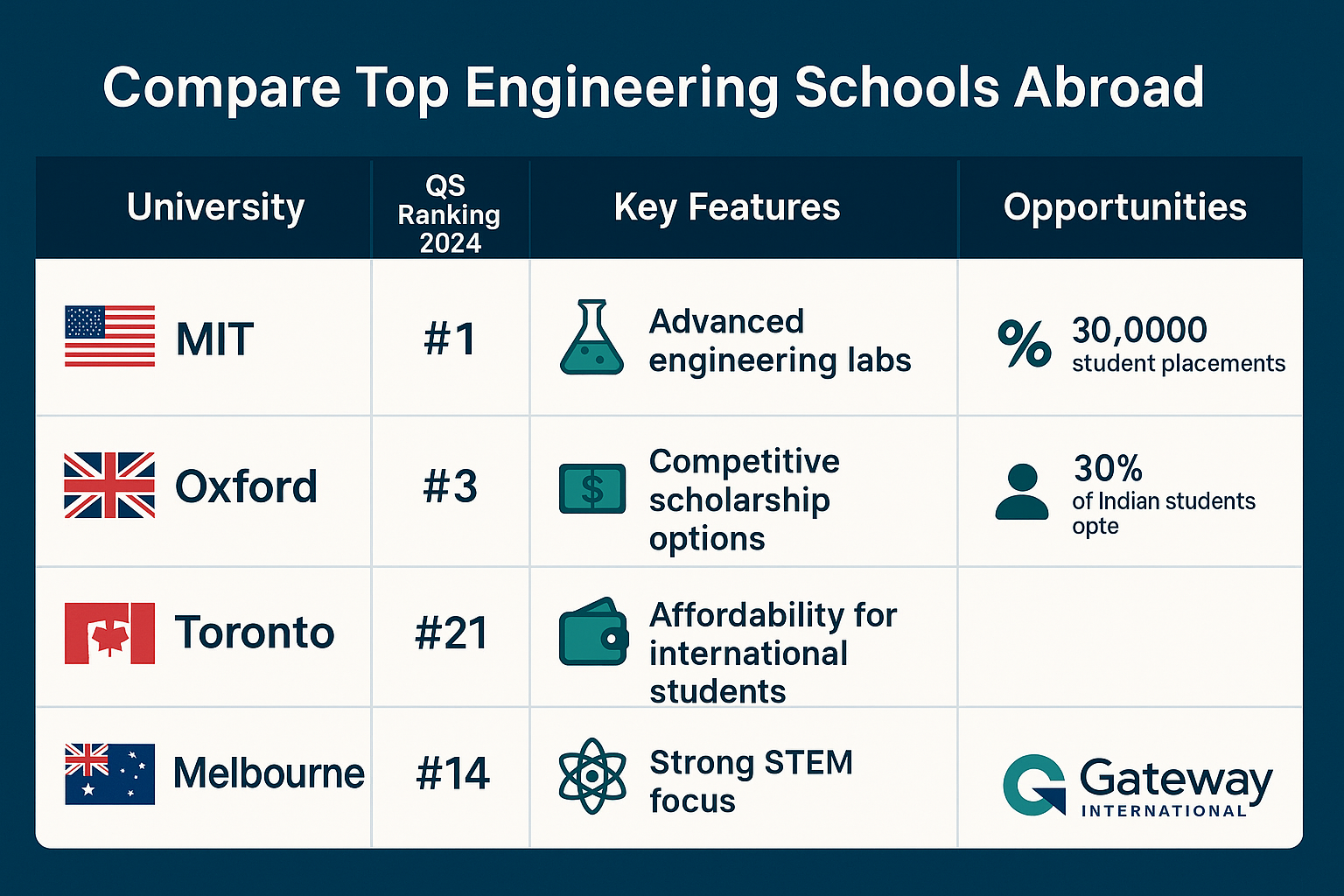
A detailed comparison of leading engineering institutions by country and ranking.
Business Degrees Abroad: Opening Doors Worldwide
Yesterday, a parent called asking if business degrees are still worth it. Their kid scored 94% in commerce, wants to do BBA abroad. “But everyone’s doing tech,” they said.
Business education has changed since I started in 2007. Back then, we’d send students to traditional MBA programs – finance, marketing, the usual. Now? Students are mixing business with data science, sustainability, even AI. The combinations are wild.
What’s actually happening in business schools now is fascinating. Take INSEAD – they’ve got students running actual startups as coursework. Not case studies. Real companies. One of our students from Pune is building a fintech solution for migrant workers while studying there. That’s the kind of exposure you won’t get sitting in Mumbai.
The networking thing everyone talks about? It’s real but different than expected. It’s not about collecting business cards at formal events. Last month, a student messaged me – she met her co-founder in the dorm kitchen at 2 AM, both stressed about the same assignment. They’re now running a sustainable fashion venture.
Here’s what bugs me though. Indian students still think business = MBA only.
Wrong.
There’s BBA, specialized masters in finance, entrepreneurship programs, business analytics courses. Each opens different doors. And the timelines vary – 3 years for BBA, 1 year for European masters, 2 years in the US.
Cost-wise, people assume business schools are expensive. Sometimes yes. Harvard, Wharton – prepare to sell a kidney. But Netherlands has solid programs under €15,000/year. Germany even cheaper. Singapore’s picking up with government subsidies for certain programs.
The internship game has completely shifted. It’s not just summer placements anymore. Students are doing virtual internships with Silicon Valley startups while studying in Barcelona. Geography doesn’t limit opportunity like before.
Actually, scratch what I said about geography. Time zones still suck. Try coordinating a project with teammates in Toronto while you’re in Seoul.
But that’s exactly the chaos that prepares you for global business. You learn to work async, manage cultural differences, handle ambiguity. Skills no textbook teaches properly.
Computer Science & IT: Gateways to the Tech World
Back in 2011, I met this kid from Pune. Brilliant coder, could build anything. But his parents wanted him to study CS at “only MIT or Stanford.” Budget? ₹50 lakhs per year wasn’t happening.
Today? That same kid runs a cybersecurity firm in Berlin. Started at TU Munich – paid almost nothing in fees, got recruited by SAP during his third year. The kicker? He’s earning more than most Silicon Valley engineers when you factor in living costs.
CS isn’t just about the big names anymore. Actually, Germany’s killing it in practical tech education. Their universities work directly with companies – you’re debugging real BMW software, not textbook problems. The apprenticeship model means you’re earning while studying. My students tell me they’re making €1,200/month during internships.
The US still dominates for pure innovation. If you’re into AI research or want to build the next unicorn, nothing beats being in the Valley. But here’s what nobody mentions – the H-1B lottery is brutal. 65,000 spots for lakhs of applicants. I’ve seen brilliant kids from IITs get rejected three years straight.
Meanwhile, Germany gives you 18 months to find work after graduation. No lottery. Just skill-based hiring.
What really matters? Projects. One student got into Carnegie Mellon with average grades but had contributed to major open-source projects. Another landed a Microsoft internship in Seattle because she’d built an app that solved traffic problems in Bangalore.
Cybersecurity’s exploding everywhere. Estonia – yes, Estonia – has become this unexpected tech powerhouse. They’re throwing scholarships at Indian students who understand security. Living costs? ₹40,000/month covers everything.
The game’s changed since we started in 2007. Machine Learning roles don’t care where you studied if you can actually build models that work. A student from a tier-3 Indian college just got placed at Google Dublin. How? Kaggle competitions and a GitHub profile that showed real problem-solving.
Germany for practical skills and job security. USA for cutting-edge research and startup culture. But honestly? The best destination is where you’ll actually code every day, not just attend lectures about coding.
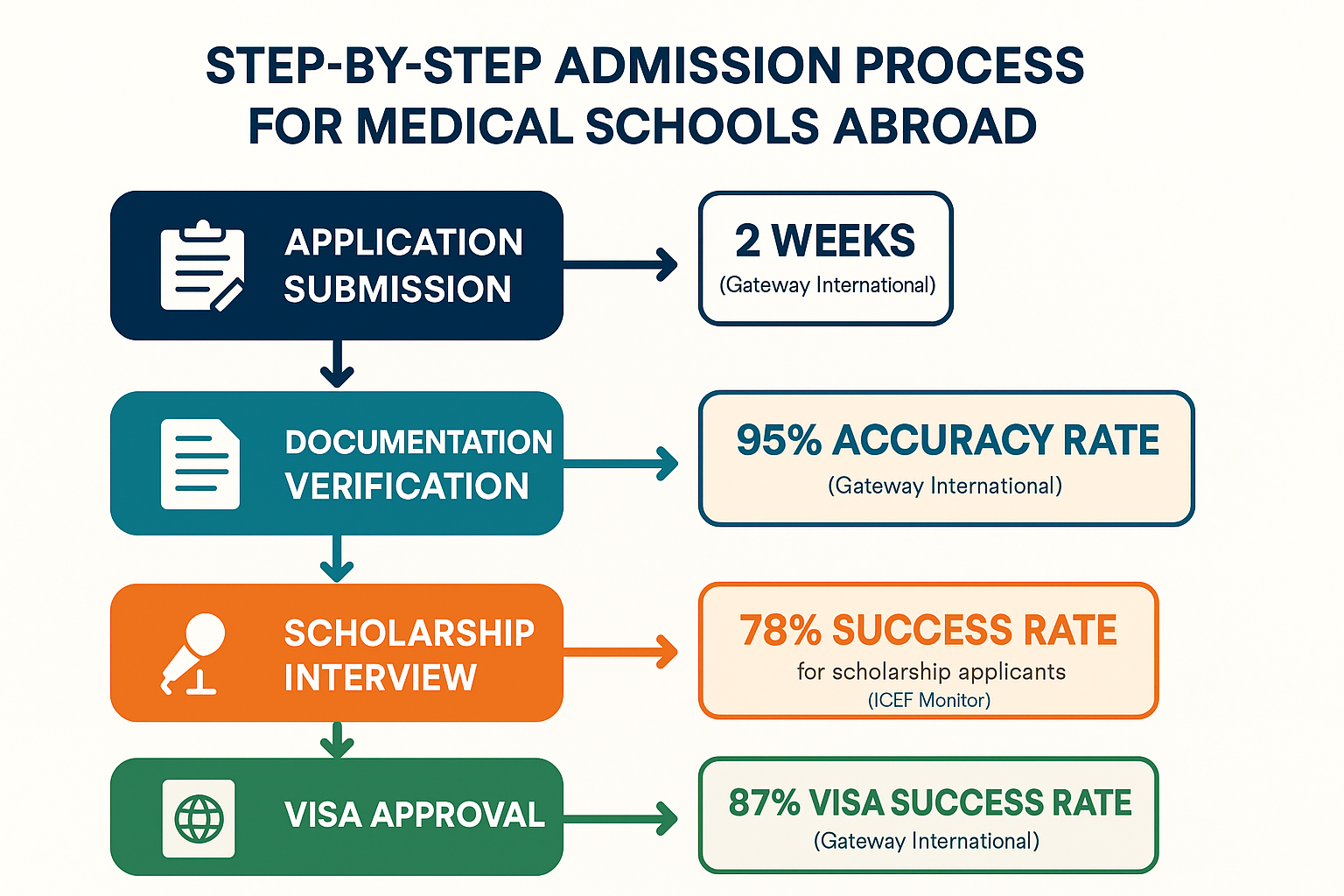
Follow the steps from application submission to visa approval for a medical degree overseas.
From Arts to Sciences: Diverse Courses for Every Aspirant
Yesterday a parent called asking if their humanities student could study abroad. “Engineering ya medicine nahi hai toh kya karenge?” Classic Indian parent worry.
Thing is, we’ve been stuck in this STEM-only mindset since forever. Back in 2007 when I started Gateway, 90% applications were for computer science or medicine. Now? The game’s completely changed. Last month alone we processed applications for everything from Digital Anthropology to Sustainable Fashion Design.
Remember that kid from Pune who wanted to study Philosophy? His parents nearly fainted. Today he’s working at a think tank in Brussels making €4,000 monthly. More than his engineer cousin.
The real shift happened around 2019. Universities started creating these hybrid programs – Environmental Economics, Computational Linguistics, Bioinformatics with Business. Suddenly that Arts student could combine literature with data analytics. Commerce kids started eyeing FinTech programs that didn’t need hardcore coding.
What’s killing me is how we still separate “Arts” and “Science” like they’re different species. Stanford doesn’t care if you studied PCM or humanities – they want interesting people. Their Design Thinking program has poets working with engineers.
Actually, interdisciplinary is where the money is now. Pure subjects? Tough market. But Psychology + AI? Companies are throwing ₹40 lakh packages at fresh grads. History + Digital Archives? Museums worldwide need these skills.
Last week we helped this girl from Bangalore – CBSE Arts student, everyone said “teacher ban jao.” She’s now studying Cultural Data Science at King’s College. Starting salary discussions already happening.
The documentation nightmare remains though. Explaining to admission committees why Indian transcripts show “History, Political Science, Economics” as separate subjects when their program combines all three… exhausting.
But here’s what excites me – tier-2 city students are catching on faster than metros. They’re not stuck in traditional thinking. Kid from Coimbatore just got into a Neuroscience + Philosophy program. His school didn’t even have proper science labs.
Stop asking “which course has scope?” Everything has scope if you’re genuinely interested. The market rewards specialists who can think broadly. That’s what these interdisciplinary programs create.
We’re tracking 200+ such hybrid programs now. Most Indians haven’t even heard of them.
Scholarships and Financial Aid: Studying Abroad Made Accessible
₹42 lakhs. That’s what a parent called me about yesterday – their kid’s dream university in Canada wanted that much for 4 years. The call ended with them saying “maybe next year.”
This happens too often. Since 2007, I’ve watched brilliant students give up on international education because of money. The thing is, there’s funding out there. Students just don’t know where to look or they mess up the applications.
Government scholarships exist but they’re competitive. Commonwealth, Chevening – these pay everything but maybe 2-3 students from each state get them. DAAD for Germany is slightly better odds. The new announcement says 1,000 STEM scholarships for Indians. Still tough but doable.
Private scholarships? Every university has them. When we built Edysor’s scholarship matching system, we found over 3,000 options just for Indian students. Problem was, 80% had deadlines students missed because nobody told them to apply 8 months before classes start.
Actually, let me correct that. 8-10 months before. Some UK universities close scholarship applications in December for September intake.
What really works? University-specific merit scholarships. Edinburgh gives £5,000 to students with 90%+ in boards. Warwick has similar schemes. Not full rides but they help. We’ve had students combine 3-4 small scholarships to cover 60% costs.
The documentation kills most applications. Last month, a student needed their income certificate translated, notarized, and apostilled. Took 3 weeks just for that one document. By then, two scholarship deadlines passed.
Gateway International now pre-screens documents before students apply. Saves time, prevents rejections. We also built templates for scholarship essays because students kept writing generic “I want to serve my nation” essays. Scholarship committees read 500 of those daily.
Financial planning goes beyond scholarships though. Part-time work permissions, co-op programs, teaching assistantships – these matter. Germany allows 120 full days of work annually. Canada’s better with 20 hours weekly during studies.
Here’s what students miss: apply for scholarships AFTER getting admission. Most think it’s simultaneous. It’s not. Get your offer letter first, then hit the funding applications. Changes everything.
The money exists. The process is just unnecessarily complicated.
Your Gateway to the World: Next Steps to Your Dream University
Students keep asking me the same thing – “Abhinav sir, I’ve decided to study abroad. Now what?”
After 17 years of watching students panic at this exact moment, I’ve seen every possible mistake. The worst? Starting visa applications before university admits. Or paying ₹50,000 to consultants who vanish after taking the money.
Here’s what actually works:
Step 1: Stop overthinking, start documenting
Get your 10th and 12th marksheets transcribed first. Universities want these in specific formats – we learned this after 300+ rejections in 2012. Most students waste 3 weeks here.
Step 2: The parallel processing trick
While transcripts are getting ready, start your entrance tests. IELTS slots fill up fast. Book for 2 months later, prep properly. Don’t rush – I’ve seen brilliant students fail because they booked next week’s slot.
Yesterday a parent called asking if we could “fast-track” their daughter’s application. Sure, if universities worked on Indian parent timelines. They don’t.
Step 3: SOP writing (the real nightmare)
Every university wants different things. Stanford wants innovation stories. German universities want technical precision. We built templates after reading 10,000+ successful SOPs. Still, each one takes 15-20 hours to perfect.
Step 4: The visa maze
This is where students break down. Different countries, different rules. USA wants financial proofs from 6 months. Canada’s processing is unpredictable – sometimes 2 weeks, sometimes 12.
Know what frustrates me? Students doing this alone when help exists.
At Gateway, we’ve automated the boring parts. Document checklist? Automated. University shortlisting based on your profile? Our AI does it in minutes. Visa appointment scheduling? We track slots 24/7.
But here’s what technology can’t replace – someone answering your panic calls at 11 PM when visa dates clash with exam schedules. That’s why our counselors’ numbers are public.
Want to skip the chaos?
Book a free consultation. Not a sales pitch – actual guidance. We’ll tell you exactly which documents you need, realistic timelines, costs.
Sometimes students just need someone to say “You’re on track. Keep going.”
That’s what we do.
Book your free consultation – let’s get you moving